PDP-8/I · Volume 3
PDP-8/I — Volume 3 — The PDP-8 Family: from the 1965 original to the 8/I
How one twelve-bit design outlived four generations of logic — discrete transistors, a one-bit serial trickle, small-scale TTL, and finally a chip you could lose in your pocket — without ever changing its mind about what a computer should be.
3.1 About This Volume
This is Volume 3 of the fourteen-volume deep dive into the PDP-8/I. Volume 1 established what the machine was; Volume 2 traced the company and the culture that made it possible. This volume tells the story of the PDP-8 family — the line of machines, from the 1965 original through the integrated-circuit 8/I and on to the single-chip implementations of the 1970s and 1980s, of which the 8/I is one member. The argument running through it is simple but easily missed: the PDP-8 was never a single computer. It was a design — a twelve-bit architecture and instruction set — that DEC rebuilt from scratch, again and again, in whatever circuit technology happened to be cheapest that year. The 8/I at the center of this series is the third such rebuild, and understanding it means understanding the ones on either side of it. By the end of this volume the through-line should be unmistakable: across discrete transistors, serial logic, TTL chips, and CMOS microprocessors, the architecture stayed put while everything underneath it was torn out and replaced.
3.2 The 1965 original: the “Straight-8”
On 22 March 1965, DEC shipped the first PDP-8. It would later be nicknamed the “Straight-8” — straight to distinguish it from the lettered variants that followed, the way one says “straight whiskey” to mean the thing before anyone added anything to it. At the time, of course, it needed no such qualifier; it was simply the PDP-8, and it was the machine that made DEC’s reputation and, arguably, the entire minicomputer industry.
It was built, crucially, out of discrete transistors. This is the single most important fact about the original, and the one most often gotten wrong by people who assume that anything from the 1960s with “8” in the name must have used integrated circuits. It did not. The microprocessor lay a decade in the future, and even the integrated circuit — a few transistors fabricated together on one sliver of silicon — was still an expensive novelty in 1965, not yet a sensible foundation for a low-cost commercial computer. So the Straight-8’s logic was assembled the older way, from individual transistors, diodes, and resistors soldered onto small printed-circuit cards. The specific logic family was diode–transistor logic, or DTL: a design style in which diodes perform the logical AND-ing and OR-ing of signals and a single transistor does the amplifying and inverting. DTL was cheap, robust, and well understood, and DEC had years of experience building it.
Those cards were DEC’s R-series flip-chip modules — the company’s standard line of plug-in logic boards, each a small rectangle of circuitry with a row of gold-plated contacts along one edge that slid into a socket. (“Flip-chip” here is DEC’s own brand name for the module format, a bit of 1960s marketing that has nothing to do with the silicon-packaging technique that later borrowed the same words.) A complete PDP-8 processor, leaving aside optional extras, was made of roughly a hundred such modules — about seventy-five single-width cards and twenty-five double-width ones, nearly all drawn from the R series. To turn that pile of identical-looking boards into a working computer, the back of the machine had to be wired: every module’s contacts connected to the right contacts on every other module. DEC did this with wire-wrap, a technique in which a wire is wound tightly around a square post rather than soldered, the sharp corners of the post biting into the wire to make a gas-tight connection. The backplanes of the early PDP-8s were wrapped semi-automatically, by a machine following a list — reliable, repairable, and suited to the modest volumes DEC expected. (It would, in the event, badly underestimate those volumes.)
The result was a computer about the size of a small household refrigerator, and it cost $18,500. That figure is the hinge of the whole story. It was the first time a general-purpose, stored-program computer had been offered for under twenty thousand dollars — not a slice of time on a shared machine, not a cut-down calculator, but a whole computer a single laboratory or department could buy outright. Volume 1 dwelt on what that price meant; here it is enough to note where it came from. The twelve-bit word kept the data paths narrow and the module count low; DTL on proven flip-chip cards kept the parts cheap; the single-accumulator architecture kept the processor minimal. Every frugal choice DEC had rehearsed on the PDP-5 was carried into the PDP-8 and pushed one notch further. The machine that emerged was the first commercially successful minicomputer, and the PDP-8 family it founded would eventually sell on the order of fifty thousand units in its classic minicomputer forms — and, once the later single-chip word processors are counted, several hundred thousand machines in all — a staggering number for the era, and proof that the under-twenty-thousand-dollar computer had found a market no one else had been serving.
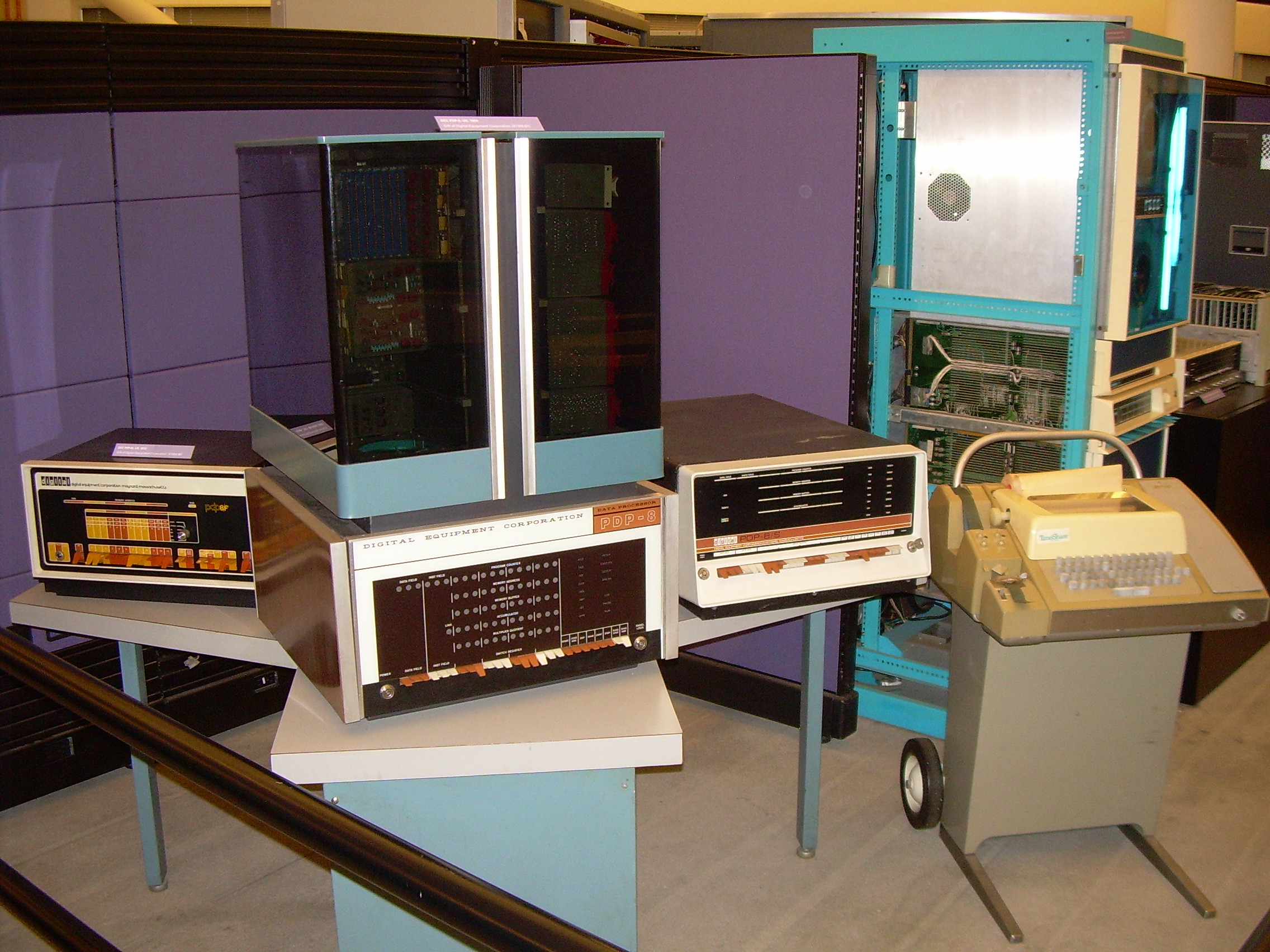
3.3 The PDP-8/S: how cheap is too slow?
Eighteen and a half thousand dollars was a revolution, but DEC had built its whole identity on the conviction that a computer could always be made cheaper, and the company was not done. In August 1966 it introduced the PDP-8/S, and with it asked a sharp and slightly dangerous question: how much of a computer could you throw away and still have a computer worth selling?
The answer the 8/S proposed was radical. The original PDP-8, like every respectable computer of its day, was a parallel machine: when it added two twelve-bit numbers, all twelve bits were processed at once, by twelve parallel sets of logic. That parallelism is fast, but it is also expensive, because it requires twelve copies of the adding hardware. The PDP-8/S — the “S,” depending on who you ask, for Small or, more honestly, for Slow — did the opposite. It used a one-bit serial arithmetic unit, a single sliver of adding logic that handled the twelve bits of a word one after another, in a trickle, the way a person adds a long column of figures digit by digit rather than all at once. Designed by DEC engineer Saul Dinman, the serial approach let the machine be built from far fewer modules, in a far smaller cabinet, and so sold for far less.
The price was the headline: a basic PDP-8/S went out the door for under $10,000 — the first computer ever to break that barrier, and roughly half the cost of the already-cheap Straight-8. But the bill for that frugality came due in performance, and it was steep. Processing a word one bit at a time, with all the shifting and book-keeping that requires, made the 8/S dramatically slower than the parallel original — on the order of a tenth of its speed. The machine that had cost about twenty percent as much delivered about ten percent of the performance. For some buyers — those who wanted a computer present in the room more than they wanted it fast, who were counting events or running a slow instrument or simply learning to program — that was a trade worth making, and the 8/S sold. But it taught DEC a lasting lesson about the floor beneath the price curve. You could keep cutting cost, but serial logic showed exactly where cutting cost started to gut the product. The customers had told DEC something important: they wanted cheap, but they were not willing to buy slow to get it. The next machine in the family would have to find a different way down the price curve — one that lowered cost without surrendering speed.
3.4 The PDP-8/I: a new foundation in silicon
That different way arrived in 1968, and it is the machine this entire series is about. The PDP-8/I answered the dilemma the 8/S had exposed not by stripping the architecture down further, but by rebuilding it on an entirely new kind of part. Where the original PDP-8 had been discrete transistors and the 8/S had been discrete transistors made to do more with less, the 8/I was the first member of the family built from integrated circuits — specifically, standard transistor–transistor logic (TTL) chips of the small-scale-integration generation, each containing a handful of logic gates, mounted on DEC’s new M-series modules.
This is the change that gives the “I” its reason to exist, and it is worth being precise about why it mattered. An integrated circuit packs what used to be several discrete components — transistors, diodes, resistors — onto a single chip, fabricated in one process and bought as one part. Replacing loose transistors with TTL chips meant fewer parts to buy, fewer connections to make, fewer things to go wrong, and a smaller, denser machine. By the late 1960s, the integrated circuit had crossed the line from costly novelty to cheap commodity — the very crossing that the original PDP-8 of 1965 had been too early to exploit. The 8/I rode that crossing. The architecture did not change at all: it was the same twelve-bit, single-accumulator PDP-8, running the same instruction set, programmable in the same way. Only the bricks were swapped out — discrete logic for silicon — and the whole edifice was rebuilt on top of them.
The payoff was exactly the combination the 8/S could not deliver. The 8/I was a parallel machine, like the original — it processed all twelve bits at once and was every bit as fast as the 1965 Straight-8, with none of the serial 8/S’s sluggishness. Yet by building it from integrated circuits, DEC fit that full parallel performance into roughly half the volume of the original and brought the entry price down to around $12,800. Read those numbers together and the appeal is obvious: cheaper than the original, smaller than the original, and just as fast as the original — with the serial compromise of the 8/S nowhere in sight. This is why the 8/I reset the line. It did not merely join the family as another option; it rendered the discrete-transistor Straight-8 obsolete, offering the same performance for less money in less space. From 1968 on, the integrated-circuit machine was simply the PDP-8 you bought, and the discrete original was retired in its favor. The 8/I is the moment the PDP-8 stopped being a discrete-transistor computer and became a silicon one — its first reinvention in a new circuit technology, but emphatically not the last.
DEC paired the 8/I with a cost-reduced sibling, the PDP-8/L, introduced the same year. The 8/L was to the 8/I roughly what the cheaper models had always been to the flagship: the same TTL-integrated-circuit, parallel, twelve-bit architecture, trimmed down to a smaller, less expandable, less expensive package for buyers who needed the computer but not the full configuration. Where the 8/S had cut cost by mutilating the architecture into serial form, the 8/L cut cost the gentler way — fewer options, a smaller cabinet, tighter limits — while keeping the fast parallel design intact. Together the 8/I and 8/L covered the family’s middle and lower ground in the new integrated-circuit idiom, and between them they marked the clean changeover from discrete logic to silicon across DEC’s whole twelve-bit line.
3.5 The later family: the Omnibus and the architecture on a chip
If the 8/I proved that the PDP-8 architecture could be lifted onto new components without changing its character, the machines that followed proved it again, and then again, each time on a more advanced foundation. The family did not stop at the 8/I; it kept being reborn for another fifteen years, and the way it did so is the clinching evidence for this volume’s central claim.
The next major reinvention came in 1970 with the PDP-8/E, and it brought a structural idea that would define the family’s most successful generation: the Omnibus. In the earlier machines, the processor, memory, and each input/output device were wired together through a thicket of individual connections — flexible, but fiddly to configure and expand. The Omnibus replaced that thicket with a single shared backplane bus: a common set of signal lines, running the length of the machine, into which the processor card, memory cards, and I/O option cards all plugged side by side. To add a device, you no longer rewired anything; you slid another card into the Omnibus, and it joined the conversation already taking place on the shared lines. This was cheaper to manufacture, vastly easier for a customer to expand, and it made the 8/E the workhorse of the whole family. Around the same architecture DEC built close relatives — the PDP-8/F and the rack-mountable PDP-8/M — sharing the Omnibus design and aimed at slightly different buyers. The point, once again, is what did not change: the Omnibus reorganized how the PDP-8’s parts were connected, but the parts were still executing the same twelve-bit instruction set the Straight-8 had run in 1965. A program written for the original would still run on the 8/E.
Then came the reinvention that should have been impossible by the standards of 1965: the entire PDP-8 processor, shrunk onto a single chip. In the second quarter of 1975, Intersil introduced the 6100, a CMOS microprocessor that implemented the complete twelve-bit PDP-8 instruction set in one integrated circuit — the whole central processor that had once filled a hundred flip-chip modules, now a single component sipping a fraction of a watt. Harris, which second-sourced and then extended the design, followed with the 6120, a refined version that folded in additional functions such as memory control. CMOS — complementary metal-oxide-semiconductor logic — was prized for drawing almost no power when idle, which made these chips suited to small, quiet, low-heat machines of a kind the refrigerator-sized Straight-8 could never have been.
DEC put those chips to work. The 6100 and 6120 became the engines of the VT78 and, most notably, the DECmate line — desktop word-processing and data-processing machines DEC sold into the late 1970s and the 1980s, each one a complete PDP-8 hiding inside an office appliance. Counting these single-chip machines, total production of the twelve-bit architecture climbed past three hundred thousand — many times the fifty thousand classic minicomputers that had come before. Stop and weigh that against the origin: a twelve-bit architecture that began in 1965 as a refrigerator full of discrete transistors and wire-wrap was, fifteen years later, running on a fingernail of silicon inside a word processor on a secretary’s desk — and it was still, at the level that mattered to a programmer, the same computer. The architecture had comfortably outlived not just its first implementation but the entire technology of its first implementation, twice over.
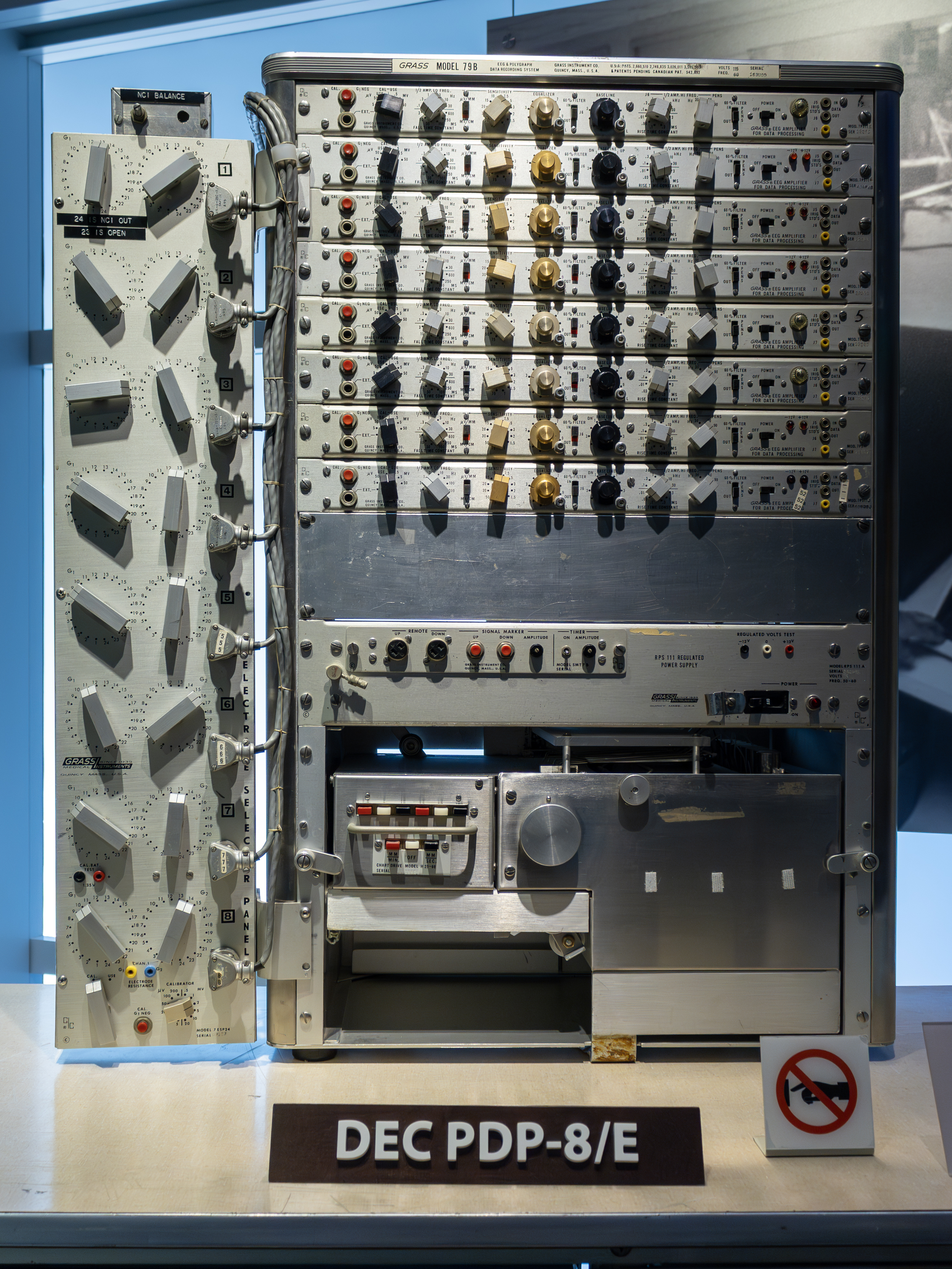
3.6 A family at a glance
The shape of the line is easiest to take in all at once. The table below lists the principal members discussed above; it is a guide to the lineage, not an exhaustive catalogue of every model and option DEC shipped.
Table 1 — A family at a glance
| Model | Year | Logic technology | Rough price | Note |
|---|---|---|---|---|
| PDP-8 (“Straight-8”) | 1965 | Discrete transistors, DTL on R-series flip-chip modules, wire-wrapped | $18,500 | The original; first computer under $20,000; parallel |
| PDP-8/S | 1966 | Discrete transistors, serial (one-bit) processor | under $10,000 | Cheapest yet but ~10× slower; “S” for Small or Slow |
| PDP-8/I | 1968 | TTL small-scale integrated circuits, M-series modules | ~$12,800 | First IC-based PDP-8; ~half the volume; fast/parallel like the original |
| PDP-8/L | 1968 | TTL integrated circuits | below the 8/I | Cost-reduced, less-expandable sibling of the 8/I |
| PDP-8/E (with /F, /M) | 1970 | TTL ICs on the Omnibus shared bus | varied | Unified processor, memory and I/O on one bus; the family workhorse |
| Intersil 6100 / Harris 6120 | 1975 / later | CMOS microprocessor (single chip) | — | Whole PDP-8 CPU on a chip; powered the VT78 and DECmate machines |
3.7 What stayed constant
Lay the family out end to end and the eye is drawn first to everything that changed. The logic technology was replaced three times over: discrete diode–transistor logic gave way to a serial trickle of the same transistors, then to small-scale TTL integrated circuits, then to a CMOS processor on a single chip. The construction changed with it — hand-loaded flip-chip modules and wire-wrapped backplanes yielding to denser boards, then to the Omnibus bus, then to a microprocessor socket. The price fell, rose, and fell again as DEC felt out the market. The size collapsed from a refrigerator to a desktop appliance. The speed swung from fast to crawling and back to fast. Across thirteen years, almost every physical fact about the machine was torn out and rebuilt at least once.
And underneath all of it, one thing never moved: the architecture. Every machine in this volume — the discrete Straight-8, the serial 8/S, the integrated-circuit 8/I and 8/L, the Omnibus 8/E, the single-chip CMOS DECmates — was, at the level a programmer cares about, the same twelve-bit computer. The same twelve-bit word. The same single accumulator. The same small, distinctive instruction set, with its memory-reference instructions, its addressing scheme, and its famous microcoded operate group. A program written for the 1965 original would, with care, run on a CMOS DECmate of 1980, because the thing that defined the PDP-8 was never the transistors or the chips or the bus — it was the design, the abstract machine that those components were arranged to imitate. The implementations were mortal and kept dying; the architecture was the thing that lived.
This is the lens through which the rest of the series should be read, and it is why this volume sits where it does. The PDP-8/I is not the PDP-8; it is a PDP-8 — the third implementation of an enduring design, the one that happened to catch the integrated circuit at the moment it became cheap, and the one Jeff’s replica reaches back to. When the volumes that follow take apart its twelve-bit word, its core memory, its accumulator, and its instruction set, they are dissecting features the 8/I inherited rather than invented — features that began on the Straight-8’s wire-wrapped backplane and would still be present, unchanged in their essentials, on a chip a decade after the 8/I was new. The machine on the bench is one beautiful, specific expression of an idea that proved far more durable than any of the parts that ever embodied it. Volumes 4 and 5 take up that idea — the architecture itself — in full.
Sources
- Wikipedia, “PDP-8.” Confirms the 22 March 1965 introduction of the original PDP-8 at $18,500 as the first computer sold for under $20,000; its construction from diode–transistor logic on flip-chip modules in a refrigerator-sized cabinet; the module count (~75 single and ~25 double, nearly all R-series) and semi-automated wire-wrapped backplanes; the August 1966 PDP-8/S with its one-bit serial ALU at under $10,000; the 1968 TTL-integrated-circuit PDP-8/I (~half the volume) and the PDP-8/L; the 1970 PDP-8/E and the Omnibus (with the /F and /M); and total family sales on the order of 50,000 units. https://en.wikipedia.org/wiki/PDP-8
- Doug Jones, “DEC PDP-8 Models and Options” and “The DEC PDP-8 Story” (University of Iowa). Corroborates the R-series flip-chip / DTL construction of the Straight-8, the serial design and ~$10,000 price of the 8/S (designed by Saul Dinman), the M-series TTL basis of the 8/I, and the relationships among the family members. https://homepage.divms.uiowa.edu/~jones/pdp8/models/ · https://homepage.cs.uiowa.edu/~jones/pdp8/DECpdp8storyII.shtml
- RICM (Rhode Island Computer Museum), “DEC PDP-8/S.” Confirms the 8/S as a serial implementation, its ~$10,000 price including 4K of core, and its much-reduced performance relative to the parallel PDP-8. https://www.ricomputermuseum.org/collections-gallery/equipment/pdp-8s
- ETHW, “First-Hand: PDP-8/E OMNIBUS Ride.” First-person engineering account of the 1970 PDP-8/E and the development of the Omnibus shared-bus architecture. https://ethw.org/First-Hand:PDP-8/E_OMNIBUS_Ride
- Wikipedia, “Intersil 6100,” and “DECmate.” Confirm the Intersil 6100 (introduced Q2 1975) and Harris 6120 as single-chip CMOS implementations of the twelve-bit PDP-8 instruction set, their low power consumption, and their use in the VT78 and DECmate machines produced into the 1970s–1980s. https://en.wikipedia.org/wiki/Intersil_6100 · https://en.wikipedia.org/wiki/DECmate
- Figure (family group): “DEC PDP-8 family — PDP-8F (1972), PDP-8 (1965), PDP-8S (c.1966) — and Teletype ASR-33,” photograph by Carlo Nardone at the Computer History Museum, via Wikimedia Commons, licensed CC BY-SA 2.0. https://commons.wikimedia.org/wiki/File:DEC_PDP-8_family_-_PDP-8F_(1972),_PDP-8_(1965),_PDP-8S_(c.1966)_-_and_Teletype_ASR-33_(1964),_on_the_side_of_Data_General_Eclips_(1974)_%26_Nova_(1969)_-_Computer_History_Museum_(2007-11-10_23.08.07_by_Carlo_Nardone).jpg
- Figure (PDP-8/E): “DEC PDP-8-E brain surgery station, 1970, Computer History Museum,” photograph by The wub, via Wikimedia Commons, licensed CC BY-SA 4.0. https://commons.wikimedia.org/wiki/File:DEC_PDP-8-E_brain_surgery_station,_1970,_Computer_History_Museum.jpg
,_PDP-8_(1965),_PDP-8S_(c.1966)_-_and_Teletype_ASR-33_(1964),_on_the_side_of_Data_General_Eclips_(1974)_%26_Nova_(1969)_-_Computer_History_Museum_(2007-11-10_23.08.07_by_Carlo_Nardone).jpg)

Comments (0)