PDP-8/I · Volume 2
PDP-8/I — Volume 2 — DEC and the Road to the Mini
How a converted woolen mill, a culture of interactive computing carried out of MIT, and a decade of deliberately small machines converged on the computer you could finally call your own.
2.1 About This Volume
This is Volume 2 of the fourteen-volume deep dive into the PDP-8/I. Where Volume 1 established what the machine was and why “mini” mattered, this volume tells the story that came before it: the founding of the Digital Equipment Corporation, the MIT laboratory culture its founders carried with them, and the line of machines — the PDP-1, the PDP-5, and the influence of Wesley Clark’s LINC — that pointed straight at a deliberately cheap, deliberately small twelve-bit computer. It is the company-and-people history that explains why the PDP-8 was even possible.
2.2 A company that would not say “computer”
In August 1957, two engineers rented eight thousand square feet of floor space on the second story of a nineteenth-century woolen mill in Maynard, Massachusetts, and set up a company. The mill — a sprawling brick complex on the Assabet River that had once turned out blankets and uniform cloth — rented to them for a few cents per square foot, attic-warm in summer and drafty in winter, with a freight elevator and the lingering smell of lanolin. The two men were Kenneth Olsen and Harlan Anderson, and the company they incorporated was the Digital Equipment Corporation. Within a decade it would build the machine that made computers personal. But on the day it opened, DEC was forbidden — by its own backers — from saying the word “computer” out loud.
The prohibition was a condition of the money. Olsen and Anderson had no capital of their own to speak of, and in 1957 a pair of engineers proposing to build digital electronics was not an obvious investment. They found their backer in American Research and Development Corporation, the pioneering Boston venture-capital firm run by the formidable Georges Doriot — a French-born Harvard Business School professor, retired U.S. Army brigadier general, and the man often called the father of institutional venture capital. ARD agreed to put up seventy thousand dollars in exchange for roughly seventy percent of the new company. It would become one of the most celebrated investments in financial history: by 1971 ARD’s stake in DEC was worth more than three hundred and fifty million dollars, a return on the order of five thousandfold.
Doriot and his partners imposed two conditions that shaped DEC’s first years. The young company was to turn a profit quickly rather than burn cash chasing a moonshot, and — crucially — it was not to describe itself as building computers. In the late 1950s the word “computer” conjured giant, ruinously expensive mainframes, a market that IBM and a handful of others already dominated and into which investors believed no small newcomer could survive. A startup announcing that it intended to make computers would have sounded, to a cautious board, like a startup announcing that it intended to lose its money. So DEC sold something with a humbler, more sellable name. Its first products, shipped in 1958, were “digital modules” — small, rugged, plug-in circuit boards built around fast switching transistors, sold to laboratories and equipment makers who needed reliable logic building blocks to test and control their own apparatus. The modules were profitable almost immediately, and they gave DEC something most computer startups never had: a healthy business to stand on before it built a single computer.
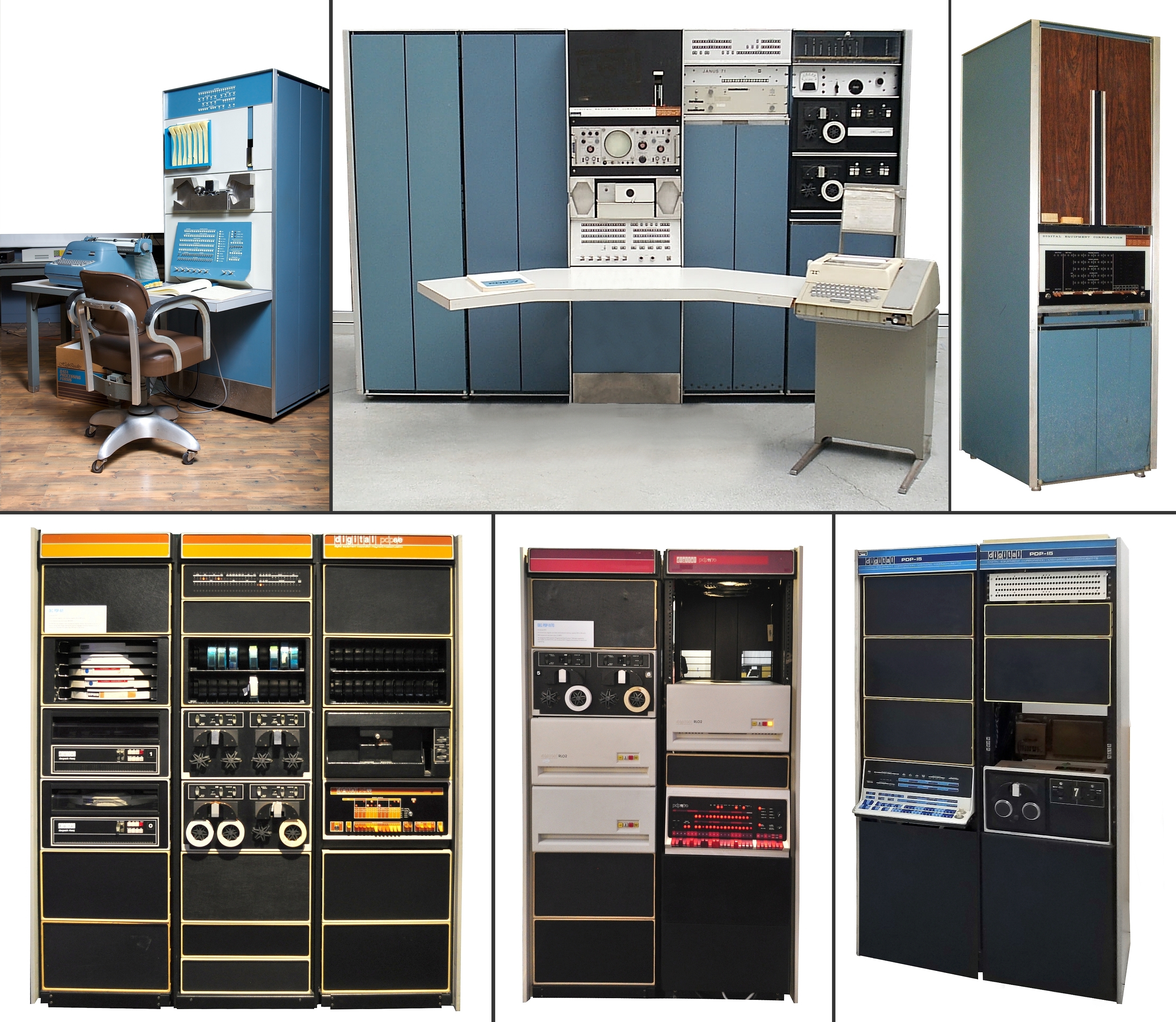
When the company finally did build a computer, it still would not call it one. The machine and its successors were christened Programmed Data Processors — PDPs — a circumlocution carefully chosen to reassure investors and customers that DEC was not trying to compete with the mainframe priesthood. The euphemism was half marketing and half strategy, and it stuck for the life of the line. Every machine in this series, from the PDP-1 of 1959 to the PDP-8/I at the center of this deep dive, wears that deliberately modest name. It is a small linguistic fossil of a large idea: that the interesting frontier in computing was not bigger and more expensive, but smaller, cheaper, and closer to the people who used it.
2.3 What Olsen brought down from the hill
To understand why DEC bet on small interactive machines when the whole industry was racing to build bigger batch ones, you have to follow Ken Olsen back to where he learned the trade: the computing laboratories of the Massachusetts Institute of Technology, and in particular Lincoln Laboratory, MIT’s defense research center north of Boston. Olsen had served in the Navy, taken his degrees in electrical engineering at MIT, and then gone to work on the great machines being built there. It was in those rooms that he absorbed a conviction the rest of the industry did not yet share — that a computer should be something a person used, directly and in real time, rather than something a person submitted work to and waited on.
The conviction had a lineage. It began with Whirlwind, the room-filling computer that MIT’s Servomechanisms Laboratory built in the late 1940s and early 1950s, originally for a flight-simulation project and ultimately for real-time air-defense work. Whirlwind was unusual among early computers in being designed for speed in the moment: it had to respond to live inputs, drive a display, and keep up with the world as it happened, rather than chew through a stack of pre-prepared calculations overnight. It pioneered magnetic-core memory — the same technology that would later store the PDP-8/I’s programs — and it married a computer to a cathode-ray-tube screen and a light pen, letting an operator interact with data visually and immediately. Whirlwind’s descendant, built at Lincoln Laboratory for the SAGE continental air-defense system, hardwired that interactive, real-time philosophy into the defense establishment on a continental scale.
Olsen’s most direct apprenticeship, though, came on a smaller and more radical machine: the TX-0. Built at Lincoln Laboratory in 1955 and 1956, the TX-0 — “Transistorized Experimental computer zero” — was one of the first computers in the world constructed from transistors rather than vacuum tubes, and it was a proving ground for both the technology and the culture that DEC would inherit. Olsen helped supervise its construction. The TX-0 was a single-user machine with a CRT display and a light pen, and around it grew exactly the kind of hands-on, exploratory, stay-up-all-night computing community that batch mainframes made impossible. Students and researchers signed up for blocks of time and sat at the computer, typing, watching the screen, trying things, debugging in the moment. Its larger sibling, the TX-2, would later host some of the foundational work in interactive graphics. This was computing as a personal instrument, and Olsen had seen with his own eyes that people loved it.
That was the insight Olsen carried down from the hill in 1957: the mainframe world treated the computer as a scarce central utility to be rationed, but a different and largely unserved world wanted the computer as a tool to be touched. The batch mainframe optimized for throughput — keeping an enormously expensive machine busy by feeding it a queue of jobs. The interactive machine optimized for the human — keeping the person productive by answering immediately, even if that meant the machine sometimes sat idle waiting for its operator to think. DEC’s whole identity would be built on the second philosophy. The PDPs were, from the first, machines you sat down at.
2.4 The PDP-1 and the interactive machine made commercial
DEC’s modules paid the bills for two years, and then, in December 1959, the company unveiled its first computer at the Eastern Joint Computer Conference. The PDP-1 was, in effect, the TX-0’s commercial cousin: a transistorized, single-user, interactive computer designed not for a queue of batch jobs but for a person sitting at a console. It was the work above all of Ben Gurley, an engineer Olsen had recruited from Lincoln Laboratory, who reportedly designed the machine in about three and a half months. DEC delivered the first PDP-1 to the consulting firm Bolt, Beranek and Newman late in 1960, with formal acceptance in early 1961.
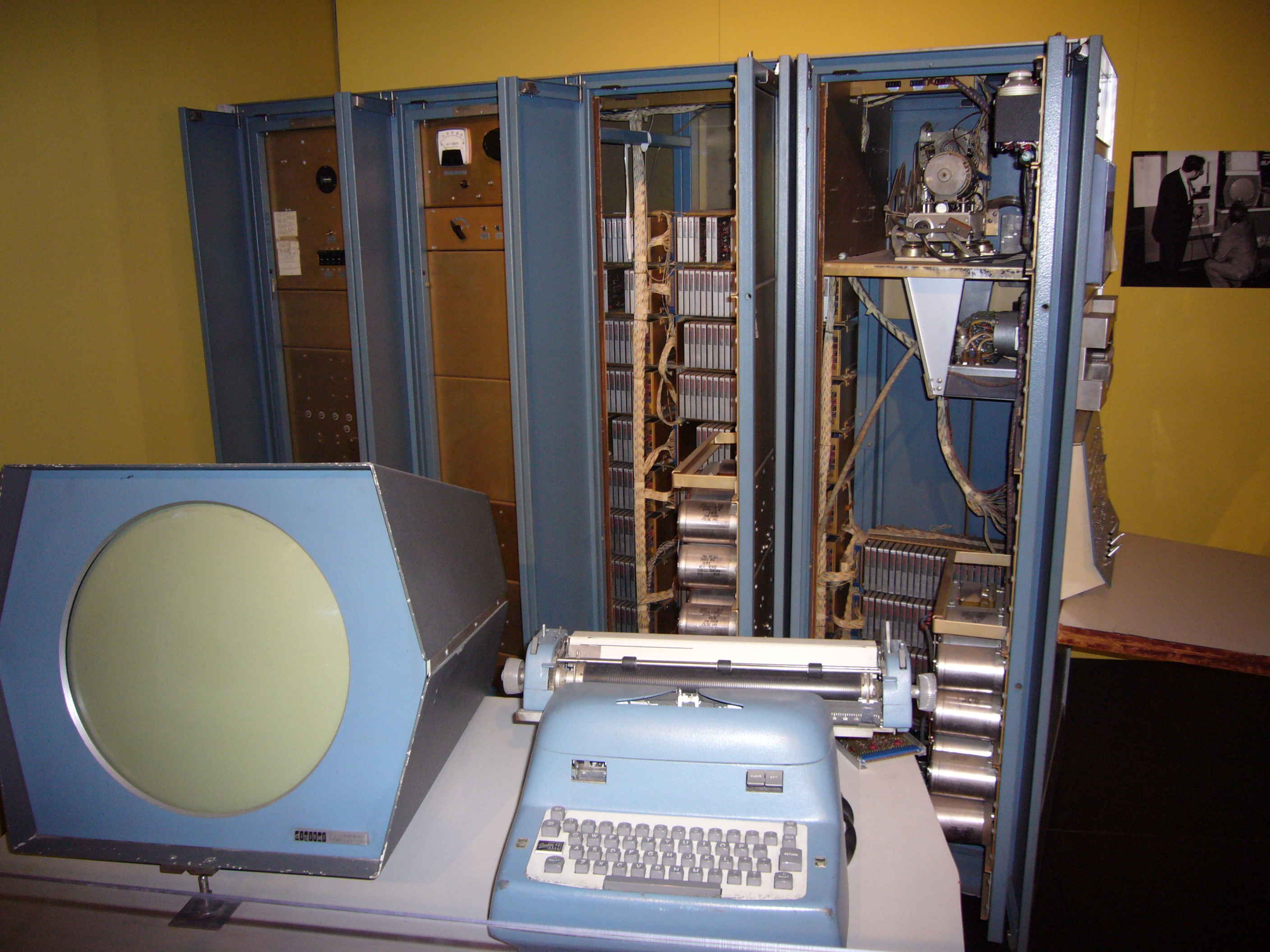
By the standards of the era the PDP-1 was astonishingly cheap. A mainframe of the day might run to the millions; the PDP-1 listed at around a hundred and twenty thousand dollars. That was still far beyond an individual’s reach, but it was a price a well-funded laboratory could contemplate, and — just as important — it bought a whole computer for one user’s undivided attention rather than a sliver of time on a shared giant. The machine used an eighteen-bit word and came wrapped in the interactive trappings DEC believed in: a console of switches and lights, paper-tape input and output, a Soroban-modified IBM electric typewriter for printed interaction, and — the part everyone remembers — the Type 30 point-plotting cathode-ray-tube display, a round screen on which the machine could draw glowing points anywhere in a grid of roughly a thousand by a thousand positions.
It was that display, more than any specification, that wrote the PDP-1 into legend. In 1961 and 1962 a group of young programmers around MIT — Steve Russell, Martin Graetz, Peter Samson, Dan Edwards and others, hackers in the original affectionate sense — used a PDP-1 and its Type 30 screen to build Spacewar!, one of the very first video games: two player-controlled rockets dueling with torpedoes around the gravity well of a central star. Spacewar! was never a product; it was something people made because the machine let them, because it was right there in front of them and would do whatever they could program it to do in real time. That is precisely the point. A batch mainframe in a glass room could never have given birth to Spacewar!. The PDP-1 could, because it embodied the interactive philosophy Olsen had brought from Lincoln Lab — and Spacewar! became, in turn, the most charming possible advertisement for what an interactive computer was for. DEC built only a few dozen PDP-1s, but the machine established the company’s character and its market: real people, doing real-time work, on a computer they could call their own.
2.5 From the PDP-4 to the twelve-bit PDP-5
If the PDP-1 set DEC’s character, the machines that followed set its course toward the PDP-8. The company learned quickly that its real opportunity was not to build a slightly cheaper version of an expensive machine, but to keep driving the price down until the computer reached customers no one else was serving. Each new PDP was an experiment in how much could be stripped away while keeping the machine genuinely useful.
The PDP-4, introduced in 1962, was a deliberately cheaper and slower reworking of the PDP-1’s eighteen-bit architecture — DEC trading raw speed for a lower price in search of a wider market. It sold modestly, but it taught a lesson the company took to heart: there was room below the PDP-1, a population of laboratories and engineering groups who would buy a computer if only it cost less. The decisive move came the following year. In 1963 DEC introduced the PDP-5, and with it the company committed for the first time to a twelve-bit word — narrower than the eighteen-bit PDPs, and narrower than the word lengths fashionable in larger machines.
The choice of twelve bits was an exercise in disciplined frugality. A narrower word meant narrower data paths, fewer flip-flops, fewer of DEC’s costly modules, and therefore a cheaper machine — at the price of a smaller directly addressable memory and a tighter instruction repertoire. For scientific number-crunching this would have been crippling; but for the work DEC was chasing — laboratory data collection, instrument control, counting and timing, modest real-time tasks — twelve bits were enough, and cheapness mattered more than range. The PDP-5 was conceived in part as a machine to be embedded in a larger experimental apparatus, a computer that could sit beside a researcher’s instruments and run them. It was, in architecture and intent, the direct predecessor of the PDP-8: the same twelve-bit word, a closely related instruction set, the same single-accumulator minimalism, the same ambition to reach a market the mainframe could not. When DEC’s engineers — Gordon Bell prominent among them — set out in 1964 to build a machine that was cheaper still and faster still, they were not starting from a blank sheet. They were redesigning the PDP-5 around newer, denser circuitry. The result, in 1965, was the PDP-8, the first computer offered for under twenty thousand dollars and the machine this whole series orbits. The PDP-5 is the hinge on which DEC turned from making interesting small computers to making the small computer that changed the industry.
2.6 The LINC and the idea of a computer on one person’s bench
There is one more strand in the story, and it did not come from inside DEC at all. While Olsen’s company was working its way down the price curve from the PDP-1 to the PDP-5, a researcher named Wesley Clark — himself a Lincoln Laboratory veteran, one of the architects of the TX-0 and TX-2 — was pursuing an idea more radical than anything DEC had yet shipped: a computer dedicated not to a laboratory, but to a single scientist at a single bench.
Clark’s machine was the LINC, the Laboratory Instrument Computer, designed with Charles Molnar at MIT’s Lincoln Laboratory and first running in 1962. The motivation was concrete and humane. Clark had watched biomedical researchers struggle to get their experimental data into and out of distant shared computers, and he became convinced that the computer belonged in the lab, under the direct control of the person doing the experiment — small enough to sit on a bench, cheap enough for a research grant, simple enough to be run without a staff of operators, and wired directly to the instruments generating the data. The LINC delivered exactly that. It was a twelve-bit machine built, tellingly, out of DEC’s own logic modules; it was tabletop-sized; it carried its own keyboard and display and a simple interactive operating environment; and it stored programs and data on small reels of magnetic tape that a researcher could keep in a drawer like notebooks. It cost roughly forty-three thousand dollars — a great deal of money, but a sum a serious laboratory could justify for a machine that belonged to it alone. Historians of computing frequently call the LINC the first true personal computer, and the claim is defensible: it was a complete, interactive, general-purpose computer designed from the start to serve one person.
Clark made the LINC’s design openly available — it was placed effectively in the public domain — and the National Institutes of Health sponsored a remarkable program in 1963 that brought biomedical researchers to a summer workshop where, over several weeks, each team assembled its own LINC and carried it home to its laboratory. Around fifty LINCs were eventually built, a number of them by DEC, and the machine seeded a generation of scientists with the conviction that a computer could be a personal instrument like an oscilloscope or a microscope.
For DEC the LINC was both a confirmation and a prod. It confirmed, from outside the company, that the deepest market for small computers was the individual researcher’s bench — exactly the territory the PDP-5 and PDP-8 were aimed at. And it prodded DEC to engage directly: the company would later marry the two ideas in the LINC-8, a single product combining LINC capabilities with a PDP-8, so that a laboratory could buy one machine and run both the beloved LINC software and the PDP-8’s growing world of programs. The LINC’s vision — one computer, one scientist, one bench — flowed straight into the thinking that produced the PDP-8 and, in time, the PDP-8/I.
2.7 Why all of this produced a cheap machine
Step back from the names and dates and the shape of an argument emerges, because the PDP-8 was not an accident or a lucky guess. It was the convergence of three forces that had been building at DEC for nearly a decade, each pushing in the same direction: down in price, down in size, and toward the individual user.
The first force was commercial and cultural, and it ran back to the woolen mill. DEC began life as a modules company, profitable from the start by selling cheap, reliable building blocks rather than expensive finished computers. That origin gave DEC two things its mainframe rivals lacked: a deep, practical expertise in squeezing dependable digital logic out of the fewest, cheapest components, and a temperamental comfort with the low end of the market. A company that made its first money selling thirty-dollar circuit modules to laboratories did not flinch at the idea of selling an eighteen-thousand-dollar computer to those same laboratories. The investors’ old prohibition on the word “computer” had pushed DEC into a humbler self-image — Programmed Data Processors, not mainframes — and that humility turned out to be a strategic advantage. While IBM built ever-grander machines for corporate data centers, DEC was happy to chase the customers everyone else considered too small to matter.
The second force was philosophical, and it ran back to MIT. Olsen had carried out of Whirlwind, the TX-0, and Lincoln Laboratory an unshakable belief in interactive, real-time, single-user computing — the computer as an instrument a person touches, not a utility a person petitions. Every DEC machine from the PDP-1 onward expressed that belief in switches and lights and CRT displays and paper tape, in consoles built for a human to sit at. This was not how the mainframe world thought, and it opened a market the mainframe world could not see: people who did not want a slice of a distant giant’s time but a whole small machine of their own, however modest. Spacewar! and the LINC were both proofs of what that market wanted, and DEC was listening.
The third force was technical and economic, and it ran through the PDP-4, the PDP-5, and the LINC. Across those machines DEC learned, in hard practical terms, exactly how much a computer could be pared down while staying useful — and discovered that the twelve-bit word was the sweet spot for the laboratory work it was chasing. Twelve bits meant a minimal, single-accumulator processor that could be built from comparatively few modules; few modules meant low cost; low cost meant the machine could reach customers no one else could. The LINC showed that those same frugal customers wanted the computer on their bench, dedicated to them. The PDP-5 proved that a twelve-bit DEC machine in that mold could actually be sold. All that remained was to do it cheaper and faster — to redesign the PDP-5 around denser circuitry and drive the price beneath the magic twenty-thousand-dollar line.
That is exactly what DEC did in 1965, and the resulting PDP-8 became the first commercially successful minicomputer. Three years later the company would rebuild it again from the new transistor-transistor-logic integrated circuits, halve its volume, and lower its price once more — and that machine, the PDP-8/I of 1968, is where this series turns next. But the road to it was already complete by 1965, paved in a converted mill, in the interactive culture of an MIT laboratory, in a euphemistic name chosen to soothe nervous investors, and in a decade of machines that each asked the same stubborn question: how small, how cheap, and how personal can a real computer be? Volume 3 takes up the answer in detail, tracing the PDP-8 family itself from the 1965 original through the variants to the integrated-circuit 8/I.
Sources
- Wikipedia, “Digital Equipment Corporation.” Confirms the August 1957 founding by Ken Olsen and Harlan Anderson, the Maynard woolen-mill location, the move from logic modules to the PDP line, and the “Programmed Data Processor” naming convention adopted to avoid the word “computer.” https://en.wikipedia.org/wiki/Digital_Equipment_Corporation
- Wikipedia, “American Research and Development Corporation,” and the Harvard Business School “Georges F. Doriot” exhibit. Confirm ARD’s $70,000 investment for roughly a 70% stake in DEC, Doriot’s role, and the investment’s later valuation. https://en.wikipedia.org/wiki/American_Research_and_Development_Corporation · https://www.library.hbs.edu/hc/doriot/innovation-vc/dec/
- Wikipedia, “Whirlwind I,” and “TX-0.” Background on the Whirlwind real-time computer, its pioneering of core memory and CRT/light-pen interaction, and the transistorized TX-0 on which Olsen worked at Lincoln Laboratory — the interactive, single-user lineage DEC inherited. https://en.wikipedia.org/wiki/Whirlwind_I · https://en.wikipedia.org/wiki/TX-0
- Wikipedia, “PDP-1,” and the Computer History Museum PDP-1 Restoration Project. Confirm the December 1959 unveiling, Ben Gurley’s design, first delivery to BBN in 1960, the ~$120,000 price, the eighteen-bit word, the Type 30 CRT display, and Spacewar! (Steve Russell et al., 1961–1962). https://en.wikipedia.org/wiki/PDP-1 · https://www.computerhistory.org/pdp-1/
- Wikipedia, “PDP-5,” and Doug Jones’s “DEC PDP-8 Story” (University of Iowa). Confirm the 1963 PDP-5 as DEC’s first twelve-bit computer and the direct architectural predecessor of the PDP-8, and Gordon Bell’s role in the PDP-8’s design. https://en.wikipedia.org/wiki/PDP-5 · https://homepage.cs.uiowa.edu/~jones/pdp8/DECpdp8storyI.shtml
- Wikipedia, “LINC,” and the NIH Office of History “Laboratory Instrument Computer (LINC).” Confirm Wesley Clark and Charles Molnar’s 1962 machine, its twelve-bit architecture built from DEC modules, the ~$43,000 cost, its claim as the first personal computer, the NIH assembly program, the ~50 units built, and the later LINC-8 combining the LINC with a PDP-8. https://en.wikipedia.org/wiki/LINC · https://history.nih.gov/pages/viewpage.action?pageId=8881600
- Wikipedia, “PDP-8.” Confirms the 1965 PDP-8 as the first computer under $20,000 and the first commercially successful minicomputer, and the family’s evolution toward the TTL-based PDP-8/I (1968). https://en.wikipedia.org/wiki/PDP-8
- Figure (PDP-1): “PDP-1.jpg” by Matthew Hutchinson, via Wikimedia Commons, licensed CC BY 2.0. https://commons.wikimedia.org/wiki/File:PDP-1.jpg
- Figure (lineage): “Six Minicomputers from Digital Equipment Corporation (DEC) from 1957 to production end in 1979,” composite derivative work by Pittigrilli from images by Marcin Wichary, Toresbe, Douglas W. Jones, MBlairMartin, Joe Mabel and Jason Scott, via Wikimedia Commons, licensed CC BY-SA 4.0. https://commons.wikimedia.org/wiki/File:Six_Minicomputers_from_Digital_Equipment_Corporation_(DEC)_from_1957_to_production_end_in_1979_-_PDP-1,_PDP-7,_PDP-8,_PDP-8-E,_PDP-11-70,_PDP-15.jpg

_from_1957_to_production_end_in_1979_-_PDP-1,_PDP-7,_PDP-8,_PDP-8-E,_PDP-11-70,_PDP-15.jpg)
Comments (0)