PDP-8/I · Volume 11
PDP-8/I — Volume 11 — How the Mini Democratized Computing
How a twelve-bit box too cheap to bother locking away pulled computing out of the glass house, set it on a workbench within arm's reach of the person who needed it, and started a price slide that would not stop until a computer sat on a kitchen table.
11.1 About This Volume
This is the volume the whole series has been building toward — the one that steps back from the cores and the flip-chips and the front-panel toggling to ask what the PDP-8 meant. The ten volumes before it have done the careful work: they have laid out the machine (Volumes 4 through 7), traced the family from the 1965 original through its successive re-implementations in ever-cheaper components (Volume 3), and followed the little computer out into the laboratories, clinics, classrooms, and factories where it actually earned its living (Volume 10). Volume 1 set the thesis on the table in a single sentence — that the minicomputer took the computer “out of the air-conditioned, glass-walled data center and set it down on a bench.” This volume is the argument that sentence deserves.
It is, by design, the series’ synthesis volume — more essayistic than its neighbors, more willing to generalize, more interested in why it mattered than in how it worked. But essayistic is not the same as loose, and the discipline here is to make a large claim carefully. The claim is that the PDP-8 democratized computing: that it changed who controlled a computer, changed how people thought with one, founded an entire industry of imitators and rivals, rode a relentless price curve downward, and in doing so cut the channel along which the personal computer would later flow. Each of those five movements is true, but each can be overstated into folklore, and the harder task is to say exactly how much weight the evidence will bear. We will name the through-line from the PDP-8 to the Altair 8800 — the machine that opens this site’s companion deep dive — without pretending the Altair was a PDP-8 in disguise. It was not. What it inherited was not a circuit but a logic: the same idea, that a computer could be small, cheap, and yours, pushed one decisive step further.
11.2 From the glass house to the bench
To feel the change the minicomputer made, you first have to feel the thing it changed. Volume 1 sketched it; here we can stand inside it. A computer, in 1964, was a mainframe, and a mainframe lived in what the industry itself called the glass house — a raised-floor, climate-controlled room, sealed behind plate glass, fed conditioned power and chilled air, and tended by a professional staff whose job was, in no small part, to stand between the machine and the people who wanted to use it. You did not walk up to a mainframe. You prepared a deck of punched cards, handed it across a counter to an operator, and came back hours or a day later for a printout — which, as often as not, told you that you had misplaced a comma on card thirty-seven and would have to do it all again. Computing was a utility: centralized, metered, scheduled, and administered, closer in its sociology to the water department than to anything a single person could be said to own.
That arrangement was not stupidity. It followed directly from price. A machine that cost a million dollars had to be shared, because no single laboratory or department could justify owning one outright, and a resource shared among hundreds of users must be rationed — which means scheduled, which means staffed, which means walled off so that no careless hand can crash the job the whole institution is waiting on. The glass house was the rational social form of a scarce and fantastically expensive machine. Everything about it — the priesthood of operators, the batch queue, the locked door — was downstream of the one fact that a computer was something an institution owned and an individual merely petitioned.
The PDP-8 broke that chain at its first link, which was price. At $18,500 in 1965 — and around $12,800 for the integrated-circuit 8/I at the center of this series — the machine fell out of the category of “capital project the whole organization must approve” and into the category of “equipment a single department can buy.” And the moment a computer becomes something a department can own, the entire social apparatus of the glass house becomes unnecessary. There is nothing to ration, because the machine serves one lab. There is no one to schedule around, because the people who own it are the people who use it. There is no operator to hand your work to, because you are the operator. The walls come down not because anyone tears them down but because the reason for them has evaporated. A PDP-8 did not need a raised floor, a chilled room, or a staff; it needed a bench, a wall outlet, and someone with a problem to solve. Volume 10 showed where it then went — onto exactly those benches, in their thousands.
This is the deepest sense in which the mini “democratized” computing, and it is worth being precise about what the word does and does not mean here. It does not mean that, in 1968, computing reached the people — the masses, the household, the ordinary citizen. It did not; a $12,800 machine is democratic only relative to a $1,000,000 one. What it means is that control over a computer moved down the institutional ladder by a full rung or two — from the corporate data-processing center to the individual department, from the institution to the team, from the priesthood to the practitioner. The physicist with a detector to read, the biologist with a nerve signal to average, the teacher with twenty students to introduce to programming: these people went from supplicants at the glass house to owners of a machine on their own bench. The relationship inverted. Where once the user shaped their work to fit the machine’s calendar, now the machine sat idle until its owner had a use for it. That inversion — from a computer you queue for to a computer that waits for you — is the hinge on which this entire volume turns, and everything that follows is a consequence of it.
11.3 Interactivity, and a new way of thinking with a machine
Owning the machine changed who controlled computing. Sitting at it changed how people thought with it — and that second change may be the more profound of the two.
The mainframe was a batch machine, and batch is not merely a slow way of computing; it is a different cognitive posture entirely. When the turnaround on a program is a day, you cannot experiment. You must plan, because every trial is expensive in the one currency you cannot get back: time. You desk-check your code line by line before you dare submit it, because a single typo costs you a full cycle. You think ahead of the machine, holding the whole computation in your head and committing to it before you press it onto cards, because the machine will not tell you whether you were right until tomorrow. Batch computing rewards the careful, deliberate, all-at-once mind, and it punishes the tinkerer.
The PDP-8 was an interactive machine, and interactivity inverts every one of those incentives. Sit at the front panel, or better, at a Teletype running FOCAL or BASIC (Volume 9), and the loop between thought and result closes from a day to a few seconds. You try something. It fails. You see how it fails, change one thing, and try again — and again, and again, a dozen times in the span that the batch programmer waited once. When the cost of being wrong collapses toward zero, the rational strategy flips completely: instead of thinking everything through in advance, you think by doing, using the machine itself as the instrument of thought. You probe it. You poke at the edges of a problem to see what it does. You learn the machine’s behavior not by reading a manual cover to cover but by the same tactile, experimental, trial-and-error process by which a child learns a toy or a mechanic learns an engine.
This is not a small difference in convenience. It is a change in the kind of relationship a person can have with a computer, and it seeded a culture. The hands-on, exploratory, take-it-apart-and-see ethos that we now call hacker in the original and honorable sense — the conviction that the way to understand a system is to get your hands on it and play — is native to the interactive machine and impossible on the batch one. You cannot tinker with something you only meet once a day through a slot in a wall. You can tinker endlessly with a machine that sits on your bench, lights blinking, waiting for the next thing you want to try. Volume 10 noted how many people who went on to build the computer industry say their first machine was a PDP-8; this is the other half of that fact. It was not only that the PDP-8 was present — close enough to touch. It was that, being interactive, it rewarded touching it. A generation learned that a computer was not a remote oracle to be consulted but a responsive instrument to be played, and they learned it because the first one they met answered back in seconds. That lesson — that computing is something you do with your hands, immediately, experimentally — outlived every specific machine that taught it, and it is one of the PDP-8’s largest and least tangible bequests.
11.4 The industry the PDP-8 set loose
A commercial success on the PDP-8’s scale does not stay contained. The machine that proved a market existed for a small, cheap, general-purpose computer proved it not only to DEC but to everyone watching DEC — and what they were watching was a company that had grown, on the strength of the PDP line, from a Maynard mill-building startup into one of the most important firms in the industry. If a twelve-bit box could sell in the tens of thousands and make Digital Equipment Corporation rich, the lesson to every ambitious engineer in the business was unmistakable: there is gold in small computers. The minicomputer industry of the 1970s is, in large part, the story of people acting on that lesson.
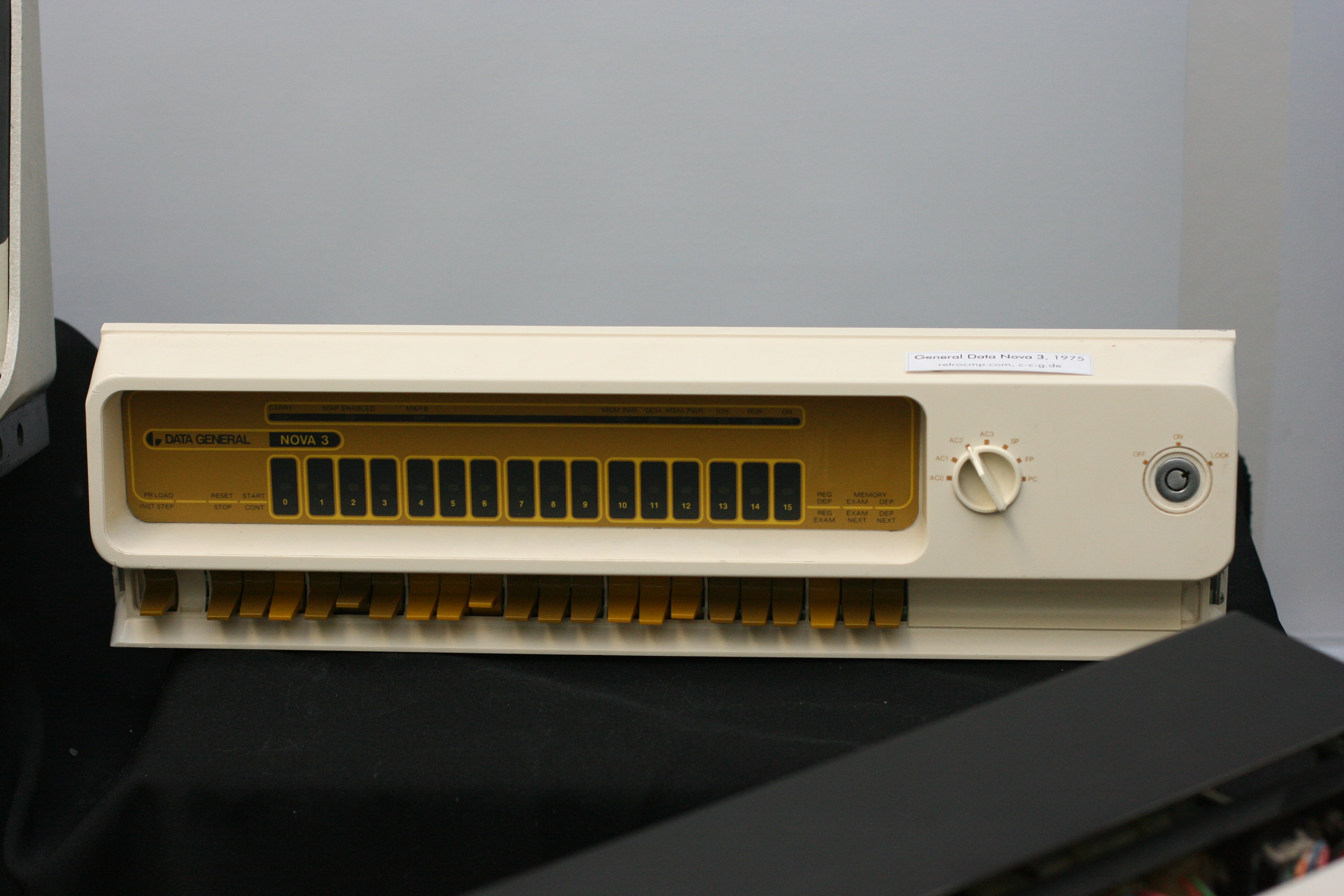
No one acted on it more pointedly, or more famously, than Edson de Castro. De Castro was no outsider; he had been the chief engineer in charge of the PDP-8 itself, the man closest to DEC’s most successful product. In late 1967 he and like-minded colleagues proposed a 16-bit successor — the PDP-X — a more capable machine to carry DEC’s small-computer franchise into the next generation. DEC’s management turned it down, judging it too risky and too awkward a fit alongside the company’s existing lines. So in 1968, de Castro left, taking with him a small group that included fellow DEC engineers Henry Burkhardt III and Richard Sogge, joined by Herbert Richman from Fairchild Semiconductor, and founded Data General in Hudson, Massachusetts — a few miles down the road from Maynard, which was rather the point. The following year, 1969, Data General shipped the Nova: a clean, 16-bit minicomputer, deliberately faster and cheaper than the 12-bit PDP-8 it was built to undercut, that became a runaway success in its own right and made Data General, almost overnight, DEC’s fiercest rival. The Nova is the iconic PDP-8 spin-off — a machine born directly out of the talent and the ambition the PDP-8 had concentrated at DEC, and then spilled. (The episode also shadowed DEC with a long-running legal and proprietary fight over how much of that talent’s knowledge de Castro had been entitled to take with him — the ordinary friction of an industry growing by fission.)
Data General was the sharpest example but far from the only one. The same logic — small computers are a real and growing market — pulled in a whole wave of companies. Hewlett-Packard, already a giant in test instruments, entered with its 2116 and the HP 1000 line, a natural extension for a firm whose customers already had the machine’s natural habitat, the laboratory bench. Wang Laboratories built a thriving business on small computers and, especially, dedicated word processors. Prime Computer, founded in 1972, and a roster of others — Computer Automation, General Automation, Interdata, and more — crowded into the space DEC had opened. For a decade and more, Route 128 around Boston became to the minicomputer what Silicon Valley would later be to the microprocessor: a dense cluster of companies all chasing the same insight the PDP-8 had proven, that the future of computing was not only larger and more central but also smaller and more dispersed.
That whole era found its literary monument late, and it is worth being exact about what the monument actually commemorates, because the title invites a natural confusion. Tracy Kidder’s The Soul of a New Machine (1981) — which won both the Pulitzer Prize and the National Book Award — is the great non-fiction account of the minicomputer business at its competitive peak. But it is not a book about the PDP-8, and it is not even, really, a book about the Nova. It chronicles a later Data General project: the crash effort, in the late 1970s, to build the company’s first 32-bit minicomputer, the Eclipse MV/8000, code-named “Eagle,” racing to answer DEC’s enormously successful 32-bit VAX. What Kidder captured — the exhausted young engineers, the “pinball” reward of getting to build the next machine, the pressure and the pride and the all-consuming culture of a minicomputer company sprinting against a rival — is the human texture of the industry the PDP-8 had founded, observed a full computer-generation downstream. So the honest way to invoke it in this series is as era-context, not lineage: the world Kidder reported from is the world the PDP-8 set in motion, but the specific machine at the heart of his book is two architectural generations and a great deal of corporate history removed from the twelve-bit box on Jeff’s bench. Cite it for the culture it preserves, not for any technical descent.
11.5 The engine underneath: price, and the curve that would not stop
Step back from the personalities and the company names and one impersonal force is doing most of the work in this story: the relentless, compounding fall in the price of a given amount of computing. Volume 3 traced the mechanism in hardware terms — the PDP-8 architecture re-implemented again and again in successively cheaper and denser components, from the discrete transistors of the 1965 original, through the small-scale TTL integrated circuits of the 8/I, to the Omnibus 8/E, and finally onto a single CMOS chip in the Intersil 6100 and Harris 6120. Each re-implementation did the same logical job in less silicon, less space, less power, and — above all — less money. That is the same broad force the industry would soon learn to call Moore’s law: the steady, exponential cheapening of digital logic as the art of packing transistors onto silicon advanced. The PDP-8 family is one architecture’s ride down that curve, captured over fifteen years.
The social consequence of that curve is the engine of democratization, and the mechanism is almost mechanically simple. Every meaningful drop in price does not merely make the machine cheaper for its existing buyers; it admits an entirely new tier of buyers who could not afford it before. The 1965 machine at $18,500 was within reach of a well-funded laboratory; the 8/I near $12,800 reached a more ordinary one; the cheaper members of the family reached a poorer school, a smaller engineering shop, a thriftier OEM building the computer into a product whose buyer would never know it was there. Volume 10 counted the result: on the order of fifty thousand classic PDP-8 minicomputers, and — counting the single-chip CMOS second life of the architecture — total production of the twelve-bit design well past three hundred thousand. Each rung down the price ladder widened the circle of who could own a computer, and the widening is the democratization. There is no separate magic ingredient; the spreading is the falling price, made social.
And the curve did not stop at the minicomputer. This is the point to hold onto, because it is the bridge to everything that comes after. The forces that took a computer from a million dollars to twelve thousand were not spent at twelve thousand; they were the same forces, and they kept running. The line on the graph that had carried computing from the glass house to the laboratory bench was still descending, with no kink at the minicomputer to suggest it would stop there. Anyone who understood why the PDP-8 had been able to sit on a bench — because logic had gotten cheap enough — could see that when logic got cheaper still, the computer would sit somewhere smaller and more personal yet. The only question was where the curve would put a computer next, and how soon.
11.6 The bridge to the microcomputer
The answer arrived from an unexpected direction. The minicomputer makers had cheapened the computer by re-implementing it in fewer and better chips; the next leap came from collapsing the heart of the computer onto a single chip. In 1971 Intel shipped the 4004, the first commercial microprocessor — an entire central processor on one sliver of silicon — and followed it with the 8-bit 8008 in 1972 and the 8080 in 1974. The microprocessor was the same descent down the same cost curve, simply carried to its next landmark: where the PDP-8’s processor had shrunk from a cabinet of flip-chips to a board to a single CMOS chip, the microprocessor made the one-chip processor the starting point for a new and far cheaper class of machine.
What that cheapness bought was another full rung down the ladder of who could own a computer — and this time the rung reached past the institution and the department all the way to the individual. A processor that cost a few hundred dollars, and then a few tens of dollars, put the price of a whole small computer not at twelve thousand dollars but at a few hundred. The same democratizing logic that had moved the computer from the glass house onto the laboratory bench now moved it one decisive step further: off the institution’s bench and onto the hobbyist’s kitchen table. The minicomputer had made the computer something a lab could own; the microcomputer made it something a person could own. It is the identical idea — small, cheap, near, and yours — pushed one tier further down than the PDP-8 could reach, by the same curve that had carried the PDP-8 as far as it went.
It is important to draw this line honestly, because the temptation to overdraw it is strong. The first famous personal computer, the Altair 8800 of 1975, was not a PDP-8, and it carried no PDP-8 circuitry; it was built around Intel’s 8080 microprocessor, a wholly different architecture with a different word length, a different instruction set, and a different lineage. There is no direct technical descent from the twelve-bit minicomputer to the eight-bit hobbyist kit. What the Altair inherited from the PDP-8 was not silicon but form and spirit: a small box with a front panel of switches and blinking lights, no built-in terminal, programmed at the bare metal by an enthusiast who finally, for a few hundred dollars, owned a computer outright. Anyone who had toggled a program into a PDP-8/I would have known instantly what to do with an Altair’s panel — not because the machines were related, but because both answered the same human desire in the same idiom, a decade and a price-tier apart. The Altair is the PDP-8’s heir in logic, not in lineage: the next chapter of the one story this volume has been telling, the story of computing falling, tier by tier, into more and more hands.
And that next chapter is the place this volume hands off. The Altair 8800 — the machine that put a computer on a hobbyist’s kitchen table, lit the spark of the personal-computer revolution, and gave a couple of young programmers named Gates and Allen their first product — is the subject of this site’s companion deep dive. Everything Volumes 1 through 11 have said about the PDP-8 — that a computer could be small, cheap, interactive, and personally owned, and that each fall in its price widened the circle of who got to use one — is the premise the Altair series picks up and carries into the era of the personal computer. The mini democratized computing by moving it from the institution to the department and onto the bench. The micro finished the move, from the bench to the desk and the kitchen table and, eventually, the pocket. The PDP-8/I at the heart of this series is one beautiful, specific waypoint on that descent: not the beginning, and emphatically not the end, but the moment the computer first became small enough, and cheap enough, to belong to the person who needed it. Where it goes next — onto the kitchen table, in a kit, for a few hundred dollars — is where the Altair story opens.
Sources
- Wikipedia, “Data General.” Founding of Data General in Hudson, Massachusetts, in 1968 by Edson de Castro, Henry Burkhardt III, and Richard Sogge (all from DEC) together with Herbert Richman of Fairchild; the 1969 Nova as a 16-bit minicomputer built to outperform and undercut the 12-bit PDP-8. https://en.wikipedia.org/wiki/Data_General
- Wikipedia, “Edson de Castro.” De Castro as DEC’s chief engineer on the PDP-8; his late-1967 proposal for the 16-bit PDP-X successor, DEC management’s rejection of it, and his subsequent departure to found Data General. https://en.wikipedia.org/wiki/Edson_de_Castro
- Computer History Museum, “Thwarted at DEC, Thriving at Data General” (CHM Revolution). The PDP-X rejection and the de Castro group’s exit from DEC to start Data General. https://www.computerhistory.org/revolution/story/338
- Wikipedia, “The Soul of a New Machine.” Tracy Kidder’s 1981 book; its Pulitzer Prize and National Book Award; its subject as Data General’s crash effort to build its first 32-bit minicomputer, the Eclipse MV/8000 (“Eagle”), in competition with DEC’s 32-bit VAX — confirming that the book is era-context for the minicomputer industry, not an account of the PDP-8. https://en.wikipedia.org/wiki/The_Soul_of_a_New_Machine
- Wikipedia, “Minicomputer,” and Engineering and Technology History Wiki, “Rise and Fall of Minicomputers.” The PDP-8 as the first commercially successful minicomputer and the wave of minicomputer firms (DEC, Data General, Hewlett-Packard, Wang, Prime, and others) clustered around Route 128. https://en.wikipedia.org/wiki/Minicomputer · https://ethw.org/Rise_and_Fall_of_Minicomputers
- Wikipedia, “Intel 4004,” “Intel 8008,” and “Intel 8080.” The 1971 4004 as the first commercial microprocessor and the 1972/1974 8008 and 8080 — the single-chip processors that carried the cost curve down to the microcomputer. https://en.wikipedia.org/wiki/Intel_4004 · https://en.wikipedia.org/wiki/Intel_8080
- Wikipedia, “Altair 8800.” The 1975 Intel 8080-based hobbyist kit with its front-panel switch-and-lamp interface — the personal-computer machine that is the subject of this site’s companion deep dive, and the heir to the PDP-8’s democratizing logic (though not its architecture). https://en.wikipedia.org/wiki/Altair_8800
- This series, Volumes 1, 3, and 10 — the orientation thesis that the mini moved the computer out of the glass house (Vol 1), the PDP-8 architecture’s ride down the cost curve from discrete transistors through TTL to single-chip CMOS (Vol 3), and the machine’s actual deployment across labs, education, and industry (Vol 10), all of which this volume synthesizes into its larger argument.
- Figure: “Data General Nova 3,” photograph by Wolfgang Stief, via Wikimedia Commons, released under CC0 — a preserved Data General Nova, the iconic PDP-8 spin-off founded by ex-DEC engineers. https://commons.wikimedia.org/wiki/File:Data_General_Nova_3.jpg

Comments (0)