PDP-8/I · Volume 10
PDP-8/I — Volume 10 — The PDP-8 in the World: Labs, Education, Embedded
Where the cheap twelve-bit machine actually went — onto laboratory benches and hospital carts, into a generation of classrooms, and inside typesetters, telephone exchanges, and the word processors on a million desks.
10.1 About This Volume
The nine volumes before this one have built a machine and taught it to speak. We have the twelve-bit word and the single accumulator (Volumes 4 and 5), the core memory that survives a power-down (Volume 6), the front panel where a person meets a bare processor (Volume 7), the Teletype and paper tape and the analog-to-digital converters that let the machine reach out and sense the world (Volume 8), and the software — PAL, FOCAL, BASIC, OS/8, time-sharing, and the DECUS tape library — that turned a pile of flip-chips into something a human could actually use (Volume 9). What we have not yet asked is the plainest question of all: once a laboratory, a hospital, a high school, or a factory could buy a whole computer for the price of a car, what did they do with it?
That is this volume. It is an applications-and-impact volume, less concerned with bits than with the places the PDP-8 ended up and the work it did once it got there. The thread running through it is that the PDP-8’s importance is not really a story about a clever architecture — Volumes 3 through 8 told that story — but a story about reach. A computer cheap enough to dedicate to a single experiment, a single classroom, a single machine on a factory floor, is a fundamentally different kind of object from a mainframe that a whole institution must schedule and share. The PDP-8 was the first computer cheap enough to be spent that way, and the consequence was that it went almost everywhere. By the end you should see why a whole generation of scientists, engineers, doctors, and students can say, truthfully, that the first computer they ever touched was a PDP-8.
We follow it into four worlds in turn — the laboratory, the clinic, the classroom, and industry — and then step back to weigh the sheer scale of the thing.
10.2 Science and the laboratory
The PDP-8 was, before it was anything else, a laboratory machine, and that was no accident of marketing. Its design descended directly from the LINC — the Laboratory INstrument Computer — built by Wesley Clark and his colleagues at MIT’s Lincoln Laboratory in 1962 expressly so that a biomedical researcher could have a computer on the bench, wired straight into an experiment. DEC’s PDP-5 of 1963 borrowed the LINC’s spirit, and the PDP-8 inherited it in turn: a small, affordable processor with the input/output hooks a scientist needed to bolt it onto real instruments. Where a mainframe sat in an air-conditioned room and accepted decks of cards, the PDP-8 sat in the lab, next to the apparatus, and that proximity is the whole point.
Consider what a programmable computer on the bench actually bought an experimenter. Volume 8 described the analog-to-digital converter — the bridge that turns a fluctuating voltage into a number the machine can hold. Wire that converter to a transducer and the PDP-8 becomes a data-acquisition engine: it can sample a signal hundreds or thousands of times a second, timestamp every reading, and write the lot to DECtape for analysis, capturing in minutes a record that a technician with a chart recorder and a ruler could never have transcribed. Run the converter the other way, through a digital-to-analog channel and a few relays, and the same machine becomes an experiment controller — stepping a motor, opening a valve, advancing a sample, triggering a flash and reading the response, tirelessly and on a schedule no human hand could keep.
The most beautiful early trick the genre offered was signal averaging. Many of the signals a scientist cares about — an evoked potential in the brain, a faint resonance line, a weak periodic return — are buried in noise far larger than themselves. But noise is random and the signal is not, so if you record the same stimulus-and-response a few hundred times and average the records point by point, the noise tends to cancel while the signal reinforces itself and rises out of the hash. Doing that by hand is hopeless; doing it with a dedicated computer is almost trivial, and the LINC had made the technique famous in neurophysiology before the PDP-8 inherited it. A 4K PDP-8 with a converter and a display was, in effect, a programmable signal averager that could also do a hundred other jobs the following week — which is exactly the flexibility a fixed-function instrument could never offer.
From there the applications fan out across the whole bench. PDP-8s ran spectrometers and chromatographs, collecting and integrating peaks that a chart pen used to draw. They sat behind scintillation counters and multichannel analyzers in nuclear and physics laboratories, binning pulses by energy and counting events far faster and more reliably than a rack of mechanical scalers. They reduced data in real time, freeing the experimenter from a later night of arithmetic. The Amsterdam nuclear-research group behind the “BOL” project, to take one documented case, bought a PDP-8 essentially the moment it came on the market, specifically for data acquisition in a particle-detector experiment — a small machine pressed into service the instant it was affordable, which is the period pattern in miniature. Across physics, chemistry, and biology the story repeated: a cheap programmable computer on the bench did not merely speed up the old experimental work, it changed what experiments were thinkable, because measurements that had been too fast, too numerous, or too noisy to capture were suddenly within reach.
10.3 Medicine and the clinic
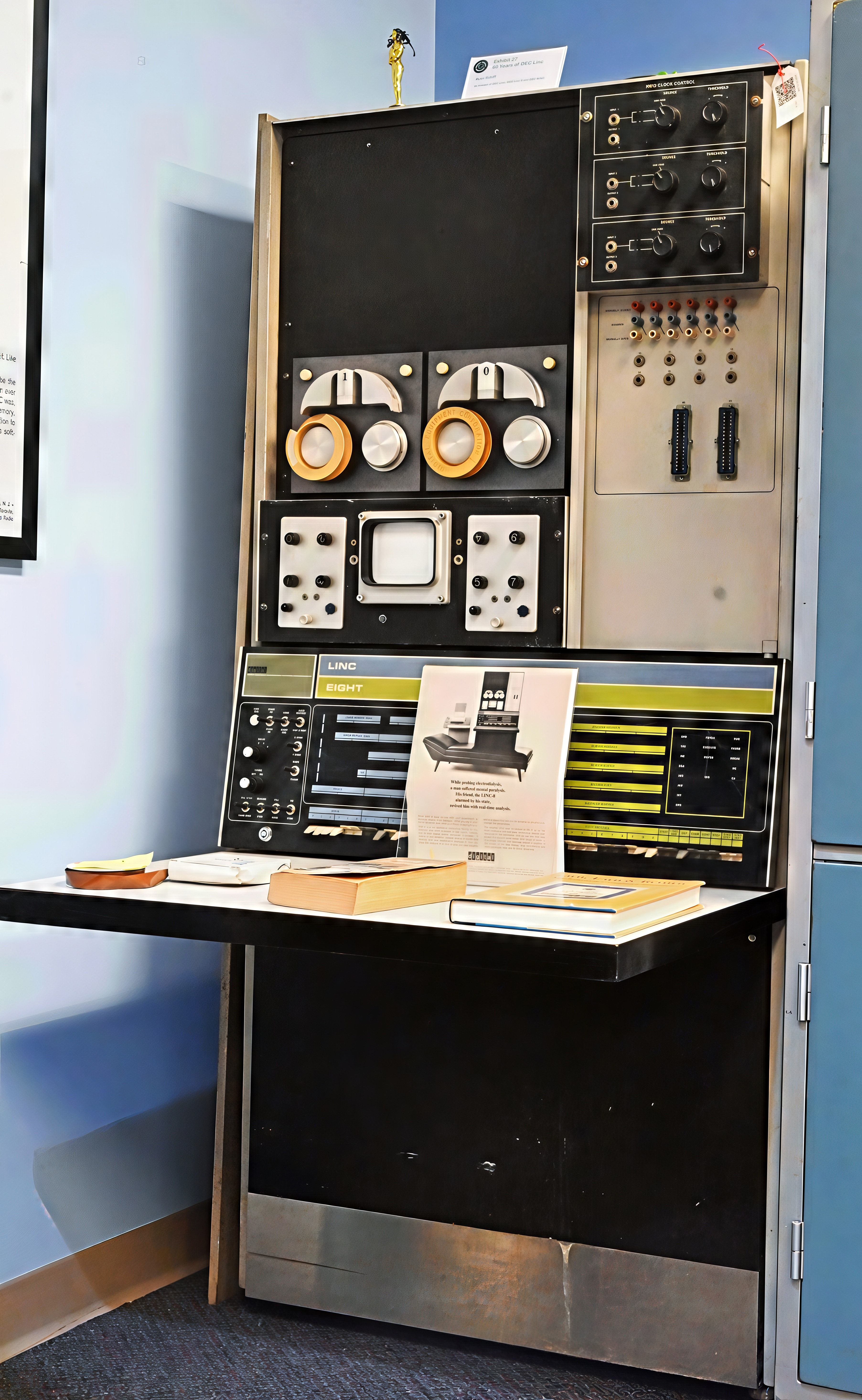
If the laboratory was the PDP-8’s birthright, the clinic was close behind it, and through the same family door — the LINC. Because the LINC had been conceived for biomedical research, the machine DEC built around it for the commercial market, the LINC-8 of 1966, found a natural home in medical and physiological laboratories. The LINC-8 was a genuine hybrid: a complete PDP-8 and most of a LINC in one cabinet, switchable between a “LINC mode” with its convenient laboratory I/O and a general-purpose “PDP-8 mode.” That combination — friendly instrument interfaces plus a real, programmable computer — made it, by contemporary accounts, a very successful research machine, and it carried the PDP-8 architecture straight into the world of nerve recordings, muscle physiology, and clinical measurement.
What the machines did there followed naturally from what they did in the lab, pointed at the body. PDP-8s averaged evoked potentials and analyzed EEG records — one surviving 1974 thesis is built entirely around frequency analysis of the EEG on a PDP “Lab-8/E” system — extracting the faint, repeatable brain response from the background rhythm by exactly the averaging trick described above. In the clinical laboratory, where a hospital runs thousands of blood and chemistry assays a day, a small computer could collect readings from automated analyzers, flag out-of-range results, and print reports, taking over the bookkeeping that had swallowed technicians’ time. In nuclear medicine and early imaging, PDP-8-class machines served as data-collection and processing back-ends: a gamma camera or a counter produced a torrent of position-and-energy events, and the minicomputer binned them into an image or a curve. Volume 3’s own figure showed a PDP-8/E configured as a neurosurgical diagnostic station, the little computer wired to an oscilloscope at the operating-room’s edge.
It is worth being careful here, because the clinical record is exactly the kind that invites overstatement. The PDP-8 era was the dawn of computers in medicine, and most of what these machines did was data acquisition, instrument control, and laboratory automation rather than the integrated patient-monitoring and hospital-information systems that came later and usually ran on larger iron. The honest claim is the modest one: the PDP-8 and its LINC-derived siblings put a programmable computer within reach of individual hospital departments and clinical researchers for the first time, and a great many of the techniques that medicine now takes for granted — digitizing a physiological signal, averaging it, automating an assay, reconstructing a count into an image — were first rehearsed on small twelve-bit machines because, for once, a department could afford to own one outright. Where a specific “first” is tempting, the record is usually too thin to support it, and this volume does not try.
10.4 Education
The classroom may be the PDP-8’s most enduring legacy, and Volume 9 already told the software half of the story — BASIC and FOCAL, the EduSystem packages from the single-user EduSystem 5 up to the time-shared EduSystem 50, and TSS/8, the system that gave a dozen students at a dozen Teletypes each their own virtual 4K PDP-8. This volume adds the human half: what those products meant once they were installed.
Around 1970, a computer a high school could actually buy was a genuinely new thing in the world. Computing, to that point, had meant a mainframe behind glass, operated by specialists, reached only through a stack of punched cards handed across a counter and answers returned hours later. The PDP-8 broke that model open. A school district could purchase a single machine, set it in a room, and let students touch it — type a program, watch it run, fix it, and run it again, the whole loop closing in seconds rather than overnight. That immediacy is the thing. A student who can see the consequence of a mistake at once, and try again, learns to program; a student who waits a day for a printout mostly learns to wait. DEC understood this and sold it deliberately: the EduSystem catalogue let a school buy the rung of the ladder it could afford, from a bare BASIC machine to a time-sharing host, and the time-sharing systems multiplied the reach of a single processor across a whole roomful of beginners at once.
The result is a fact recited by a remarkable number of people who went on to build the computer industry: the first machine they ever programmed was a PDP-8, clattering out their first run on a Teletype Model 33 in a classroom or a college lab. Time-sharing one small computer among twenty students — each apparently alone with their own machine — was the trick that made hands-on computing affordable for institutions that could never have dreamed of a mainframe, and it put the experience of commanding a computer in front of teenagers for the first time at scale. The PDP-8 did not teach a generation to program by being powerful; it taught them by being present — close enough to touch, cheap enough to risk a mistake on, and patient enough to let a beginner try again. That, more than any feature in the instruction set, is why so many careers trace back to a twelve-bit machine in a school.
10.5 Industry, embedded, and OEM
For all its fame in labs and classrooms, the largest share of the PDP-8’s working life may have been spent out of sight, buried inside other equipment, doing a single job over and over. This is the embedded PDP-8, and it was a deliberate DEC business. The same qualities that made the machine a good bench instrument — small, cheap, rugged, programmable, with rich I/O — made it an excellent controller, and DEC sold the PDP-8 not only as a finished computer but as a building block to OEMs: other manufacturers who bought 8s in quantity, wrote the software, wired in their own peripherals, and shipped the result under their own name, as a typesetter or a tester or a control system whose buyer might never know there was a PDP-8 inside. Selling a computer to be built into someone else’s product was a substantial part of DEC’s volume, and it is a large part of why the production numbers ran so high.
The applications were everywhere once you knew to look. PDP-8s ran process control in plants and machine tools on shop floors, sequencing operations and watching sensors. They handled industrial and laboratory automation of every description. They turned up in some splendidly public places: a PDP-8 drove the moving news display in Times Square, another ran the stage-lighting control at the Shubert Theatre, and the architecture found its way into telephone, traffic, and signaling systems where a small, reliable, programmable controller was exactly what the job wanted. None of these needed a fast or a large computer; they needed a cheap one that could be dedicated permanently to one task, and the PDP-8 was the first machine that fit.
One embedded application grew large enough to deserve its own paragraph: typesetting. An early and important use of the PDP-8 was driving phototypesetters using the TTS (teletypesetter) code already in wide use on the news wire services, and there was a major PDP-8-based typesetting effort within Digital itself. Setting type is a job of reading a stream of text and codes and emitting precisely timed control signals — exactly the kind of patient, rule-bound stream-processing a small computer does tirelessly — and the PDP-8 took to it well.
From typesetting it is a short step to the PDP-8’s longest and least-expected career: word processing. Here the history has to be told carefully, because the famous machines are not quite the ones a reader might assume. DEC’s word-processing software line, WPS-8, was an early and influential package — one of the first such systems written for a general-purpose computer rather than a fixed-function typewriter, developed by a Digital team that included Dan Bricklin, who would shortly go on to co-create the VisiCalc spreadsheet. But the celebrated dedicated word processors that carried this line to a mass market — the VT78 and especially the DECmate family of the late 1970s and 1980s — were not 8/I machines or even classic minicomputers at all. As Volume 3 set out, they were powered by the CMOS single-chip implementations of the PDP-8 architecture, the Intersil 6100 and Harris 6120, which folded the entire twelve-bit processor onto a sliver of silicon. So the accurate statement is a careful one: it was the PDP-8 architecture, not the 8/I itself, that spent the 1980s hiding inside office word processors on secretaries’ desks. The instruction set the 8/I ran in 1968 was, fifteen years later, quietly editing memos in a beige desktop appliance — the same computer, on utterly different hardware, doing a job no one in 1968 would have predicted. That single-chip generation is the bridge between the laboratory PDP-8 of this volume and the embedded architecture’s long afterlife, and it is why the architecture’s total reach so far exceeds the classic machine’s.
10.6 Scale and reach
Step back, and the numbers tell the story this volume has been circling. The PDP-8 is generally regarded as the first commercially successful minicomputer — the machine that proved a market existed for a small, affordable, general-purpose computer and, in proving it, more or less founded the minicomputer industry. (One should hedge the bare word “first”: there were earlier small and inexpensive machines, and which one counts as the first minicomputer depends on definitions historians still argue over. The PDP-8’s claim is to the first one that sold in volume, and that claim is solid.)
How much volume? The classic PDP-8 minicomputers — the discrete-transistor original, the serial 8/S, the integrated-circuit 8/I and 8/L at the center of this series, the Omnibus 8/E family, and their kin — sold on the order of fifty thousand units, a staggering figure for the era and far beyond anything a computer had achieved before. And that is only the machines that looked like computers. Counting the later single-chip CMOS implementations of the same architecture — the 6100- and 6120-based VT78 and DECmate word processors and their relatives — total production of the twelve-bit design climbed past several hundred thousand, comfortably north of three hundred thousand machines in all, as Volume 3 recorded. The classic minicomputer was a runaway success; the architecture, counting its single-chip second life, was a phenomenon.
Underneath the unit counts ran a steady fall in price that powered the whole story. The 1965 original broke the twenty-thousand-dollar barrier at $18,500; the serial 8/S dropped under ten thousand; the 8/I brought full parallel performance to around $12,800; and across the family’s life the price of a useful twelve-bit machine kept sliding, until the architecture finally cost no more than the office appliance it lived inside. Every drop opened a new tier of buyers — a smaller lab, a poorer school, a thriftier OEM — and each new tier is a reason the machine spread as far as it did.
That spread is the point this volume exists to make. The PDP-8’s significance is not that it was the fastest or the most elegant computer of its day; it was neither. Its significance is that it was the first computer cheap enough to be ordinary — cheap enough to dedicate to one experiment, one classroom, one typesetter, one stage, one desk — and so it became the computer that an entire generation of scientists, engineers, doctors, and students first touched with their own hands. The machine on Jeff’s bench, the 8/I at the heart of this series, is one specific, beautiful instance of a design whose real achievement was measured not in cycles per second but in places it reached. It went into the lab, the clinic, the classroom, and the factory, and in going there it changed who got to use a computer at all. That, in the end, is what the little twelve-bit machine was for.
Sources
- Wikipedia, “PDP-8.” The PDP-8 as the first commercially successful minicomputer, with more than 50,000 classic units sold; its descent from the LINC and the LINC’s design for easy interfacing to laboratory equipment; the LINC-8 as a successful laboratory machine combining LINC I/O with PDP-8 programmability; PDP-8 typesetting using TTS code on the news wire services and the major in-house typesetting effort at Digital; and the single-chip CMOS 6100/6120 implementations underlying the VT78 and DECmate word processors. https://en.wikipedia.org/wiki/PDP-8
- Wikipedia, “DECmate.” The DECmate family as late-1970s/1980s PDP-8-architecture machines aimed at word processing, running WPS-8; WPS-8 as one of the first word-processing packages written for a general-purpose computer, developed by a Digital team including Dan Bricklin (later of VisiCalc), and ported to the VT78/DECmate line. https://en.wikipedia.org/wiki/DECmate
- Wikipedia, “Intersil 6100,” and “DECmate.” The Intersil 6100 and Harris 6120 single-chip CMOS PDP-8 processors and their use in the VT78 and DECmate word processors — the architecture’s embedded second life (cross-referenced with this series’ Volume 3). https://en.wikipedia.org/wiki/Intersil_6100
- Computer History Museum, “DEC’s Blockbuster: The PDP-8” (CHM Revolution). The PDP-8 as DEC’s breakthrough machine and the spread of the minicomputer into laboratories, industry, and education — including signal analysis in physics labs, the Times Square news display, Carnegie Mellon time-sharing, and lighting control at New York’s Shubert Theatre. https://www.computerhistory.org/revolution/minicomputers/11/331
- Doug Jones, DEC PDP-8 Story and PDP-8 FAQs (University of Iowa). The LINC heritage, the LINC-8 and its laboratory role, the PDP-8’s data-acquisition and instrument-control applications, and the OEM/embedded business. https://homepage.cs.uiowa.edu/~jones/pdp8/ · https://homepage.cs.uiowa.edu/~jones/pdp8/faqs/
- “The EL-X8 computer and the BOL detector … a personal historical review” (arXiv). Documents the Amsterdam BOL nuclear-physics group purchasing a PDP-8 essentially as soon as it was available, specifically for data acquisition in a particle-detector experiment. https://arxiv.org/pdf/2203.11280
- L. M. Gorham, EEG frequency analysis on the PDP Lab 8-E computer system (Naval Postgraduate School thesis, 1974), via Wikimedia Commons / Internet Archive. A period example of a PDP-8-class laboratory machine used for biomedical signal analysis (EEG). https://commons.wikimedia.org/wiki/File:EEG_frequency_analysis_on_the_PDP_Lab_8-E_computer_system._(IA_eegfrequencyanal00gorh).pdf
- This series, Volumes 3, 8, and 9 — the PDP-8 family and its single-chip CMOS afterlife (Vol 3), the analog-to-digital and laboratory interfaces underpinning data acquisition (Vol 8), and the EduSystem/TSS/8/BASIC educational software whose impact this volume extends (Vol 9).
- Figure: “LINC-8 computer,” photograph by Bubba73, via Wikimedia Commons, licensed CC BY-SA 4.0 — a preserved LINC-8, the PDP-8/LINC hybrid that carried the architecture onto laboratory and biomedical benches. https://commons.wikimedia.org/wiki/File:LINC-8_computer.jpg

Comments (0)