PDP-8/I · Volume 13
PDP-8/I — Volume 13 — The Modern Revival: PiDP-8/I and Kindred Replicas
How a retired Dutch maker, a thirty-dollar Raspberry Pi, and a faithful old simulator put the PDP-8/I's blinking front panel back on workbenches all over the world — not as a museum relic behind glass, but as a kit you solder together yourself.
13.1 About This Volume
The last volume left the PDP-8 in three kinds of safekeeping — the surviving iron, the SIMH simulator, and the scanned manuals — and noted that all three together had begun to grow something new. This volume is about that new thing. It is the first volume in the series written wholly in the present tense and pointed forward: not how the PDP-8/I was built in 1968, but how, in 2026, an ordinary enthusiast with a bench and a soldering iron can build one of their own. The bridge between those two worlds is a small, beloved object called the PiDP-8/I, and the work of this volume is to explain exactly what it is, why it succeeds so completely, where it sits in a wider family of homebrew recreations — and why it is the natural last step before Jeff picks up the iron himself in Volume 14.
This is a maker’s volume, and it leans directly on the one before it. The PiDP-8/I is not a from-scratch reinvention of the PDP-8; it is a physical front panel wrapped around the SIMH simulator described in Volume 12. So everything that volume said about SIMH — that it boots the real OS/8, runs FOCAL, models the twelve-bit instruction set and the peripherals faithfully — is the running engine underneath everything described here. What the replica adds is the one thing a simulator on a laptop screen can never supply: the object. The panel of switches and lights that Volumes 1 and 7 called the soul of the machine. This volume is the story of how that soul was given a body again, cheaply, and put within reach of anyone who wants one.
13.2 The replica impulse
Begin with a question that sounds naive and is not: if SIMH already runs the real software, perfectly, for free, on any laptop — why would anyone build a physical PDP-8 at all? The simulator boots OS/8, assembles programs, plays the same games, and never needs a capacitor replaced. By every functional measure the problem of “experiencing a PDP-8” is solved. And yet a steady stream of people spend evenings and real money soldering hundreds of components onto a circuit board to own a panel that does, electrically, nothing the simulator was not already doing. The reason is the gap between behavior and object, and it is the gap this whole revival lives in.
A PDP-8/I is not, experientially, its instruction set. It is a thing — a slab of switches and lamps, the specific orange glow of incandescent bulbs behind a dark acrylic legend, the mechanical click of a toggle thrown down to deposit a word into memory. Volume 11 argued that the machine’s deepest bequest was tactile: a computer you learned by touching, by throwing switches and watching lights answer back. A SIMH window reproduces the logic of that experience and discards its entire physical form. You can read a register’s value in a terminal; you cannot watch it flicker. The replica impulse is the desire to get the form back — to have the blinkenlights, the real switches under the fingers, the actual blinking front panel sitting on the bench where it can be glanced at and toggled and shown to a visitor, rather than confined to a rectangle of pixels.
It helps to lay the options out as a spectrum, because the PiDP-8/I occupies a very specific and clever point on it. At one end is pure software emulation: SIMH on a laptop, complete in behavior, empty of body. At the far other end is full hardware re-creation: building an actual twelve-bit processor out of real logic — discrete chips, or a modern FPGA configured to be a PDP-8 down to the gate — so that the machine is genuinely a computer and not a simulation at all. Between those poles sits the approach this revival made famous: a physical panel driven by emulation. The front panel is real — real switches, real LEDs, real wiring — but the processor behind it is SIMH running on a cheap single-board computer. You get the authentic interface married to an emulated core, at a fraction of the cost and difficulty of either extreme.
Two things made that middle path suddenly practical in the 2010s, and both belong to the broader maker movement rather than to retrocomputing as such. The first is the Raspberry Pi and its kin — credit-card-sized Linux computers selling for tens of dollars, with a row of general-purpose input/output pins exposed on a header, precisely the cheap, hackable, GPIO-equipped brain a panel needs to drive its lights and read its switches. The second is the maturing maker ecosystem around it: affordable custom printed circuit boards in small runs, online kit fulfillment, communities that share open-source hardware files freely. A faithful panel replica had been buildable in principle for decades; what changed is that it became affordable, reproducible, and shareable. The retrocomputing instinct met cheap single-board computers, and the replica revival followed almost inevitably.
13.3 The PiDP-8/I: a real panel over a simulated core
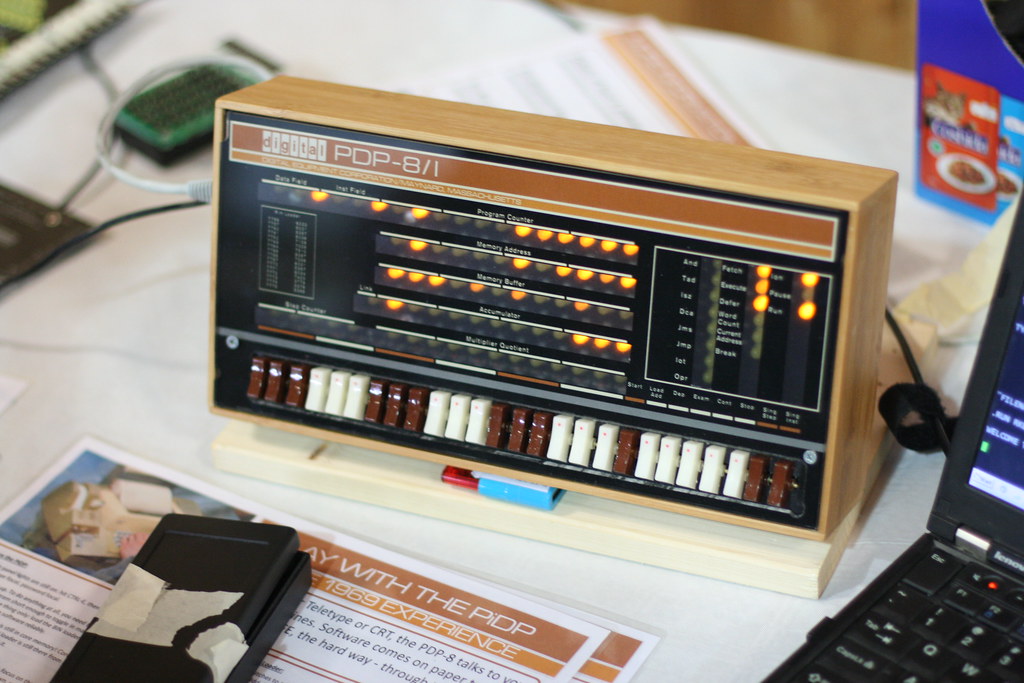
The machine that crystallized all of this is the PiDP-8/I, designed by Oscar Vermeulen under the project name Obsolescence Guaranteed. It is exactly the hybrid the spectrum predicts: a faithful reproduction of the PDP-8/I’s iconic front panel, reduced to roughly two-thirds the size of the original (the panel is scaled to fit smaller, off-the-shelf toggle switches — close to a 2:3 reduction of the 19-inch-rack original, though one should not treat the figure as exact), mounted over a Raspberry Pi that runs SIMH underneath. The Pi is the computer; the panel is its face. The genius of the thing is in how completely the face and the computer are joined.
The panel itself is dense and faithful. It carries the full array the real 8/I had — on the order of eighty-nine LEDs standing in for the original’s incandescent indicator lamps, and twenty-six switches: the bank of data/address toggle switches plus the momentary control switches (Start, Load Address, Deposit, Examine, Continue, Stop, Single Step, Single Instruction) that Volume 7 walked through one by one. The LEDs are laid out exactly as the original lamps were — Program Counter, Memory Address, Memory Buffer, Accumulator, Multiplier Quotient, the instruction-decode and state indicators — so that the panel shows the real register activity of the simulated processor, bit for bit, in the same places the iron showed it. Throw the switches to set an address and deposit a word, press Start, and the lights dance through the fetch-and-execute cycle exactly as they would have on a 1968 machine, because underneath, a faithful PDP-8 is genuinely running.
The trick that makes this work on cheap hardware is multiplexing, and it is worth understanding because it is the same problem the original panel’s designers faced, solved with modern parts. A Raspberry Pi exposes only around two dozen usable GPIO pins — nowhere near enough to wire one pin to each of the eighty-nine LEDs and twenty-six switches individually. So the panel is built as a matrix. The LEDs are organized into several logical rows; a tight software loop running on the Pi lights one row at a time, very briefly, setting just the LEDs that should be on in that instant, then moves to the next row, cycling through all of them hundreds of times a second. Persistence of vision does the rest: no single LED is ever lit continuously, but the eye sees a steady, glowing panel. The switches are scanned the same way, row by row, so the same handful of pins both drive the lights and read the toggles. It is, pleasingly, a software re-creation of exactly the kind of time-multiplexed display the real machine’s brief, register-tracking lamp flicker amounted to — the panel shows CPU and memory state by sampling it, rapidly, just as the original did.
The software side is the SIMH of Volume 12, modified so that the simulator and the panel are one system. On boot the Pi comes up into Linux (Raspberry Pi OS), logs itself in, and launches a SIMH PDP-8 session; a dedicated thread continuously copies the simulated machine’s register contents out to the LED matrix and reads the switch matrix back into the simulator’s controls. The result is that the physical switches are the SIMH machine’s front panel, not a decoration over it — toggling a switch on the panel pokes a SIMH register, and a SIMH register lights a panel LED. On that simulated 8 you run the whole PDP-8 world: OS/8, the FOCAL and BASIC interpreters, the games, and — because the host is a full Linux box — you can simultaneously use the Pi as an ordinary computer, ssh into it, or have it serve files, while the eight blinks away. (A small honest footnote, characteristic of the project’s care: the simulated processor actually implements the slightly later PDP-8/e instruction set, a superset of the 8/I’s, so a handful of details differ from a literal 8/I — but for everything this series has described, it behaves as the 8/I did.) The elegance is total: an authentic interface over an emulated core, each doing what it does best.
13.4 What it gets right
The PiDP-8/I is not merely a replica; it is the one that broke through, selling in the thousands where most homebrew projects build a handful. (Vermeulen has spoken of well over two thousand PiDP-8 kits shipped, and later thousands more across the family — figures worth treating as approximate, but unambiguously in the thousands, which for a niche retrocomputing kit is extraordinary.) That success is not an accident, and it is instructive to name the specific design choices that earned it, because each is a small lesson in how to make a faithful thing people actually want.
First, visual fidelity. The panel is not a stylized homage; it is a careful reproduction of the actual 8/I layout, with the legend text, the lamp groupings, and the switch arrangement all matched to the original, so that someone who learned the real machine recognizes it instantly and someone who never saw one is looking at a true likeness. The early kits even shipped in a warm bamboo case whose color answered the period industrial aesthetic. Second, real tactile switches — not buttons painted to look like toggles, but genuine toggle switches you throw with a finger, restoring the single most important physical fact of front-panel computing: that you program the bare machine by hand, one bit at a time, and feel it. Third, software completeness: because the core is SIMH, you do not get a toy that blinks decoratively, you get a whole working PDP-8 — OS/8 and its utilities, FOCAL, BASIC, assemblers, games, even multi-user TSS/8 — an entire software world, not a demo loop. Fourth, price and accessibility: a real PDP-8/I, if you can find one, is a rare, heavy, fragile, expensive artifact needing a skilled restorer; the PiDP-8/I has historically sold in the rough vicinity of a hundred-odd US dollars as a kit (the exact price and current availability have varied over the years and through periodic production batches — anyone wanting one should check the project’s own pages for what is on offer now). For two orders of magnitude less than a collector’s machine, you get its panel, alive on your desk.
Fifth, and not least, the community. The PiDP-8/I is open-source hardware, and around it has grown an active ecosystem that long outlived the initial launch. The software in particular has been carried forward well beyond Vermeulen’s original release by volunteers — most prominently Warren Young, who with others maintains the comprehensive PiDP-8/I Software distribution documented on the tangentsoft.com wiki, an unusually thorough body of build notes, software, and history. One small jewel of that community work captures the project’s spirit exactly: an incandescent lamp simulator (begun by Ian Schofield, refined by Young) that models the way a real filament lamp glows up and fades rather than switching cleanly on and off, so that the modern LEDs imitate not just which lamps the original lit but the soft thermal lag of the bulbs themselves. That is the level of care that made the thing beloved: not content to recreate the panel’s logic, the community recreated the very texture of how its lights once behaved.
13.5 The wider replica family
The PiDP-8/I did not stay a single object; it became the seed of a small ecosystem, and placing it among its kin is the best way to see what kind of thing it is. The most direct descendant is its own sibling, the PiDP-11 — the same idea applied to DEC’s later, hugely influential 16-bit machine, reproducing the dramatic front panel of the PDP-11/70 (a roughly 6:10-scale panel, by the project’s own description) over, again, a Raspberry Pi running a simulator. The PiDP-11 runs an even richer software world than the 8 — early Unix (Version 5 through the later BSDs), DEC’s own RSX-11 and RT-11 — and it cemented Obsolescence Guaranteed as a maker of front-panel kits rather than a one-machine project. (Vermeulen has since extended the family further up the DEC line; treat the exact roster and the status of any newer panel as something to verify against the project’s current pages.) Underneath several of these sits not only SIMH but a SIMH variant called BlinkenBone, the work of Jörg Hoppe, originally built to drive the real salvaged front panels of museum machines and adapted here to drive the replicas — another thread of the preservation work of Volume 12 feeding directly into the revival.
Step outside the Obsolescence Guaranteed family and there is a wider world of PDP-8 recreation that the PiDP-8/I sits among, defined usefully by where each lands on the emulation-to-hardware spectrum from earlier in this volume. Toward the full-hardware end is the SBC6120, a single-board PDP-8-compatible computer designed by Bob Armstrong of Spare Time Gizmos, built around the Harris HD-6120 — the very single-chip CMOS PDP-8 processor Volume 3 traced as the architecture’s final hardware incarnation. The SBC6120 is not an emulation at all: it is a genuine PDP-8 in silicon, running OS/8 on real period-correct logic, and it can itself be dressed with a front panel. Further along the same end are the FPGA PDP-8s — designs that configure a field-programmable gate array to implement the twelve-bit machine directly in reconfigurable hardware, a true gate-level re-creation rather than a program pretending to be one — alongside a long tail of individual homebrew PDP-8s built by hobbyists out of discrete logic. (One enthusiast even adapted an FPGA PDP-11 to drop into the PiDP-11’s panel in place of the Raspberry Pi, fusing the two ends of the spectrum.)
Seen against that field, the PiDP-8/I’s particular achievement comes into focus. The hardware re-creations are more authentic in their cores — an SBC6120 really is a PDP-8 — but they are harder, costlier, and rarer, the province of serious hardware hackers. Pure SIMH is the easiest and freest but bodiless. The PiDP-8/I deliberately splits the difference, and that is precisely why it, and not the purer projects at either extreme, is the one that put thousands of blinking panels on thousands of desks. It is faithful enough to satisfy, easy and cheap enough to spread.
13.6 The hand-off: a kit, a soldering iron, and Volume 14
Which brings the series, at last, to the workbench. For all the architecture and history in the twelve volumes before it, the PiDP-8/I resolves into a very concrete proposition: it is sold as a kit you build yourself. What arrives is a bare printed circuit board and bags of components — the rows of LEDs, the toggle switches, the headers and small parts — together with the panel overlay and (in the full kits) a case. Building it is an evening or two of methodical soldering: seating and soldering each LED in its place, mounting the bank of switches square and true, fitting the header that mates the board to a Raspberry Pi, then flashing the prepared software image to the Pi’s memory card and dropping it in behind the panel. The project has always pitched the build as approachable — explicitly friendly to people who have never soldered before — which is much of the point. The barrier to owning a PDP-8/I’s front panel is no longer money, rarity, or restoration skill; it is a few quiet hours and a willingness to learn to lay down a clean solder joint.
That is the most accessible way, in 2026, to own the thing this entire series has been describing — not a photograph of a PDP-8/I, not a simulation of one on a screen, but its actual panel, its real switches and lights, blinking on your own bench, running the real OS/8 underneath your fingers. Everything the series built toward — the cores and flip-chips of Volumes 4 through 7, the instruction set of Volume 6, the front-panel ritual of Volume 7, the software of Volume 9, the SIMH preservation of Volume 12 — converges here, in a kit on a workbench, made buildable by exactly the cheap, democratized computing the PDP-8 itself helped set in motion (Volume 11). The wheel comes full circle: the machine that took the computer out of the glass house and put it on a bench is now, itself, a thing you build on a bench.
And that is where this volume hands off. The story can no longer be told from the outside, because the next chapter is Jeff’s own. Volume 14 documents Jeff actually building his PiDP-8/I — opening the kit, taking up the iron, soldering the LEDs and switches to the panel board, fitting the Raspberry Pi, loading the software, and bringing the panel to life for the first time. After thirteen volumes of history and architecture, the soldering iron finally comes out. Turn the page and watch the smoke rise.
Sources
- Obsolescence Guaranteed (Oscar Vermeulen), “PiDP-8” project pages — the PiDP-8/I as a Raspberry-Pi-based replica of the PDP-8/I front panel running a modified SIMH, sold as an easy-to-build kit (or assembled), running OS/8, FOCAL, games, and multi-user systems; open-source hardware. https://obsolescence.dev/pidp8.html · https://obsolescence.wixsite.com/obsolescence/pidp-8-overview
- Raspberry Pi Foundation, “PiDP-8/I — remaking the PDP-8/I” — overview of Vermeulen’s project: a Raspberry Pi running Raspberry Pi OS and a SIMH emulator modified to reflect PDP-8 CPU register state through the panel LEDs and to respond to the switches; described as open-source hardware. https://www.raspberrypi.com/news/pidp-8i-remaking-the-pdp-8i/
- tangentsoft.com, “PiDP-8/I Software” wiki (Warren Young, Bill Cattey, and contributors) — the comprehensive community software distribution and documentation: the LED/switch matrix and multiplexing scheme (≈89 LEDs and 26 switches scanned in logical rows from the Pi’s ~25 GPIO pins), the Incandescent Lamp Simulator (originally Ian Schofield, improved by Warren Young) modeling filament glow/fade, and the note that the simulated CPU implements the later PDP-8/e instruction set; software including OS/8 and U/W FOCAL. https://tangentsoft.com/pidp8i/ · https://tangentsoft.com/pidp8i/wiki?name=Incandescent+Lamp+Simulator · https://github.com/tangentsoft/pidp8i
- Hackaday.io and Hackster.io project pages for the PiDP-8/I — independent write-ups of the kit, its Raspberry-Pi-plus-SIMH design, and the scale and approachability of the build. https://hackaday.io/project/4434-pidp-8x2fi · https://www.hackster.io/obsolescence/pidp-8-a-pdp-8-minicomputer-on-raspberry-pi-8a7b5a
- Obsolescence Guaranteed and Raspberry Pi Press, “PiDP-11” — the sibling kit reproducing the PDP-11/70 front panel (≈6:10 scale) over a Raspberry Pi, running early Unix, BSD, RSX-11 and RT-11 via SIMH/BlinkenBone, including Jörg Hoppe’s BlinkenBone variant originally built to drive real museum panels; and mention of an FPGA PDP-11 adapted to the PiDP-11 panel. https://www.hackster.io/obsolescence/pidp-11-a-pi-based-replica-of-the-pdp-11-70-1dcda9 · https://obsolescence.wixsite.com/obsolescence/pidp-11
- Spare Time Gizmos (Bob Armstrong), “SBC6120” — a single-board hardware PDP-8 built around the Harris HD-6120 single-chip CMOS PDP-8 processor, a genuine (non-emulated) PDP-8 running OS/8, representing the full-hardware end of the recreation spectrum; with FPGA PDP-8 implementations and homebrew discrete-logic 8s as further hardware re-creations. http://www.sparetimegizmos.com/Hardware/SBC6120-2.htm
- This series, Volume 12 (SIMH, surviving machines, and document preservation — the engine and the soil this revival grows from), Volume 11 (the democratizing, tactile, hands-on ethos the replicas restore), Volume 7 (the original 8/I front panel and its switches and lamps), and Volume 3 (the architecture’s re-implementation down to the single-chip Intersil 6100 / Harris 6120 CMOS PDP-8). Volume 14, to which this volume hands off, documents Jeff’s own PiDP-8/I build.
- Figure: “PiDP-8/l (Selbstbau-Kit),” photograph by stiefkind, via Openverse / Flickr, released under CC0 1.0 — a fully built PiDP-8/I in its bamboo case with the panel lit and running. https://www.flickr.com/photos/52924836@N00/17180052250
Comments (0)