PDP-8/I · Volume 1
PDP-8/I — Volume 1 — The Minicomputer That Changed Everything
An orientation to the 1968 machine that brought the computer within reach of a single laboratory — and to the fourteen-volume journey that ends on a workbench.
1.1 A small machine with a large shadow
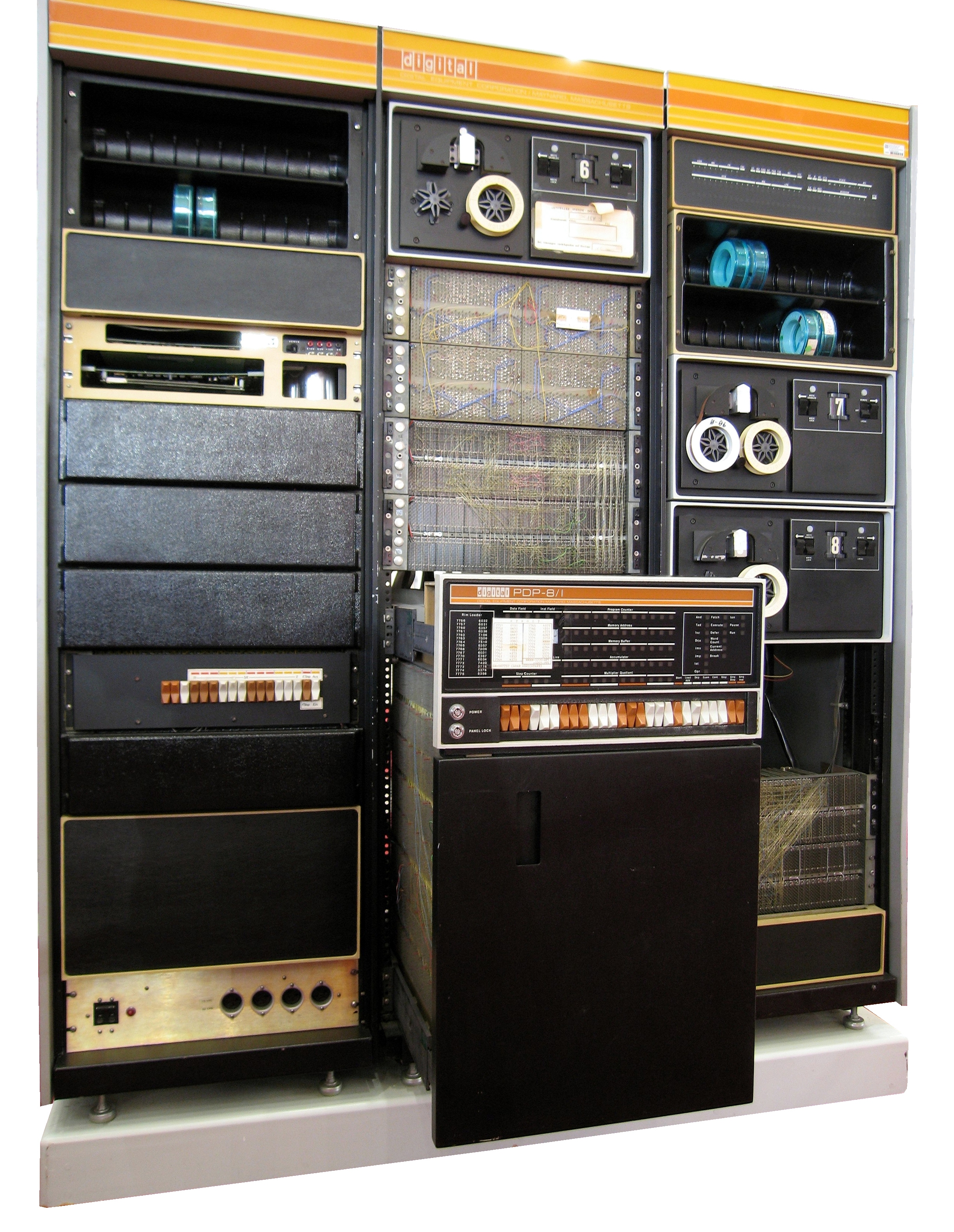
Stand in front of a PDP-8/I and the first thing you notice is the panel: a horizontal row of stubby toggle switches beneath a constellation of small incandescent lamps, all set into a brushed-and-painted bezel. There is no keyboard built into the machine, no screen, no mouse — just switches you flip and lights you read. To a modern eye it looks less like a computer than like the control board of some mid-century power plant. Yet this unassuming box, introduced by the Digital Equipment Corporation in 1968, belongs to one of the most consequential product lines in the history of computing. The PDP-8 family was the machine that took the computer out of the air-conditioned, glass-walled “data center” and set it down on a bench, in a lab, in a classroom — within arm’s reach of the people who actually needed to compute.
This is Volume 1 of a fourteen-volume deep dive into the PDP-8/I specifically, and into the world it came from and helped create. It is an orientation volume. It assumes no prior knowledge of the machine, no familiarity with twelve-bit arithmetic or magnetic-core memory or front-panel toggling — all of that comes later, unhurried, in its own volume. The job here is simply to explain what the PDP-8/I is, why it mattered, what was at stake for the people and institutions of the late 1960s, and how the rest of the series is laid out. Think of it as the establishing shot before the story proper begins.
1.2 What the PDP-8/I is
The PDP-8/I is a twelve-bit minicomputer built by the Digital Equipment Corporation — DEC — of Maynard, Massachusetts. It belongs to the PDP-8 family, a line that DEC launched in 1965 and continued to develop into the 1970s. The “I” marks a specific generation within that family: where the original 1965 PDP-8 had been built from discrete transistors on DEC’s flip-chip circuit modules, the 8/I was the first member of the family constructed from standard transistor–transistor logic (TTL) integrated circuits — small-scale-integration chips, each holding a handful of logic gates, mounted on DEC’s new M-series modules. That change of internal technology is the whole reason the “I” exists, and it is a theme this series returns to: the same architecture, reimplemented in successively cheaper and denser components, gradually falling in price and shrinking in size.
A few defining traits will recur throughout the volumes, so it is worth naming them now. The PDP-8/I is a twelve-bit machine: its fundamental unit of data and its memory words are twelve binary digits wide, an unusual choice even in its own day and one with far-reaching consequences for how the machine is programmed. Its main memory is magnetic-core memory — tiny ferrite rings, each threaded by wires, each storing a single bit by the direction of its magnetization. A basic 8/I shipped with four thousand (“4K”) words of core, with a memory cycle time of roughly 1.5 microseconds. And its human interface, in the absence of any built-in terminal, is the front panel: a register of toggle switches through which an operator can enter binary numbers directly into memory, and a bank of lamps that display the machine’s internal registers in real time. To run a program with nothing else attached, you literally key it in, bit by bit, and watch the lights.
The machine is built around a single arithmetic register called the accumulator, through which nearly all data flows, and a deliberately tiny instruction set. These are not accidents of frugality so much as the signature of a particular design philosophy — minimalism in the service of low cost — and they are the subject of two full architecture volumes later in the series. For now it is enough to picture the whole: a refrigerator-sized-or-smaller cabinet, a panel of switches and lights, a few thousand words of core, and a processor simple enough that a determined person could hold its entire behavior in their head.
1.3 Why “mini” mattered
To understand why a twelve-bit box with a few thousand words of memory was revolutionary, you have to picture what a computer was in the early and mid-1960s. A computer was a mainframe: a roomful of equipment, often from IBM, that arrived on a loading dock, required a raised floor and dedicated cooling, was tended by a priesthood of operators, and cost hundreds of thousands or even millions of dollars. You did not own such a machine so much as feed it. Programs were submitted as decks of punched cards, run in batches by the staff, and returned hours or days later. Computing was a scarce, centralized, bureaucratic resource — something you queued for.
The PDP-8 broke that model on price alone. The original 1965 PDP-8 sold for $18,500, which made it the first general-purpose computer to be offered for under twenty thousand dollars. That was not merely cheaper than a mainframe; it was a different category of purchase entirely. A sum like that could come out of a single department’s equipment budget, a research grant, or a modest capital line — no corporate computing committee required. The PDP-8/I pushed the proposition further: by rebuilding the same machine from integrated circuits, DEC fit comparable performance into roughly half the volume of the original and brought the entry price down to around $12,800. Cheaper, smaller, and just as fast as the machine it replaced — the 8/I is the moment the original PDP-8 was retired in its favor.
Size compounded the effect of price. A PDP-8 did not need a special room; it could sit on a bench or roll on a cart. It ran on ordinary power and tolerated an ordinary environment. One person could operate it, and — crucially — could operate it interactively, flipping switches and reading lights and getting an answer back in the moment rather than waiting overnight for a batch job. The PDP-8 family went on to become the first genuinely commercially successful line of small computers, with on the order of fifty thousand units sold across its lifetime. That commercial success is what turned “small computer” from a curiosity into an industry. The very word minicomputer crystallized in this period, around 1967–1969; the often-repeated DEC origin story credits a London staffer who, amid the era of the Mini Cooper and the miniskirt, declared that everything fashionable was now “mini,” and the label stuck to the small machines DEC was selling.
1.4 The human and era stakes
It is easy to let the specifications obscure what was really happening, so let us state it plainly: the minicomputer changed who got to own a computer, and ownership changes everything. When computing is something you rent — time on a distant mainframe, metered and scheduled — your relationship to it is supplicant. You prepare your work to fit the machine’s calendar and the operators’ rules. When computing is something you own, the relationship inverts. The machine waits for you. You can leave a program half-finished on the panel and come back to it after lunch. You can wire the computer directly to an instrument on your bench and let it gather data all night. You can make mistakes cheaply, experiment freely, and learn by doing rather than by petition.
In the late 1960s this was a profound shift. A university physics lab, a hospital, a high-school science department, a small engineering firm, a factory floor — none of these could realistically have justified or housed a mainframe, and few could have afforded to rent serious time on one. A PDP-8, by contrast, was attainable. It put a real, programmable, general-purpose computer inside the reach of a single laboratory or a single classroom for the first time. The machine became an instrument among instruments: counting pulses from a detector, running a mass spectrometer, controlling a machine tool, teaching a roomful of students what a stored program actually was. The democratization that this series will trace all the way to the personal-computer era begins precisely here, with an institution — and eventually, as prices kept falling, an individual — able to say this computer is mine.
DEC itself embodied the spirit of the change. Founded in 1957 by Ken Olsen and Harlan Anderson, the company built its identity around small, affordable, interactive machines at a time when the industry’s center of gravity was the giant batch mainframe. Gordon Bell, who would architect much of DEC’s PDP line, helped give that instinct technical form. The PDP-8 was the breakthrough that proved the instinct right commercially, and the 8/I was the integrated-circuit refinement that carried it into the new decade.
1.5 A preview of the whole arc
This series is built to be read in order but to reward dipping. Having set the scene, the volumes that follow widen out and then drill down. Volumes 2 and 3 are history: how DEC came to exist and to think the way it did, and how the PDP-8 family evolved from the 1965 original through its variants to the 8/I and beyond. Volumes 4 through 8 are the heart of the machine — its architecture, its instruction set, its core memory and physical construction, the art of programming it from the bare front panel, and the world of paper tape and peripherals through which it talked to the outside. Volumes 9 through 11 step back out to the software ecosystem (FOCAL, OS/8, BASIC, the DECUS user community), the machine’s real-world deployment across science, education, and industry, and the larger argument about how the mini democratized computing.
The final stretch, Volumes 12 through 14, brings the story into the present and then, deliberately, onto a workbench. Volume 12 surveys the surviving machines, the SIMH emulation project that keeps the architecture alive in software, and the museums that preserve the hardware. Volume 13 turns to the modern revival — the replicas and kits that let enthusiasts own a PDP-8 panel again. And Volume 14 is personal: it documents the building of Jeff’s own PiDP-8/I, Oscar Vermeulen’s faithful, open-source recreation of the PDP-8/I front panel, driven by a Raspberry Pi running the SIMH emulator underneath. That replica — switches and blinking lights faithful to the 1968 original, software-perfect inside, sold as a kit and assembled by hand — is where this whole series is headed. The arc runs from a 1968 product announcement in Maynard to a soldering iron on a desk in 2026, and it is meant to.
1.6 The fourteen volumes
Table 1 — The fourteen volumes
| Vol | Title | Focus |
|---|---|---|
| 1 | The Minicomputer That Changed Everything (this volume) | Orientation — what the PDP-8/I is, why “mini” mattered, and the shape of the whole series. |
| 2 | DEC and the Road to the Mini | Ken Olsen, the founding of Digital Equipment Corporation, and the culture that bet on small, interactive machines. |
| 3 | The PDP-8 Family: from the 1965 original to the 8/I | The lineage — discrete-transistor original, the 8/S, and the TTL-based 8/I that reset the price. |
| 4 | Architecture I — 12-bit Words, Memory, the Accumulator | The fundamental data path: twelve-bit words, the memory model, and the single accumulator everything flows through. |
| 5 | Architecture II — the Instruction Set, Addressing, Auto-Index | The tiny instruction set, page-based addressing, indirection, and the auto-index registers that make it workable. |
| 6 | Core Memory & the Physical Machine | Ferrite cores, M-series logic, backplanes and cabinet — how the 8/I was actually built. |
| 7 | Programming the Front Panel | Keying programs in by hand: the switch register, the lamps, and the discipline of bare-metal operation. |
| 8 | I/O, Paper Tape & Peripherals | Talking to the world — the I/O bus, Teletypes, high-speed paper tape, and the peripheral catalogue. |
| 9 | The Software World — FOCAL, OS/8, BASIC, DECUS | The languages, the operating system, and the user community that grew up around the machine. |
| 10 | The PDP-8 in the World — Labs, Education, Embedded | Where the machines actually went: science, the classroom, and embedded control. |
| 11 | How the Mini Democratized Computing | The big argument — from rented mainframe time to owned, interactive computing, and what it set in motion. |
| 12 | Surviving Machines, SIMH & Museums | Preservation today: the hardware that survives, the SIMH emulator, and the museums keeping it running. |
| 13 | The Modern Revival — PiDP-8/I and Kindred Replicas | The replica scene — Oscar Vermeulen’s PiDP-8/I and the wider family of front-panel recreations. |
| 14 | ⭐ Building My PDP-8/I Replica | The workbench finale — assembling Jeff’s own PiDP-8/I and bringing the blinking lights back to life. |
1.7 Where we go from here
That is the orientation. The PDP-8/I was, in the end, a deceptively simple object: a twelve-bit processor, a few thousand words of core, a panel of switches and lights, built from the first generation of TTL chips and sold cheaply enough that an ordinary lab could own one. But simplicity at the right price, at the right moment, is exactly what reshapes the world. The PDP-8 family proved that computers did not have to be vast, remote, and rented — that they could be small, near, and yours — and in proving it laid a foundation under everything that followed, right down to the kit on the workbench at the end of this series. Volume 2 begins the story properly, with the company and the people who decided that small was the future.
Sources
- Wikipedia, “PDP-8.” Confirms the 1965 introduction (March 22, 1965) at $18,500 as the first computer sold for under $20,000; the PDP-8/I (1968) as the first PDP-8 built from standard TTL ICs; twelve-bit word and magnetic-core memory; and roughly 50,000 units sold over the family’s lifetime. https://en.wikipedia.org/wiki/PDP-8
- Doug Jones, “DEC PDP-8 Models and Options,” University of Iowa. Details the PDP-8/I’s M-series flip-chip/TTL construction, the ~$12,800 price, 4K-word core memory and ~1.5-microsecond cycle time, the roughly half-volume reduction versus the original, and the retirement of the earlier PDP-8. https://homepage.cs.uiowa.edu/~dwjones/pdp8/models/
- Computer History Museum, “DEC’s Blockbuster: The PDP-8” (CHM Revolution). Context on the PDP-8 as DEC’s breakthrough small computer. https://www.computerhistory.org/revolution/minicomputers/11/331
- Wikipedia, “Digital Equipment Corporation” and “Gordon Bell.” Confirm DEC’s 1957 founding by Ken Olsen and Harlan Anderson and Gordon Bell’s role as architect of much of the PDP line. https://en.wikipedia.org/wiki/Digital_Equipment_Corporation · https://en.wikipedia.org/wiki/Gordon_Bell
- Wikipedia, “Minicomputer,” and Engineering and Technology History Wiki, “Rise and Fall of Minicomputers.” Origin and timing of the term “minicomputer” (c. 1967–1969) and the DEC/London “everything is mini” anecdote; the PDP-8 as the first commercially successful minicomputer. https://en.wikipedia.org/wiki/Minicomputer · https://ethw.org/Rise_and_Fall_of_Minicomputers
- Raspberry Pi Foundation, “PiDP-8/I — remaking the PDP-8/I,” and the PiDP-8/I software project. Confirm Oscar Vermeulen’s open-source front-panel replica driven by a Raspberry Pi running the SIMH emulator. https://www.raspberrypi.com/news/pidp-8i-remaking-the-pdp-8i/ · https://tangentsoft.com/pidp8i/wiki?name=Home
- Figure: “DEC PDP-8-I Minicomputer” by Ray Swi-hymn, via Wikimedia Commons, licensed CC BY-SA 2.0. https://commons.wikimedia.org/wiki/File:DEC_PDP-8-I_Minicomputer.jpg

Comments (0)