Altair 8800 · Volume 9
Altair 8800 — Volume 9 — Clones & Competitors: IMSAI and the S-100 Wars
How the open hundred-pin bus that made the Altair a phenomenon also handed its market to anyone with a soldering iron and a better idea — turning MITS's monopoly into a crowded, fast-moving industry, and then burying MITS inside it.
9.1 About This Volume
Volume 6 established the single fact on which this entire volume turns: the Altair’s bus was open. When MITS ran a hundred lines down a passive backplane and let any card that honoured the signalling drop into a slot, it solved its own near-term engineering problem — how to ship a computer it could not yet build all of — and, in the same stroke, published a hardware standard to the world. There was no patent on the slot, no licensing fee on the pinout, no proprietary connector. Anyone could build a board that worked in an Altair. Anyone, it turned out, could build the Altair itself.
Volume 8 supplied the other precondition: the Homebrew Computer Club, the Wednesday-night gathering in Menlo Park where the people who would build those boards and those machines first met each other, traded schematics, and discovered how many of them had looked at the MITS RAM board, or the MITS price list, or the months-long MITS delivery queue, and thought I could do that better. The club was the social network of the coming industry before the industry existed. Many of the founders in this volume — Bob Marsh of Processor Technology, Harry Garland and Roger Melen of Cromemco, the principals of North Star — sat in those same folding chairs.
This volume is what that openness and that gathering produced. It is the story of the competitors: the rivals who took the open S-100 bus the Altair had created and out-engineered the company that created it. It begins with the most important of them, the IMSAI 8080 — the better-built clone that, a decade later, would become the most famous microcomputer in the world by appearing in a Hollywood film. It widens to the wave of board houses and machine makers — Processor Technology, Cromemco, North Star, Vector Graphic — who turned a one-company product into a multi-company ecosystem. It explains the dynamic the period earned its nickname for: the “S-100 wars,” in which compatibility and competition drove price, performance, and reliability forward faster than any single firm could have managed. And it ends with the casualty: MITS itself, sold to Pertec in 1977, with Ed Roberts walking away from the industry he had ignited to eventually become, of all things, a country doctor. The openness that made the Altair a phenomenon is the same openness that made it, within thirty months, an also-ran. That paradox — and the explosive, compounding industry it set loose — is the bridge from the Altair’s own story into the broader personal-computer revolution of Volume 10.
9.2 The IMSAI 8080: the clone that was better than the original
The first and most consequential competitor did not begin as a hardware company at all. IMS Associates, Inc. — the initials stood for “Information Management Sciences,” not for anything to do with computers — was a consulting firm William Millard had run out of his home in the San Francisco Bay Area since the early 1970s, doing systems work for clients who needed business data processing. Millard was a businessman first and a hobbyist not at all, and that orientation would shape the machine his company built. Where Ed Roberts had been a calculator man chasing a hobbyist market, Millard saw the Altair through the eyes of someone who imagined selling computers to businesses — which meant a machine that had to actually work, reliably, day after day, in the hands of people who would not tolerate a board that needed coaxing.
IMS placed an advertisement in Popular Electronics in October 1975 and shipped its first kits that December, roughly ten months after the Altair’s own debut. The IMSAI 8080 is, by near-universal agreement among historians of the period, the first true clone microcomputer: an Intel 8080 machine built on the same S-100 bus as the Altair, deliberately compatible with the Altair’s cards, and positioned squarely as the thing you bought instead of an Altair. At launch it listed for $439 as a kit and $621 assembled with 1K of RAM — close enough to the Altair’s pricing to compete head-to-head, and aimed at the same hundred-pin slots.
What made the IMSAI matter was not that it copied the Altair but that it improved on it at exactly the points where the Altair was weakest. The Altair’s Achilles’ heel, established in earlier volumes, was a chronic shortage of robustness: a power supply with little headroom, a chassis built to a price, a front panel of small toggle switches, and — most damningly — a RAM board that did not reliably work. Millard’s machine answered each of these. It carried a heavy-duty power supply, rated to deliver something on the order of twenty to thirty amps at the bus’s +8-volt rail (plus the ±18-volt rails the S-100 standard expected the cards to regulate down), with enough margin to drive a backplane full of hungry boards without browning out — precisely the failure mode that plagued heavily-expanded Altairs. It sat in a heavier steel chassis built for service rather than for the lowest possible cost. And its front panel — the feature every photograph of an IMSAI makes unforgettable — replaced the Altair’s modest toggles with rows of large, sturdy paddle switches, colour-coded in red and blue and grouped in nibbles, levers substantial enough to throw confidently and built to survive years of doing so. It was, in short, the Altair as a piece of equipment rather than as a kit: the same architecture, the same bus, the same software, but engineered to be relied upon.
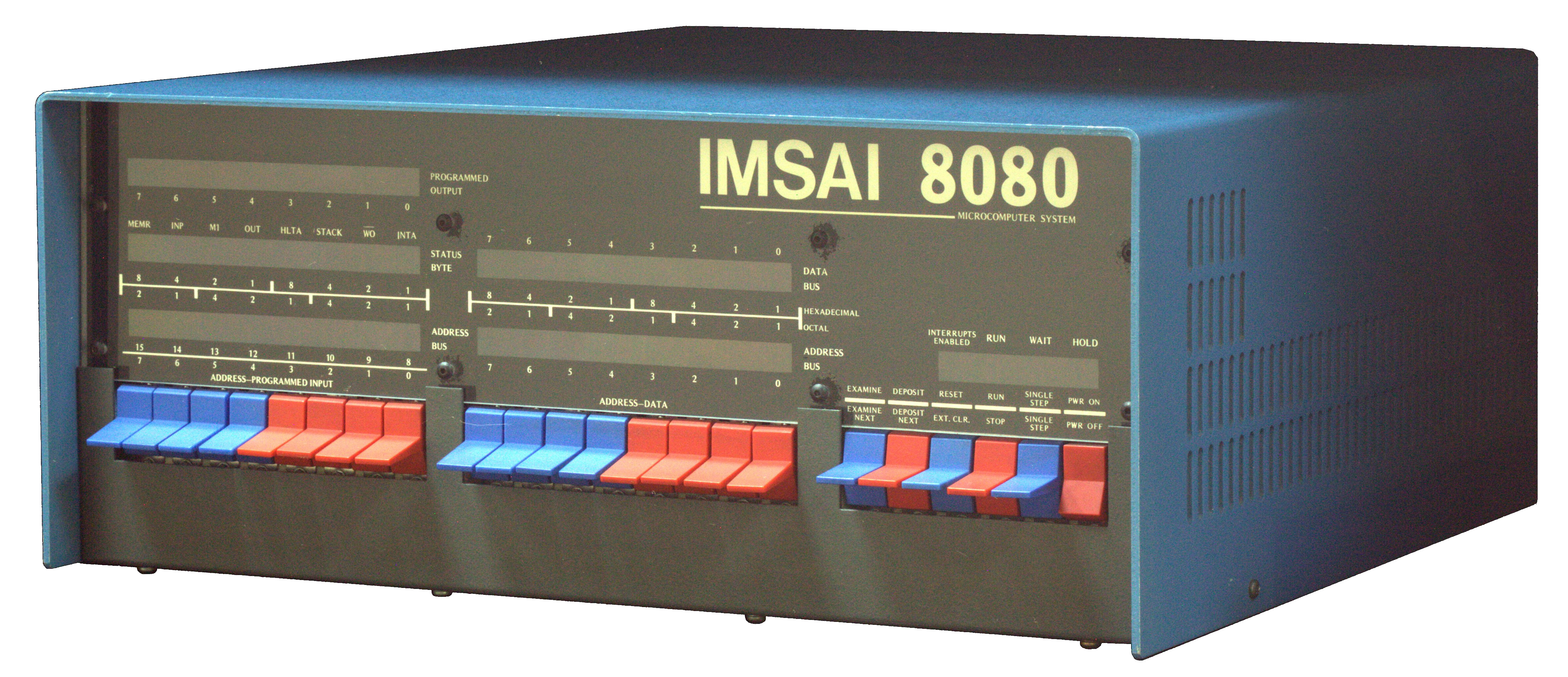
The business orientation showed in the software too. In 1977 IMSAI’s marketing director, Seymour Rubinstein — later the founder of MicroPro and the force behind WordStar — paid Gary Kildall $25,000 for the right to bundle CP/M, Kildall’s disk operating system, which IMSAI shipped as a rebadged version called IMDOS. This was a shrewd move that pointed at the future: CP/M would become the standard operating system of the entire 8080/Z80 business-computer world, and IMSAI’s early embrace of it helped make the S-100 machine a serious tool rather than a toy. The IMSAI did well by the standards of the moment, with somewhere between 17,000 and 20,000 units produced across its 1975–1978 run — a respectable showing against, and arguably exceeding, the Altair’s own numbers in the same window.
9.2.1 WarGames, and an unlikely immortality
The IMSAI 8080’s place in popular memory, however, owes almost nothing to its sales figures and almost everything to a single film. In the 1983 movie WarGames, the teenage hacker David Lightman — played by Matthew Broderick — sits in his Seattle bedroom and uses his home computer to dial out across phone lines, change his school grades, and ultimately stumble into the North American Aerospace Defense Command’s war-game supercomputer, WOPR, very nearly starting the Third World War. The machine on Lightman’s desk, prominent in scene after scene and on the film’s poster, is an IMSAI 8080. The archival film-appearance database Starring the Computer rates its importance to the picture at the maximum five stars: “the IMSAI is David’s home computer that he uses for his hacking activities.”
By 1983 the IMSAI was already an eight-year-old machine, obsolete and out of production, and its selection was partly happenstance and partly inspired: the prop department wanted something that read instantly as “hacker’s computer,” and the IMSAI’s wall of glowing paddle switches photographed beautifully. The production fitted it with an IMSAI IKB-1 intelligent keyboard, programmed so that a few keystrokes from Broderick would trigger an off-camera computer to drive the on-screen display — meaning the IMSAI you see is, strictly, a prop, not the machine generating the text. None of that mattered to the millions who saw the film. WarGames was the fifth-highest-grossing film in the United States in 1983, and it lodged the IMSAI 8080 in the cultural imagination as the home computer of the hacker — an immortality the engineers in San Leandro could never have predicted for a discontinued business machine. (The IMSAI’s own corporate fortunes had long since collapsed: IMSAI Manufacturing Corporation filed for bankruptcy in 1979, undone in part by an ill-judged all-in-one machine, the VDP, that could not stand against the new wave of Apple IIs, Commodore PETs, and TRS-80s. The brand outlived the company largely on celluloid.)
9.3 The wave: board houses and machine makers
The IMSAI proved that a better Altair could be built. The deeper story of the period is that the open bus invited not one competitor but a swarm — and that many of the swarm did not bother to clone the whole computer, because the bus let them sell a single board that slotted into the computers other people had already bought.
9.3.1 Processor Technology: the board that fixed the RAM, and the Sol-20
The clearest illustration is Processor Technology, founded in Berkeley in April 1975 by Bob Marsh and Gary Ingram — Marsh a Homebrew Computer Club regular who, in the club’s origin myth, shared a garage with Lee Felsenstein. The company’s first product struck directly at the Altair’s most notorious weakness. As established in Volume 6, the MITS 4K dynamic RAM board was the part of the Altair that did not work: a roughly $264 board whose dynamic memory, marginal design, and timing sensitivities made it unreliable enough to generate returns, lost sales, and a chorus of complaint. Dynamic RAM has to be constantly refreshed and was, in 1975, fussy to get right; MITS had not gotten it right.
Marsh designed a 4K static RAM board — static memory holds its contents without the refresh circuitry that was tripping up the MITS design, trading higher chip count and cost for plain dependability — made it plug-compatible with the Altair’s bus, and sold it for around $255, undercutting MITS on price while comprehensively beating it on reliability. This was a watershed. For the first time, an Altair owner could fix the worst thing about his Altair by buying a part from a different company, with no permission from MITS required, because the bus was open. The static-RAM board drew customers away from MITS in droves; it was, in a real sense, the opening shot of the S-100 wars, and it established the template every board house would follow — find the weak board, build a better one, drop it in the slot. (It was not a free lunch: the static board drew more current than the dynamic one it replaced, so two or three of them could tax an Altair’s thin power supply — exactly the deficiency the IMSAI’s heavier supply was built to cure. The competitors’ products reinforced one another.)
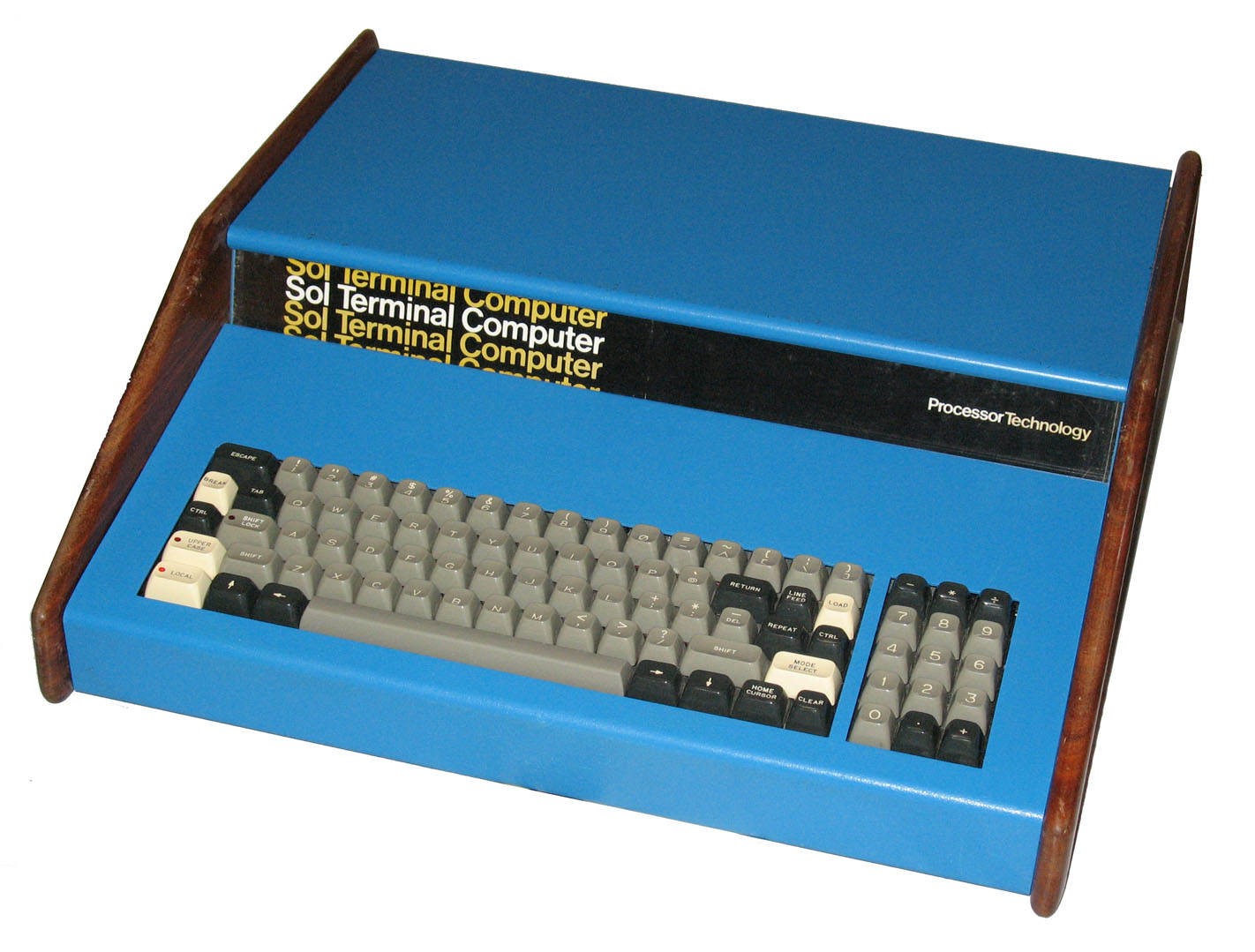
Processor Technology then climbed the value chain from boards to a whole machine. In 1976 it shipped the Sol-20, designed by Lee Felsenstein — the Homebrew Club’s moderator and one of the movement’s defining figures — as one of the first microcomputers conceived as an integrated product rather than a box of slots. Where the Altair and IMSAI presented the user with a front panel of switches and lamps and nothing else, the Sol-20 wrapped an S-100 machine in a case with a built-in keyboard, a built-in video driver that let you plug in an ordinary monitor, and distinctive walnut side panels. It looked, years ahead of its time, like a thing a person would put on a desk and use, not a thing a hobbyist would toggle. Launched on the cover of Popular Electronics in July 1976 and shipping that December, the Sol-20 sold on the order of 10,000 units before Processor Technology — having stumbled at developing a successor — ceased operations in May 1979. It is one of the great near-misses of the era: a machine that anticipated the appliance computer of 1977 and the company that failed to capitalise on having built it first.
9.3.2 Cromemco, North Star, Vector Graphic, and the rest
Processor Technology was one node in a dense and rapidly growing constellation. Cromemco — its name a contraction of Crothers Memorial, the Stanford dormitory where its founders had lived — was started by two Stanford physics doctoral students, Harry Garland and Roger Melen, who had also passed through the Homebrew orbit. Their early S-100 products were characteristically clever: the Cyclops, a digital camera, and the Dazzler, a colour-graphics interface that could put images on a television from an Altair-class machine — a startling capability in 1976. Cromemco went on to build some of the most robust S-100 machines of the era, the Z-80-based Z-1 and System Three among them, and earned a reputation for industrial-grade reliability that carried it well into the 1980s, long after most of its contemporaries had folded.
North Star Computers, founded in Berkeley in 1976 by Charles Grant and Mark Greenberg — a company that began, tellingly, partly as a dealer selling IMSAI machines — made its mark with the Micro Disk System, an S-100 floppy-disk controller and drive package that gave hobbyist machines fast, reliable mass storage at a moment when most owners were still wrestling with cassette tape. Affordable floppy storage was as transformative for the S-100 world as the static-RAM board had been, and North Star’s later integrated machine, the Horizon, became a workhorse of small-business computing. Vector Graphic, founded in 1976 in Southern California, followed the now-familiar arc — it began selling memory boards for S-100 systems and then, in 1977, brought out its own complete machine, the Vector 1, going on to build well-regarded business systems through the late 1970s.
The pattern across all of them is the same and is the whole point of the period. A company started by building one good board for the bus the Altair had opened. It found customers among the people who already owned Altairs and IMSAIs. It used the revenue and the reputation to climb toward building complete machines. And every one of those machines, by honouring the same hundred-pin standard, enlarged the common market rather than fragmenting it — a board sold by Processor Technology worked in a Cromemco, a disk system from North Star worked in an IMSAI, software written for one ran on all. The bus was the commons, and the commons grew.
9.4 The S-100 wars: how openness accelerated everything
It is worth being precise about why this arrangement drove the industry forward so fast, because the mechanism is the lasting lesson of the Altair’s bus.
An open, unowned standard turns a single product into a platform, and a platform behaves very differently from a product. Because no one owned the S-100 bus, no one could charge rent on it, gate access to it, or slow it down to protect a position. Any engineer with a better idea for a memory board, a disk controller, a serial interface, or a whole computer could build it, drop it into the existing installed base, and compete on the merits — on price, on reliability, on performance — without anyone’s permission. That is second-sourcing in its purest form: a customer was never captive to a single vendor for any part of the system, which meant every vendor was under permanent pressure to be better or cheaper than the alternative sitting one slot away.
The consequences compounded. Reliability improved because Processor Technology’s static RAM made MITS’s dynamic RAM untenable and forced everyone toward parts that actually worked. Price and performance improved because a dozen firms were racing on the same axis with interchangeable products. Compatibility improved because the market punished anyone who broke from the de-facto standard and rewarded anyone who extended it cleanly — so much so that the informal MITS pinout was eventually written up and ratified as a formal industry standard, the IEEE-696 bus, codifying in the early 1980s what the hobbyist market had been enforcing by consensus since 1975. The “S-100 wars” was the contemporary nickname for this scramble, and the word wars is apt for the competitive ferocity, but the deeper truth is that the combatants were collectively building something none of them could have built alone: a fast-moving, multi-vendor, mutually-compatible industry, growing far quicker than any one company’s roadmap. The customer was the winner. The one clear loser was the company that had started it all and tried, too late, to behave like a monopolist on a commons it did not own.
9.5 The decline and sale of MITS
MITS, for its part, did not so much lose the S-100 wars as get swallowed by the dynamics it had unleashed. The company that had created the market found itself, within two years, outcompeted on its own architecture from every direction.
Several pressures converged. On the hardware side, MITS’s reputation never recovered from the flaky RAM board and the strained power supply, and the IMSAI and the board houses offered better-engineered alternatives for the same money. On the software side, the friction recounted in Volume 7 did real damage: the licensing dispute over Altair BASIC — Bill Gates’s furious 1976 “Open Letter to Hobbyists” denouncing the rampant copying of the tape, the awkward fact that MITS controlled the only good language for its own machine and charged dearly for it, and the eventual legal fight over whether MITS or Micro-Soft held the rights to license that BASIC to others — alienated the hobbyist base and entangled the company at exactly the moment it needed to be moving fast. MITS had tried, with its “Altair BASIC is free with a memory board” bundling, to use software to sell its weakest hardware; the strategy backfired when the software escaped onto duplicated paper tapes and the hardware lost to the competition anyway.
By late 1976 Ed Roberts was tired, the company was beleaguered, and a buyer appeared. Pertec Computer Corporation — a California maker of disk and tape drives for minicomputers and mainframes, a company that wanted a foothold in the booming microcomputer market and the established Altair brand to plant it with — signed a letter of intent on December 3, 1976, and the sale closed in May 1977 for roughly $6 million in Pertec stock. Ed Roberts’s personal share is reported at something on the order of two to three million dollars; the remaining MITS shareholders, including Altair co-designer Bill Yates, divided the balance. Pertec absorbed the Altair line, and — in a final irony — largely smothered it: the brand that had launched the personal computer faded under corporate ownership within a couple of years, while the rivals it had spawned thrived on the open bus it had created.
Ed Roberts’s own exit is the period’s most human note. The man whom many credit as the father of the personal computer — the engineer who, with the Altair, had put a real computer in the hands of ordinary people and lit the fuse on an entire industry — took his proceeds, walked away from microcomputers, and went home to Georgia. He bought a farm, and then, in his forties, enrolled in medical school. He became a physician, practising as a small-town country doctor in Cochran, Georgia, for the rest of his working life. He had handed the world a machine and, having done so, left the field to the swarm of competitors his openness had summoned — content to let others fight the S-100 wars while he tended patients in rural Georgia. He died in 2010, with Bill Gates and Paul Allen at his bedside, eulogized by the men whose first company had been built writing BASIC for the machine he made.
That is the shape of the paradox this volume set out to trace. The Altair’s openness was its genius and its undoing in the same gesture. By giving the bus away, MITS created the conditions for a real industry — for IMSAI’s reliability, Processor Technology’s RAM and the Sol-20, Cromemco’s robustness, North Star’s disks, and the dozens of firms that filled in the rest. And by giving the bus away, MITS guaranteed it could not keep the industry to itself. The personal-computer business that exploded out of this churn — the integrated, mass-market machines of 1977 and after — is the subject of Volume 10. It was built on the commons the Altair opened, by the competitors who learned, in the S-100 wars, how to out-build the machine that started everything.
Sources
- Wikipedia, “IMSAI 8080.” Primary source for the IMSAI’s origins (IMS Associates, founded by William Millard as a consulting firm; “Information Management Sciences”), its first shipment in December 1975, the October 1975 Popular Electronics advertisement and the “$439 kit, $621 assembled” pricing, its status as the first “clone” microcomputer on the Intel 8080 and S-100 bus, Seymour Rubinstein’s 1977 purchase of CP/M rights from Gary Kildall for $25,000 (shipped as IMDOS), the 17,000–20,000 units produced 1975–1978, and the 1979 bankruptcy of IMSAI Manufacturing after the VDP failed against the TRS-80, PET, and Apple II. https://en.wikipedia.org/wiki/IMSAI_8080
- Wikipedia, “IMS Associates, Inc.” Corroborates Millard’s founding of the company and the firm’s consulting-to-hardware trajectory, and the San Leandro / Bay Area location. https://en.wikipedia.org/wiki/IMS_Associates,_Inc.
- retrocmp (retro computing), “IMSAI 8080 History” and “IMSAI 8080 Front Panel.” Source for the engineering refinements over the Altair — the heavy-duty power supply (rated ~20–30 A at the +8 V rail with ±18 V rails), the heavier steel chassis, and the distinctive front panel of large, nibble-grouped, red-and-blue paddle switches with masked LEDs that make the IMSAI instantly recognisable. https://www.retrocmp.de/imsai/imsai_p02_history.htm · https://retrocmp.de/imsai/imsai_p03_cpa.htm
- Starring the Computer, “IMSAI 8080 in WarGames (1983).” Confirms the IMSAI 8080 as David Lightman’s home computer in the film, rated five stars (maximum) for importance to the picture, used for his dial-out hacking. https://starringthecomputer.com/appearance.html?f=10&c=10
- Wikipedia, “WarGames.” Confirms the plot (David Lightman / Matthew Broderick uses his home computer and modem to access the school’s system and WOPR), the IMSAI’s prominence including the poster, and the film’s commercial success (fifth-highest-grossing U.S. film of 1983, ~$79.6 M domestic). Used together with the CIO and Original Prop Blog reporting that the on-screen IMSAI was driven via a programmed IKB-1 keyboard with the actual display generated off-camera — i.e., the IMSAI was a working prop, not the display source. https://en.wikipedia.org/wiki/WarGames
- Wikipedia, “Processor Technology.” Source for the founding (Bob Marsh and Gary Ingram, Berkeley, April 1975), the 4KRA 4K static RAM board offered as a more reliable alternative to the MITS dynamic RAM board, the Sol-20 (designed with Lee Felsenstein, integrated keyboard and built-in video driver, Popular Electronics cover July 1976, first shipments December 1976), the ~10,000 Sol-20 units, and the company’s closure in May 1979. https://en.wikipedia.org/wiki/Processor_Technology
- S100Computers.com, “MITS 4K Dynamic RAM Board” and “MITS 4K Static RAM Board.” Documents the unreliability of the ~$264 MITS dynamic RAM board (design and component problems causing returns, lost sales, and an opening for competitors), Robert Marsh’s plug-compatible 4K static board at $255, and the caveat that the static board drew more current than the dynamic one — taxing the Altair’s power supply when several were installed. https://www.s100computers.com/Hardware%20Folder/MITS/4K%20Dynamic%20RAM/4K%20DRAM.htm · http://www.s100computers.com/Hardware%20Folder/MITS/4K%20Static%20RAM/4K%20SRAM.htm
- Wikipedia, “Cromemco.” Source for the founders (Harry Garland and Roger Melen, Stanford), the name’s origin (Crothers Memorial dormitory), incorporation in 1976, and the early Cyclops digital camera and Dazzler colour-graphics S-100 products. https://en.wikipedia.org/wiki/Cromemco
- The History of Personal Computing and Wikipedia, “S-100 bus.” Background on North Star Computers (founded 1976 by Charles Grant and Mark Greenberg in Berkeley, beginning partly as an IMSAI dealer, known for the Micro Disk System floppy package and later the Horizon) and Vector Graphic (founded 1976, started with S-100 memory boards, brought out the Vector 1 in 1977), and the later formalisation of the MITS bus as the IEEE-696 standard. http://historyofpersonalcomputing.com/category/s-100/ · https://en.wikipedia.org/wiki/S-100_bus
- “MITS - Altair company is sold to Pertec (May 1977),” Old and New Computer (history blog), with Wikipedia, “Ed Roberts (computer engineer)” and “Micro Instrumentation and Telemetry Systems.” Source for the Pertec acquisition: letter of intent December 3, 1976; sale closing May 1977 for roughly $6 million in stock; Ed Roberts’s personal share of ~$2–3 million and the distribution to other MITS shareholders including Bill Yates; Pertec’s absorption and subsequent fading of the Altair line; and Roberts’s departure from the industry to farm, attend medical school, and practise as a country physician in Cochran, Georgia, until his death in 2010 (Gates and Allen at his bedside). https://oldandnewcomputer.blogspot.com/2009/12/mits-altair-company-is-sold-to-pertec.html · https://en.wikipedia.org/wiki/Ed_Roberts_(computer_engineer)
- Fire in the Valley: The Making of the Personal Computer (Freiberger & Swaine) and the Computer History Museum’s coverage of IMS Associates / IMSAI. General narrative backbone for the period — the Homebrew Computer Club origins of many S-100 founders, the competitive dynamics of the “S-100 wars,” and MITS’s decline relative to its better-engineered rivals — against which the specific claims above were checked. https://www.computerhistory.org/brochures/g-i/com-42bc1d195cbb3/
Comments (0)