Altair 8800 · Volume 3
Altair 8800 — Volume 3 — MITS, Ed Roberts & Popular Electronics, January 1975
How a bankrupt calculator company in the New Mexico desert, a determined Air Force engineer, and a single magazine cover lit the fuse of the personal-computer age.
3.1 About This Volume
Volume 2 ended with a chip — the Intel 8080, finally fast enough, roomy enough, and cheap enough in quantity to anchor a computer a private person could own. But a chip is not a company, and a capability is not a product. Someone had to decide to build the machine, scrape together the money to do it, talk a national magazine into putting it on a cover, and gamble that an audience existed for a thing no one had ever successfully sold. That someone was Ed Roberts, and the company was MITS, and the gamble very nearly did not happen at all — because by the time Roberts placed his bet, MITS was a failing business buried in debt, weeks from going under.
This is the human volume of the series. Where Volume 2 followed silicon and Volume 1 sketched the whole machine, this one follows people and a moment: a small Albuquerque firm that began life making electronics for model rockets, a man who bet that failing firm on an idea most of his peers thought fanciful, an editor at Popular Electronics who was hunting for exactly such an idea, and the January 1975 cover that connected all of it to a hobbyist nation primed to buy. It is a story rich in the kind of detail that hardens into legend — a lost prototype, an empty box photographed as a triumph, a name supposedly plucked from a Star Trek episode — and part of the job here is to tell those stories while marking carefully where the documented record ends and the folklore begins.
We will move in order: MITS before the Altair and the calculator catastrophe that drove it to the brink; Ed Roberts himself, and the unlikely shape of his life; the deal with Popular Electronics and the famous mishap behind the cover; the name and the machine as it was announced to the world; and finally the deluge of orders that proved, beyond any further argument, that a market for personal computers had been there all along, waiting.
3.2 MITS before the Altair
The company that would launch the personal computer did not set out to build computers, or anything like them. It set out to instrument model rockets.
Micro Instrumentation and Telemetry Systems — the grand name was, from the start, larger than the enterprise — was founded in December 1969 in Albuquerque, New Mexico, by Ed Roberts together with three partners: Forrest Mims, Stan Cagle, and Robert Zaller. All four were connected, one way or another, to the Air Force’s presence in Albuquerque, and the founding idea came largely from Mims, an electronics writer and hobbyist who had built a transistorized tracking light to follow night-launched model rockets during his service in Vietnam. The article that grew out of that work appeared in a model-rocketry magazine in 1969, and the demand it hinted at suggested a business. MITS, run at first out of Roberts’s garage, would sell miniaturized telemetry modules and radio transmitters for model rockets — a roll-rate sensor, a tracking transmitter, the small specialist electronics a serious rocketry hobbyist might want and could not easily build.
It was a tiny market, and MITS made a tiny living from it. The hobby-rocketry electronics did not scale into a real company, and within a couple of years Roberts — who had bought out his partners and taken the helm — went looking for a product with broader appeal. He found it in the device that was, at that moment, the most exciting thing in consumer electronics: the electronic calculator. In 1971 MITS pivoted into calculator kits, and the timing initially looked inspired. The MITS 816, a desktop calculator sold as a kit the hobbyist assembled himself, landed on the cover of Popular Electronics in November 1971 — the company’s first taste of what a magazine cover could do for a small mail-order outfit, and a rehearsal, though no one knew it yet, for the far more consequential cover three years later. For a while, calculators were good business. MITS grew, hired, moved out of the garage, and built a real operation selling calculator kits and assembled units to the booming hobbyist and small-office market.
Then the bottom fell out — and it fell out for a reason that is central to this whole story, because it is the same economic force, running in the opposite direction, that would soon make the Altair possible. The calculator price war of the early 1970s was a textbook case of integration crushing cost. As the big semiconductor firms learned to put a calculator’s entire logic onto a single cheap chip, the price of a finished calculator collapsed. Texas Instruments, which made the chips and then decided to sell the finished product too, undercut everyone. By January 1974, Roberts was offering an eight-function calculator kit for $99.95 while TI was selling a comparable, fully assembled calculator for less than half that. The logic of a kit — save money by soldering it yourself — evaporates entirely when the finished article costs less than the bag of parts. MITS’s calculator business did not so much decline as implode. The company had to shut the calculator operation down, and Roberts found himself running a firm that owed its creditors something on the order of $300,000 and had no product left to earn the money to pay them back.
This is the situation that matters. The Altair was not born in a flush of confident innovation; it was born in desperation, in a nearly bankrupt company looking for one last product audacious enough to save it. By the late summer of 1974 Roberts was, by his own later account, out of money and out of options — preparing to walk into his bank to ask for yet another loan he fully expected to be refused. A more cautious man, or a man with anything left to protect, would have folded. Roberts decided instead to bet everything on the least cautious idea available.
3.3 Ed Roberts
Henry Edward “Ed” Roberts (born 13 September 1941, died 1 April 2010) is one of those figures who is simultaneously famous and forgotten — central to a revolution that quickly moved on without him, and content, in the end, to let it. He is the man most often given the title “father of the personal computer,” a claim worth stating plainly and then handling with a little care: it is a frequently made and defensible attribution rather than an undisputed fact, since the personal computer had many parents and the honour is shared, in various tellings, with others. But if any single person built the first commercially successful machine that an individual could buy and own, it was Roberts, and the phrase has stuck to him for good reason.
Roberts was a large man with a large manner — an Air Force engineer by training, expansive, stubborn, and given to grand ambitions that his finances could not always support. He had come to Albuquerque through the military, worked in laser electronics at the Air Force Weapons Laboratory, and run MITS on the side and then full-time through its rocketry-and-calculator years. Those who knew him describe a forceful, opinionated personality, a natural salesman’s optimism welded to a real engineer’s competence. It was a combination well suited to the moment that found him: the Altair required someone who could both design a workable machine and believe, against the evident skepticism of nearly everyone around him, that hobbyists in their thousands would pay real money for a bare computer kit they would have to assemble and then figure out how to use.
That belief is the heart of the matter. The conventional wisdom of 1974 held that there was no market for a personal computer — that computers were institutional tools, that no individual had any use for one at home, that the hobbyist who wanted to compute could not afford it and the person who could afford it had no reason to want it. Roberts simply did not accept this. He bet the failing company, and what remained of his own credit and reputation, on the contrary proposition: that a real, affordable, general-purpose computer kit would find an audience that had been there all along, latent and unserved. He was right, more spectacularly than even he had imagined — and the proof, when it came, arrived as sacks of mail.
The coda to his life is one of the most striking in the history of the industry, and it is worth a brief telling precisely because it is so unexpected. Having ignited personal computing, Roberts did not ride it. He sold MITS in 1977, walked away from the business he had created, and retired to rural Georgia, where he farmed for a time and then did something almost no one in his position has ever done: he went back to school and became a medical doctor. He graduated from medical school in 1986, completed a residency in internal medicine, and from 1988 practiced as a small-town physician in Cochran, Georgia, where he remained until his death from pneumonia in 2010, at the age of 68. The man who put the first computer on the kitchen table spent the second half of his life as a country doctor making house calls — a biographical arc so improbable it would strain a novel.
3.4 The deal with Popular Electronics
A cheap computer kit from an unknown desert company could easily have died unseen. What carried the Altair into history was a magazine, and a relationship between two men who each needed exactly what the other had.
Les Solomon was the technical editor of Popular Electronics, the leading American hobbyist-electronics magazine of its day — the publication whose covers could, as the MITS calculator had already shown, make or break a small mail-order product. Solomon had watched the early stirrings of microcomputing with interest and wanted a computer project to feature: an ambitious, build-it-yourself machine of the kind that would excite his readers and keep Popular Electronics ahead of its rival, Radio-Electronics, which had run computer-related projects of its own. He was, in short, shopping for precisely the gamble Roberts was desperate to make. The two connected, and Solomon offered Roberts the thing that could legitimize the whole venture: a cover story. His conditions were straightforward and shrewd — the machine had to be genuinely powerful, it had to look like a real, professional piece of equipment rather than a hobbyist’s lash-up, and it had to sell for under $500. Those constraints shaped the Altair as much as the 8080 inside it did.
Roberts and his collaborator William “Bill” Yates designed and built the machine to meet them, and finished the first working prototype in October 1974. And here the story arrives at its most famous, and most retold, episode — one that is well attested in the historical accounts but has been polished by repetition into something close to legend, so it is worth telling as the consensus story while flagging that the fine details rest largely on the participants’ own later recollections. The single working prototype was crated up and shipped from Albuquerque to the magazine’s offices in New York via the Railway Express Agency — and it never arrived. A shipping strike (the accounts variously describe a strike or a loss in transit) swallowed the only finished Altair in existence somewhere between New Mexico and New York. Roberts later said the lost prototype actually resurfaced a month or two after the article appeared; but at the moment it was needed, the star of the cover story had simply vanished.
The fix is the detail everyone remembers. With no machine to photograph and a cover deadline bearing down, the team improvised. Yates, by the usual telling, assembled an empty mock-up — a case fitted with the front panel’s toggle switches and lamps and just enough rudimentary circuitry to make the lights blink, but with nothing of substance behind them. That hollow shell, dressed to look like a finished computer, is what appears on the photographs. The most important magazine cover in the history of personal computing thus shows a box that was not a working computer at all — an empty case standing in for a machine lost in shipping. It is a wonderful story and the sources agree on its shape; treat the specifics, as ever with such well-worn anecdotes, as the participants’ recollection rather than documented certainty. What is not in doubt is the effect.
3.5 The name and the machine announced
Before the world could order the machine it needed a name, and the question of where the name “Altair” came from has generated one of the most charming small controversies in computing folklore. Both of the competing stories trace the name to the magazine’s New York offices rather than to MITS, and both should be held as legend — affectionately repeated, plausibly true, but resting on memory rather than record.
The first and most beloved version credits Les Solomon’s twelve-year-old daughter, Lauren. As the story goes, Solomon asked her what to call the new computer, and she — watching Star Trek — replied that the Enterprise was going to Altair that night, and the name should be that. (The episode is usually identified as one in which the starship sets course for the Altair system.) The second version is more prosaic and concerns the editors themselves: the machine was at first to be called the dull “PE-8,” for Popular Electronics, 8-bit; Solomon disliked it, and he and his fellow editors decided that since this was “a stellar event,” they would name it after a star — settling, by this account, on Altair, one of the brightest stars in the sky. Both stories may even be true in part; both may be later embellishments. The honest position is that the name came from the Popular Electronics side, that a star called Altair is the source, and that the picturesque Star Trek detail is a cherished legend that cannot be fully verified.
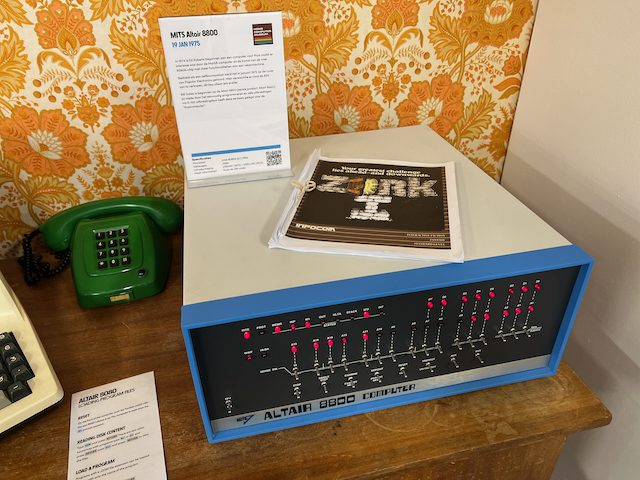
The machine that the January 1975 issue announced to the world was, in its essentials, exactly the one sketched in Volume 1 and built around the chip of Volume 2. At its heart was the Intel 8080 microprocessor — the new, capable, single-chip processor that made the whole proposition arithmetically possible. It was offered by mail order as a kit for $397 — comfortably under Solomon’s $500 ceiling — or fully assembled for around $498. The bare machine came with just 256 bytes of memory, no keyboard, no display, and no storage; its entire interface was the front panel, a bank of toggle switches for entering instructions and data in binary and a bank of red lamps for reading the machine’s state back out. Internally it was organized around a passive backplane of expansion slots — the open bus, soon standardized as the S-100, into which owners could later plug the memory and interface boards the bare kit so obviously needed. The article inside, written up with Roberts and Yates, walked readers through this astonishing thing: not a toy, not a calculator, but a genuine, general-purpose, stored-program computer they could build at home for the price of a good colour television. The pitch was audacious precisely because it was sincere — this is a real computer, and it can be yours.
3.6 The deluge, and what it proved
Roberts had run the numbers the way a man on the edge of bankruptcy runs them: carefully, and with no room for optimism. To climb out from under the company’s debts, he reckoned he needed to sell on the order of a few hundred machines over the coming year — roughly two hundred to break even, perhaps eight hundred if everything broke his way, a figure he is said to have offered his banker as a wild best case. The bank, by most accounts, was unconvinced that anyone would buy a bare computer kit at all. So was much of the industry. The conventional wisdom held firm right up to the moment it shattered.
What actually happened when the January issue reached subscribers is the hinge of the entire story. The orders did not trickle; they flooded. Within weeks MITS was overwhelmed — buried in mail, its phones ringing without pause, the tiny Albuquerque company scrambling to hire extra hands just to open envelopes and answer calls. And these were not idle inquiries: people were mailing cheques, hundreds of dollars at a time, to an unknown firm in New Mexico, to buy a machine they had never seen, in kit form, sight unseen, on the strength of a single magazine article. MITS took in on the order of a thousand orders in the first month and claimed to have shipped something like 2,500 machines within a few months of the announcement. A company that had hoped to sell two hundred units in a year to survive instead found itself sitting on thousands of orders and hundreds of thousands of dollars in incoming cheques, unable to manufacture fast enough to keep up. The desperation gamble had not merely paid off; it had detonated.
The significance ran far beyond MITS’s rescued balance sheet. The deluge proved a proposition that almost no one had believed: that a large, latent, pent-up demand for personal computers existed and had simply never been offered anything to buy. Every assumption of 1974 — that computers were institutional, that individuals had no use for them, that the hobbyist market was too small and too poor to matter — was overturned in a single month by the plain evidence of the mail. The people were there. They had been there all along. They had only been waiting for a machine they could afford, and the moment one appeared, they emptied their wallets for it. That revelation, more than any feature of the Altair’s modest hardware, is what makes January 1975 the conventional birth-month of the personal computer.
It also set in motion everything this series turns to next. The thousands of buyers needed memory their 256-byte machines did not have, ways to attach a Teletype, a real language to program in — and that hunger summoned an entire ecosystem to feed it. The open bus at the back of the cabinet would become the S-100 standard and a cottage industry of boards (Volume 6). Two young programmers reading that same cover would write Altair BASIC and found the company that became Microsoft (Volume 7). Hobbyists drawn together by the machine would form the Homebrew Computer Club (Volume 8), and the Altair’s open design would invite the clones and rivals of the S-100 wars (Volume 9). But all of it begins here, with the people and the moment: a bankrupt calculator company, a stubborn engineer who refused to believe the market did not exist, an editor who wanted a computer for his cover, an empty box photographed in New York, and a sack of cheques that proved a revolution had been waiting only to be invited. Volume 4 opens the cabinet to study how the 8080, the S-100 bus, and the front panel actually fit together — the architecture of the machine that all those cheques were buying.
Sources
- Wikipedia, “Micro Instrumentation and Telemetry Systems.” Confirms the December 1969 founding in Albuquerque by Ed Roberts with Forrest Mims, Stan Cagle, and Robert Zaller; the model-rocketry telemetry origin (roll-rate sensor, tracking transmitter) and Mims’s Vietnam tracking-light article; the 1971 pivot to calculators; the MITS 816 calculator kit on the November 1971 Popular Electronics cover; and the calculator price war that forced MITS to close its calculator operation. https://en.wikipedia.org/wiki/Micro_Instrumentation_and_Telemetry_Systems
- Wikipedia, “Ed Roberts (computer engineer).” Confirms Henry Edward Roberts (13 September 1941 – 1 April 2010); his Air Force engineering background; the “father of the personal computer” attribution; the development of the Altair 8800 around the Intel 8080; the $397 kit and the flood of orders; his sale of MITS in 1977; his retirement to Georgia, medical-school graduation in 1986, internal-medicine residency, and practice as a physician in Cochran, Georgia from 1988 until his death from pneumonia in 2010. https://en.wikipedia.org/wiki/Ed_Roberts_(computer_engineer)
- Wikipedia, “Altair 8800.” Confirms the January 1975 Popular Electronics cover; Les Solomon’s role and his conditions (powerful, professional case, under $500); the Roberts/Bill Yates prototype finished October 1974 and lost when shipped via the Railway Express Agency during a strike; the empty-box mock-up used for the cover; both name-origin legends (Solomon’s daughter Lauren and Star Trek; and the PE-8 / “name it after a star” account); the $397 kit / ~$498 assembled prices; 256 bytes of RAM; and the deluge of orders. https://en.wikipedia.org/wiki/Altair_8800
- Computer History Museum, “Altair 8800 on cover of Popular Electronics.” Corroborates the January 1975 cover and the demand it generated, and the Altair’s standing as the spark of the personal-computer era. https://www.computerhistory.org/collections/catalog/102652186
- Adwater & Stir, “Altair History.” Background on MITS, Ed Roberts, the calculator-business collapse, the ~$300,000 debt and the desperate bank visit of September 1974, the lost-prototype story, and the empty-case cover photo. (Also the maker of the Altair-Duino replica that is the subject of Volume 14.) https://adwaterandstir.com/altair-history/
- The Den (Mercer University School of Medicine), “Event honoring Dr. Henry Edward ‘Ed’ Roberts (1941–2010).” Confirms Roberts’s later life as a physician in Georgia and the dates of his life. https://den.mercer.edu/edroberts/
- Datamath Calculator Museum, “Calculator War,” and Michael Swaine, “The Calculator Wars” (The Pragmatic Programmers). Confirm Texas Instruments’ entry into the finished-calculator market in the early 1970s and the price collapse that gutted kit makers such as MITS — the ~$99.95 MITS kit undercut by a sub-$50 assembled TI unit. http://www.datamath.org/Story/Calculator-War.htm · https://medium.com/pragmatic-programmers/the-calculator-wars-66bdf4cbab3d
- Forrest M. Mims III, “The Altair story; the computer that started a revolution” (and Mims’s accounts in Computers & Electronics), as summarized in the above sources, for the founding of MITS and its rocketry-telemetry beginnings. (Mims was a MITS co-founder and primary first-hand source for the company’s early history.)
- Figure: “HomeComputerMuseum - MITS Altair 8800” by Sandra Fauconnier, via Wikimedia Commons, licensed CC BY 4.0. https://commons.wikimedia.org/wiki/File:HomeComputerMuseum_-_MITS_Altair_8800.jpg

Comments (0)