Altair 8800 · Volume 10
Altair 8800 — Volume 10 — The PC Revolution It Sparked
How a blue box of switches and lamps, built to break even at two hundred sales, set the template every personal computer that followed would inherit.
10.1 About This Volume
For nine volumes we have stayed close to one machine. We have traced the silicon at its heart — the Intel 8080 that made a computer-on-a-bench thinkable at all (Volume 2). We have stood at its front panel and toggled programs in by hand, one octal byte at a time (Volume 5). We watched a pair of young programmers in Albuquerque write the language that turned that toggling-and-lamps machine into one a person could converse with — Altair BASIC, and the company, Micro-Soft, that grew up around it (Volume 7). We followed the Homebrew Computer Club, the Bay Area room where an Altair was passed hand to hand and where a young Steve Wozniak, having seen one, went home and designed a machine of his own (Volume 8). And we surveyed the industry the Altair created almost by accident — the IMSAI, the Processor Technology boards, the whole S-100 ecosystem of clones and cards that grew up around the bus MITS had stumbled into (Volume 9).
This volume gathers those threads and asks the largest question the series can ask: what did it all lead to? The chip, the language, the club, the bus, the competitors — every one of those strands runs forward out of 1975 and converges, within two years, on something genuinely new in the world: a consumer personal computer, sold assembled, in a store, to ordinary people who had never held a soldering iron and never would. This is the “what came next” volume. It is about the through-line from a kit that hobbyists soldered together in 1975 to the three pre-built machines of 1977 that put computing into bedrooms and classrooms and small-business back offices; about the architectural template the Altair set, which those machines and a thousand after them simply inherited; about the Altair’s settled place in the canon as the spark; and about the road from there to the IBM PC of 1981 and the mass market that swallowed the whole industry whole. The Altair did not look like the future. It had no keyboard, no screen, no software, and a name borrowed from a Star Trek episode. But it carried, in embryo, nearly every idea the personal computer would be built on — and once people saw what it implied, there was no putting the genie back.
10.2 The spark
There is remarkable consensus, among historians who agree on little else, about the Altair’s role. It is, in the standard phrase, the spark — the machine that ignited the personal-computer industry. The Computer History Museum frames it exactly that way in its Revolution exhibit: the Altair 8800 is “the machine that inspired Bill Gates and Paul Allen to create Microsoft BASIC,” displayed at the head of the personal-computing story as the object from which the rest descends. Paul Freiberger and Michael Swaine’s Fire in the Valley — the foundational popular history of the period, and the book the film Pirates of Silicon Valley was drawn from — opens the microcomputer era with the Altair and the January 1975 Popular Electronics cover that announced it. Wikipedia’s summation is the one that has hardened into common knowledge: the Altair was the first commercially successful personal computer, “the spark that ignited the microcomputer revolution.”
What does it actually mean to call a machine a spark? Not that it was the first of its kind in every technical sense — there were earlier microprocessor-based machines, the French Micral and the Scelbi-8H among them, that have legitimate claims to priority. The Altair’s distinction is consequential rather than chronological: it was the first machine whose appearance visibly changed the behaviour of thousands of people. Ed Roberts, running the floundering calculator company MITS, had hoped to sell perhaps two hundred Altairs to clear his debts; within three months he was sitting on a backlog of around four thousand orders. That surge is the spark made measurable. It revealed, to everyone watching, that a latent demand existed which nobody had previously believed in — that out there in the country were thousands of people who wanted a computer of their own badly enough to mail a check to a company in New Mexico for a box of parts.
Trace what that single fact directly caused, and the claim of primacy becomes concrete rather than rhetorical. It caused Microsoft: Gates and Allen saw the Popular Electronics cover, cold-called Roberts claiming to have a BASIC for the 8080, and then wrote one — the founding product of what would become the most valuable software company on earth (Volume 7). It caused the S-100 industry: because Roberts, to save money, had wired the Altair’s internals to a passive backplane of identical hundred-pin slots, he inadvertently published an open bus, and a swarm of companies — IMSAI, Processor Technology, Cromemco, dozens more — rushed in to build the memory boards, the I/O cards, and eventually the whole clone computers that the bare Altair so plainly needed (Volume 9). And it caused the hobbyist-to-consumer transition that is this volume’s subject: the Homebrew Computer Club and its dozens of imitators formed because the Altair gave the scattered electronics hobbyists of the mid-1970s a common object to gather around, and out of those clubs walked the founders — Wozniak first among them — of the companies that would build the consumer machines of 1977. The Altair did not do these things itself. It set them in motion, and that is exactly what a spark does.
10.3 The template
The deeper reason the Altair mattered is not the orders it took or even the companies it spawned, but the architecture it normalized. Strip away the front panel and the blue steel and what the Altair proposed was a particular shape for a personal computer — a shape so well-suited to the problem that it became the default, and stayed the default, for the better part of a decade. Four ideas make up that template, and it is worth naming each, because every one of them reappears, almost unaltered, in the machines that followed.
A microprocessor as the CPU. The Altair was built around a single-chip processor, the Intel 8080, rather than a backplane of discrete logic or a minicomputer’s board-level CPU. This sounds obvious only because the Altair won; in 1974 it was a real choice, and it was the choice that made a personal computer economically possible. A microprocessor put the entire central processor onto one inexpensive part, and once that part existed the cost of a computer collapsed from a minicomputer’s thousands of dollars toward a hobbyist’s hundreds. Every machine in this volume — the Apple II on a 6502, the PET on a 6502, the TRS-80 on a Zilog Z80 (itself a superset of the Altair’s 8080) — is a single-microprocessor computer. The Altair established that a personal computer is built around a CPU chip, and the only argument afterward was about which chip.
An expansion bus. The Altair’s passive backplane — the bus later christened S-100 — meant the machine was not a fixed appliance but a frame into which capability could be plugged. You bought the chassis and the CPU card; you added memory boards, a serial card for a Teletype, a cassette interface, later a floppy controller, each on its own card sliding into an identical slot. This idea — that a personal computer is an expandable thing with internal slots for cards — is perhaps the Altair’s most durable single contribution. Wozniak fought hard to give the Apple II eight expansion slots over Steve Jobs’s objection that an appliance should be sealed, and history vindicated Woz: the slots are what let the Apple II grow into a serious machine. The IBM PC of 1981 would be built on the same conviction, its own bus of card slots descending in spirit straight from the S-100 backplane Ed Roberts wired up to save a few dollars. The Altair taught the industry that a personal computer should be open at the edges.
Expandability and peripherals. Bound up with the bus, but worth stating separately, is the idea that the computer is the hub of a growing system of attached devices — a keyboard, a display, mass storage, a printer. The bare Altair had none of these, which is precisely why it taught the lesson so forcefully (Volume 5): the howling, obvious need for a way to talk to the machine pulled an entire peripheral ecosystem into existence within a year. The pattern it set — buy the computer, then add the things that make it useful — is the pattern of personal computing ever since.
A BASIC in ROM. The fourth pillar took the Altair itself a little while to fully express, but it is the one that mattered most for the consumer transition. Altair BASIC arrived in 1975 on paper tape, loaded laboriously into RAM (Volume 7). But the idea it embodied — that the way an ordinary person commands a personal computer is by writing BASIC — proved so powerful that the obvious next move was to bake the language permanently into the machine, in read-only memory, so that the computer came up speaking BASIC the instant you switched it on. Put a BASIC in ROM and the bare-machine predicament simply vanishes: no toggling a bootstrap, no loading a tape, just READY and a blinking cursor. This is the single change that turned the hobbyist computer into the consumer computer, and it is the through-line that connects Albuquerque to the trinity, because the BASIC that ended up in those ROMs was, overwhelmingly, Microsoft’s.
10.4 The 1977 trinity
In 1977 the template put on consumer clothes. Three machines appeared that year, all pre-assembled, all sold to be used rather than built, and they have been grouped ever since — the term comes from a 1995 Byte magazine retrospective — as the “1977 trinity.” They were the Commodore PET 2001, the Apple II, and the Tandy/Radio Shack TRS-80 Model I. Together they mark the hinge this whole volume turns on: the moment the personal computer stopped being a thing you soldered and became a thing you bought.
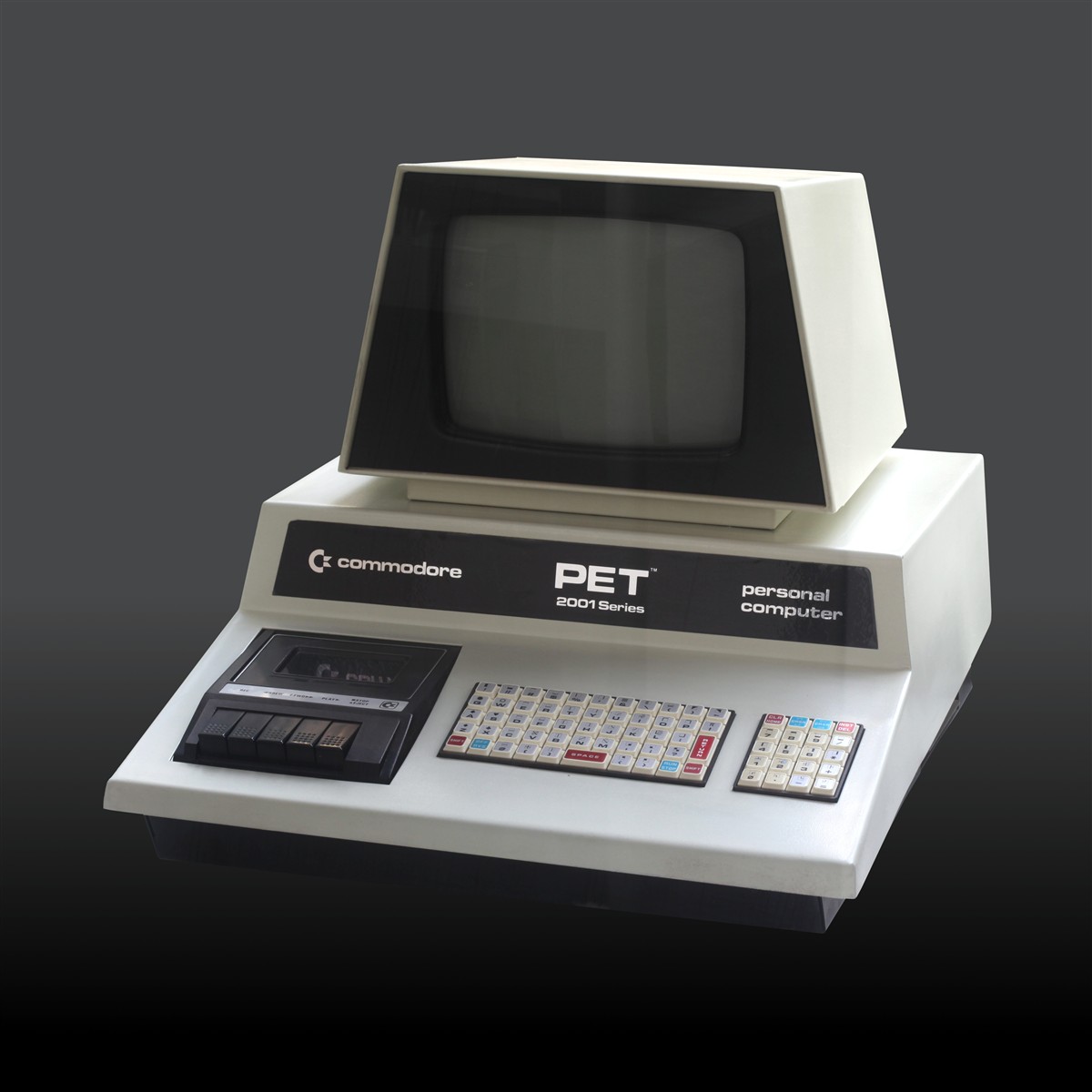
The Commodore PET came first, demonstrated at the January 1977 Consumer Electronics Show and billed as a computer for the masses. It was the purest expression of the appliance idea: a single sheet-metal wedge containing a 6502 processor, a built-in nine-inch monochrome monitor, a chiclet keyboard, and a cassette tape deck for storage, all in one sealed unit you carried home and switched on. There was nothing to assemble and nothing to wire. Where the Altair owner faced a wall of switches, the PET owner faced the word READY.
The Apple II followed in June, the machine that more than any other defined what a personal computer could feel like. Wozniak’s design (its lineage runs straight back to the Apple I he had shown off at Homebrew — Volume 8) gave it color graphics, sound, and the eight internal expansion slots that kept the Altair’s open-frame philosophy alive inside a friendly beige case. It was the most technically elegant of the three and, eventually, the most commercially enduring, carried for years by the spreadsheet VisiCalc into businesses its makers had never imagined.
The TRS-80 Model I arrived last, in August, and outsold both of the others at first by the simple expedient of being sold in thousands of Radio Shack stores across the country. Tandy expected to move a few hundred; it sold something like ten thousand in the first month and well over a hundred thousand within two years. For a great many Americans the TRS-80 was the first computer they ever saw in person, because it sat on a counter in a shop they already visited for batteries and CB radios.
Notice what all three have in common, and how exactly it maps onto the Altair’s template. Each is built around a single microprocessor. Each is expandable with peripherals — cassette and then floppy storage, printers, and in the Apple’s case internal cards. And each, crucially, boots straight into BASIC, the language resident so that an owner with no engineering background could type a program the day they brought the machine home. The trinity did not invent this shape. They inherited it from the Altair and finished it — taking the architecture the blue box had roughed out and wrapping it in a case an ordinary family could live with.
10.5 Microsoft BASIC, the near-universal tongue
The single thread that runs most visibly from the Altair through the entire trinity is the language. The BASIC that Gates and Allen wrote for the Altair in 1975 did not stay on the Altair. Microsoft’s whole business model, in those first years, was licensing that interpreter to everyone who built a machine — and very nearly everyone who built a machine took the deal. The result is one of the most consequential standardizations in computing history: across machines from rival companies, built on different processors, sold in different stores, the language an owner actually typed in was, again and again, Microsoft BASIC.
The story on each trinity machine repays a moment’s precision, because the popular shorthand — “they all ran Microsoft BASIC” — is true in the end but tidier than the history. The Commodore PET is the clean case: Commodore licensed Microsoft’s 6502 BASIC and shipped it in ROM from the start. The licensing deal itself became legendary — Commodore’s Jack Tramiel reportedly paid Microsoft a flat fee of around $25,000 for an unlimited license rather than a per-unit royalty, a bargain that would look, in retrospect, like one of the great mispricings of the era as millions of Commodore machines went out the door carrying that code. The Apple II is the layered case: it actually shipped in 1977 with Wozniak’s own Integer BASIC in ROM, but Apple soon licensed Microsoft’s more capable floating-point BASIC and shipped it as Applesoft — a name literally fusing Apple and Microsoft — first on cassette in 1977–78 and then in the ROM of the Apple II Plus. The TRS-80 is the staged case: it launched with a small Level I BASIC that Tandy’s Steve Leininger adapted from the public-domain Palo Alto Tiny BASIC, then offered, from 1978, a far more powerful Level II BASIC licensed from Microsoft that most serious users adopted.
So the honest version is this: of the three, only the PET shipped Microsoft BASIC out of the gate; the Apple II and the TRS-80 each started with a non-Microsoft BASIC and then moved to Microsoft’s as their standard, fuller-featured language within a year. But the destination is what matters for the canon. By 1979 Microsoft could run an advertisement boasting that “the largest-selling microcomputer systems use software by Microsoft,” and it was simply true: the PET, the Apple II, and the TRS-80 — the three machines that were the consumer personal computer in the late 1970s — all, eventually, ran Microsoft BASIC. The company’s own slogan of the period, “We set the standard,” was not bravado. A program written in BASIC on one machine would, with minor dialect changes, very nearly run on the others, because under the hood it was the same interpreter family wearing different ROMs. That portability — that standard — is a direct inheritance from the Altair, the machine for which the very first Microsoft BASIC was written.
10.6 From kit to appliance to mass market
Step back and the largest pattern of the era resolves into a single arc: from kit to appliance to mass market, and the Altair sits at its origin.
The Altair was a kit — and more than that, it was a kit that, in stock form, barely worked: 256 bytes of memory, no software, no way in but the front-panel switches (Volume 5). To own one in 1975 was to enlist in a project. You soldered, you toggled, you debugged with a voltmeter and a wall of lamps, and the reward was the deep, bit-level intimacy with the machine that the bare-panel craft bred. This was personal computing as a demanding hobby, and its natural habitat was the club — Homebrew and its kin, where people who had signed up for the same difficult thing traded boards and tips and software on cassette.
The trinity converted that hobby into a product. The decisive move was simply to do, in the factory, all the work the Altair had pushed onto the owner: assemble the boards, attach a keyboard and a screen, add a cassette deck, and burn a BASIC into ROM so the machine was useful the instant it powered on. A PET or a TRS-80 was not a project; it was an appliance. You did not need to know what a bit was, or own a soldering iron, or join a club. The barrier to entry dropped from “competent electronics hobbyist with patience” to “anyone with a few hundred dollars and curiosity,” and the population of computer owners exploded accordingly. This is the hobbyist-to-consumer transition in one sentence: the Altair proved the demand, and the trinity served it by finishing the machine before it left the building.
From there the arc bends toward the mass market and, decisively, toward IBM. By 1980 the personal computer was visibly a real industry — Apple was about to go public, software like VisiCalc was selling machines into businesses, and the thing had grown too large for the giant of the computer world to keep ignoring. In August 1981 IBM shipped the IBM PC, the model 5150, and in doing so ratified the entire architecture the Altair had originated and the trinity had popularized: a single microprocessor (Intel’s 8088, lineal descendant of the Altair’s 8080), an open expansion bus of internal card slots, a published design that third parties could build cards and clones around, and — once again — a Microsoft BASIC in ROM, alongside a Microsoft operating system, MS-DOS, that would make the company that the Altair had birthed into the dominant force in software. The IBM PC’s open, slotted, third-party-friendly architecture is the S-100 philosophy grown up and given a corporate imprimatur; its clone-able design touched off the commodity-PC industry that would carry computing into hundreds of millions of homes. The line from the blue box on the Popular Electronics cover to the machine on every office desk a decade later is not a metaphor. It is a chain of direct inheritance — microprocessor, bus, peripherals, BASIC in ROM, Microsoft — each link forged, in embryo, in Albuquerque in 1975.
That is the Altair’s true monument. Not the four thousand orders, not even the front panel that a generation learned to read, but the template — the particular shape of machine and ecosystem that it roughed out almost by accident and that the whole industry, from the trinity to IBM to the device you are likely reading this on, simply built upon. The Altair was the spark; the personal-computer revolution was the fire. And the shape of the flame was set, from the first, by the unlikely little kit that started it.
Sources
- Computer History Museum, Revolution exhibit — “Altair 8800” (Personal Computers gallery). Frames the Altair as the machine that inspired Gates and Allen to create Microsoft BASIC and places it at the head of the personal-computer story; basis for the “spark” framing and the canon discussion. https://www.computerhistory.org/revolution/personal-computers/17/312/1140
- Computer History Museum, Timeline of Computer History — 1977. Documents the appearance of the Apple II, Commodore PET, and TRS-80 in 1977 as the first wave of pre-assembled consumer machines. https://www.computerhistory.org/timeline/1977/
- Wikipedia, “Altair 8800.” Source for the Altair as the first commercially successful personal computer and “the spark that ignited the microcomputer revolution,” for Ed Roberts’ break-even hope of ~200 units versus the ~4,000-order backlog within three months, and for the passive S-100 backplane that opened the bus to third parties. https://en.wikipedia.org/wiki/Altair_8800
- Paul Freiberger and Michael Swaine, Fire in the Valley: The Making of the Personal Computer (the foundational popular history of the era; opens the microcomputer story with the Altair and the January 1975 Popular Electronics cover). Used for the overall hobbyist-to-consumer narrative and the Altair’s place at the origin of the industry.
- Wikipedia, “Commodore PET.” Confirms the PET 2001 demonstrated at the January 1977 CES as a mass-market personal computer, sold fully assembled with built-in monitor, keyboard, and cassette deck; and that Commodore licensed Microsoft’s 6502 BASIC (shipped in ROM) for a flat fee of about $25,000. https://en.wikipedia.org/wiki/Commodore_PET
- Wikipedia, “TRS-80.” Confirms the August 1977 release of the TRS-80 Model I, the ~10,000 units sold in the first month and 100,000+ within two years, and Radio Shack’s retail distribution as the reason for its early sales lead. https://en.wikipedia.org/wiki/TRS-80
- Wikipedia, “Applesoft BASIC” and “Integer BASIC.” Establish that the Apple II shipped in 1977 with Wozniak’s Integer BASIC in ROM, while Applesoft BASIC — supplied by Microsoft, its name fusing Apple and Microsoft — shipped on cassette in 1977–78 and was later placed in the ROM of the Apple II Plus. https://en.wikipedia.org/wiki/Applesoft_BASIC · https://en.wikipedia.org/wiki/Integer_BASIC
- “Level II BASIC” (trs-80.org) and Wikipedia, “TRS-80 Level II BASIC.” Confirm that TRS-80 Level I BASIC was Tandy’s adaptation (by Steve Leininger) of the public-domain Palo Alto Tiny BASIC, while Level II BASIC, available from March 1978, was licensed from Microsoft. http://www.trs-80.org/level-2-basic.html · https://en.wikipedia.org/wiki/TRS-80_Level_II_BASIC
- Byte magazine’s 1995 retrospective coining of the “1977 trinity” (PET, Apple II, TRS-80), as reported in secondary histories of the early PC market. Basis for the term and its three named members. https://cybernews.com/editorial/the-1977-trinity-and-other-era-defining-pcs/
- Microsoft’s late-1970s advertising and slogans (“We set the standard”; “The largest-selling microcomputer systems use software by Microsoft”), documenting that the PET, Apple II, and TRS-80 all eventually ran Microsoft BASIC. Used for the BASIC-ubiquity claim. https://opensource.microsoft.com/blog/2025/09/03/microsoft-open-source-historic-6502-basic/
- Figure: “Commodore 2001 Series” photographed by Rama for the Musée Bolo, CC BY-SA 2.0 fr, via Wikimedia Commons — a Commodore PET 2001, representing the 1977 trinity of pre-assembled consumer machines that inherited the Altair’s template. https://commons.wikimedia.org/wiki/File:Commodore_2001_Series-IMG_0448b.jpg

Comments (0)