Altair 8800 · Volume 8
Altair 8800 — Volume 8 — The Homebrew Computer Club & the Hobbyist Explosion
A rainy garage in Menlo Park where an Altair on the table drew thirty hobbyists out of the dark — and seeded, in a single evening, the industry that would become Silicon Valley.
8.1 About This Volume
Volume 7 ended on a letter. In February 1976, Bill Gates — twenty years old, his Altair BASIC interpreter the most coveted software in the hobby — sat down and wrote An Open Letter to Hobbyists, an indignant accusation that the people copying his paper tapes were thieves, that “most of you steal your software,” and that the casual sharing rampant in the microcomputer world was strangling the very thing it loved. It was a thunderclap, and it announced, more sharply than any product ever could, that the question of who owns the software had arrived. But to understand why that letter landed the way it did — why it felt to its readers like a betrayal rather than a reasonable invoice — you have to understand the culture it was aimed at. The tapes Gates was furious about were being copied and re-copied at the meetings of one particular club, passed hand to hand down the rows of folding chairs by people who genuinely believed that was the point. This volume is about that club, and that belief.
The Homebrew Computer Club was not the only hobbyist group to form in the wake of the Altair — clubs sprang up in dozens of cities through 1975 and 1976 — but it was the one that mattered most, because of where it sat and who walked through its door. It met a few miles from Stanford, drew on the engineering talent of the entire San Francisco Peninsula, and convened at exactly the moment the Altair made a personal computer real. Out of its membership came Apple, Cromemco, Processor Technology, North Star, Morrow Designs, and roughly twenty other companies — the founders of an industry, all of them sitting in the same room on alternate Wednesday nights, showing each other what they had built.
This is the social volume of the series. Volume 5 put you alone at the front panel; Volume 6 wired the machine into the S-100 ecosystem; Volume 7 gave it a language and, with the Open Letter, its first cultural fault line. Here we step back from the silicon to watch the community — the show-and-tell ethic, the schematic-swapping, the radio-music demo that became legend, and the young engineer named Wozniak who designed the Apple I largely to show it off on a Homebrew Wednesday. The club seeds nearly everything that follows: the competitors of Volume 9 (IMSAI and the S-100 wars) and the full personal-computer revolution of Volume 10 trace their lineage, person by person, back to this garage.
8.2 A garage in Menlo Park, March 5, 1975
It was raining the night the personal-computer industry was born. On Wednesday, March 5, 1975, roughly thirty people — engineers, ham-radio operators, students, a couple of self-described “computer bums” — found their way to Gordon French’s garage in Menlo Park, California, summoned by a mimeographed flyer. The flyer had gone out under the names of French, a hardware engineer, and Fred Moore, a peace activist and tinkerer; the two had met at the People’s Computer Company, a Menlo Park storefront that ran a time-sharing system and preached the gospel of computers-for-the-people. The invitation Moore sent was disarmingly plain. “Are you building your own computer?” it asked. “Terminal? T V Typewriter? I/O device? or some other digital black-magic box? Or are you buying time on a time-sharing service? If so, you might like to come to a gathering of people with like-minded interests.”
The occasion — the thing that made March 1975 the right month rather than some month the year before — was the Altair 8800. The MITS machine had been on the cover of Popular Electronics in January, and the first units were now reaching the Bay Area. One of them, a review unit sent to the People’s Computer Company, sat on a table in French’s garage that first night, lid off, for the assembled to crowd around. It was, for most of them, the first time they had stood in front of a computer they could conceivably own — not an institutional mainframe glimpsed through a glass wall, but a real, working processor that a person could carry home. The Altair was the proof of concept the room had been waiting for, and it became, fittingly, the first order of business: what is this thing, what can it do, and what do we build next.
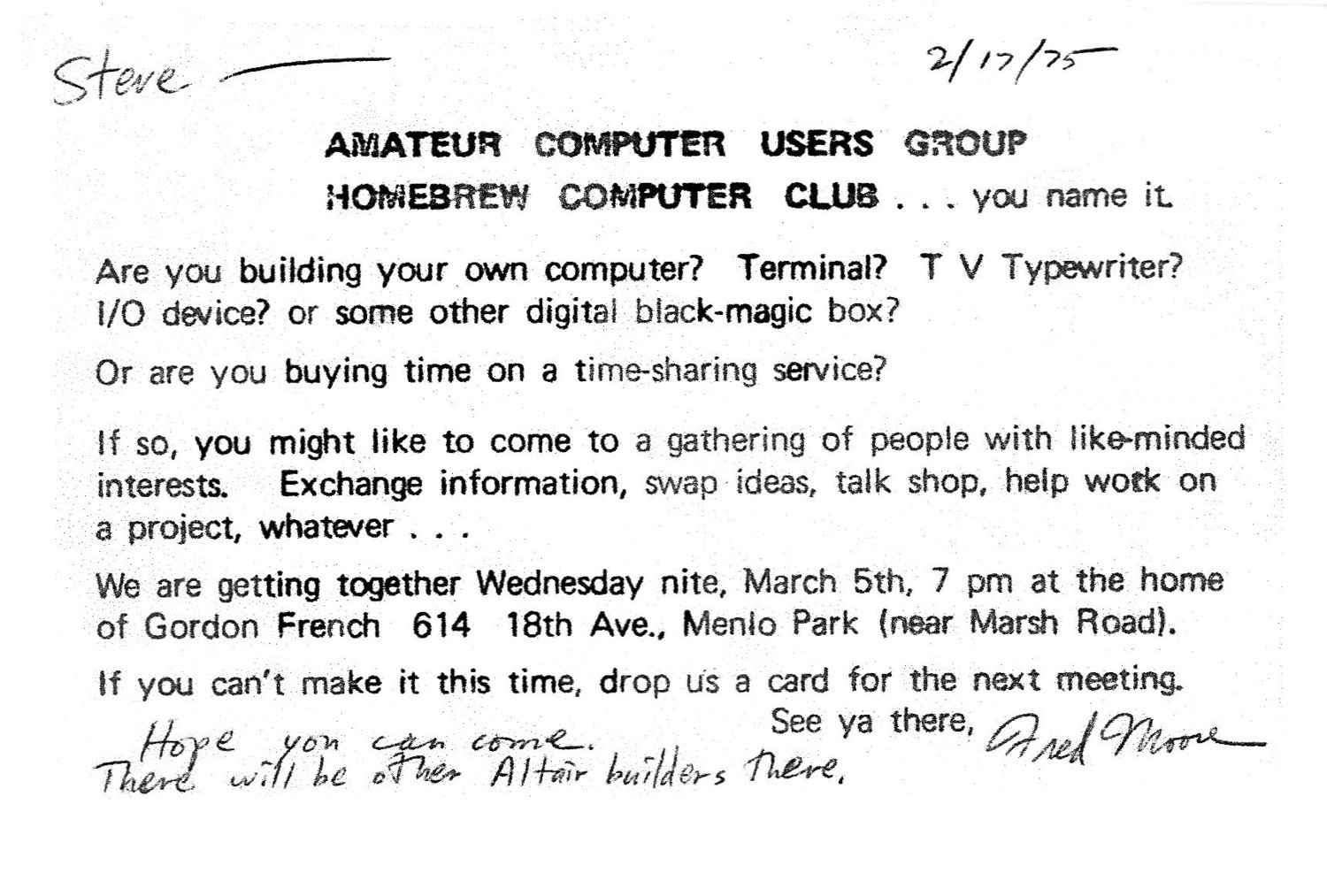
The flyer reproduced above was the copy mailed to one Steve Dompier, an early member whose own appetite for the Altair had already become a small Homebrew legend: impatient with MITS’s notorious shipping backlog, he is said to have travelled to Albuquerque in person to pry his machine out of the MITS workshop. Dompier would, within weeks, give the club its first piece of folklore.
That first meeting had no chairman, no agenda, no name. People simply went around the room introducing themselves and saying what they were working on, and the talk ran late. By the time it broke up, the thirty had agreed on one thing: they wanted to do it again, soon. They settled into a fortnightly rhythm, and as the crowd outgrew French’s garage they moved — first to a hall, and before long to the auditorium at the Stanford Linear Accelerator Center (SLAC) in Palo Alto, where attendance would swell into the hundreds. The group went through a couple of working names before settling on the one that stuck, the one that captured exactly what it was about: the Homebrew Computer Club. You did not buy a computer. You brewed one. At home.
8.3 The culture: show-and-tell and the open schematic
What made Homebrew Homebrew was not its location or even its membership roster; it was a way of running a meeting, and that style was largely the invention of one man. From the fourth meeting onward, Lee Felsenstein — an engineer and veteran of Berkeley’s radical politics, later the designer of the Processor Technology Sol-20 and the Osborne 1 — took the role of moderator, and he gave the proceedings a structure that turned out to be perfectly tuned for spreading information fast.
Felsenstein ran the meeting in two halves. The first was the “mapping” period: he would go around the hall calling on people one at a time, each given a brisk slot — a “selectively enforced ninety-second limit,” in the club’s own description — to stand up, say who they were, ask a question, announce a problem, or report a result. Someone would describe a bug they could not crack; three rows back, a hand would go up with the answer. Someone would say they had finally gotten a cassette interface working; a dozen people would want the details. Felsenstein deliberately kept himself out of the flow of information — he was a traffic conductor, not a source — so that the knowledge moved sideways, member to member, rather than down from any authority. The second half was the “random access” period: the formal session dissolved and everyone surged into the aisles and out into the parking lot to swap schematics, trade chips, copy paper tapes, argue about bus standards, and peer at each other’s half-finished boards under the fluorescent lights.
That second half is the soul of the thing. The governing ethic of Homebrew was open sharing, and it was close to absolute. If you designed a circuit that worked, you brought the schematic and let people copy it. If you wrote a useful routine, you read out the octal or handed over a tape. The prevailing conviction — later distilled into the slogan information wants to be free — held that the way to advance the whole enterprise was to pool everything, that a design improved fastest when the most eyes were on it, and that hoarding a good idea was not just unfriendly but faintly irrational. Many members had come out of the academic, ham-radio, and counterculture worlds, where freely trading knowledge was simply how things were done, and they imported that instinct wholesale into the new hobby.
It is precisely this culture that collided, in early 1976, with Bill Gates’s Open Letter to Hobbyists (Volume 7). The flashpoint was Altair BASIC. Paper tapes of the Micro-Soft interpreter had a way of multiplying at Homebrew meetings: a tape would appear — by one well-worn account, a roll “liberated” from a MITS demonstration — and during the random-access period it would be run off, copy after copy, and carried home in coat pockets by the dozen. To Gates, who had poured months into the code and was owed a royalty on every sale, this was simple theft, and he said so in print. To the Homebrew members doing the copying, it was the most natural thing in the world — exactly what you did with every useful thing at a meeting — and many genuinely could not see why software should be different from a schematic. The Open Letter did not so much start that argument as expose it: two whole worldviews, the proprietary and the communal, discovering at the same instant that they could not both be right. The tension was never fully resolved; it simply became one of the permanent fault lines of the software business, and it runs straight through this garage.
8.4 Steve Dompier and the music on the Altair
The single best-loved moment in the club’s early life belonged to Steve Dompier, and it perfectly captures the Homebrew spirit: a discovery made by accident, demonstrated for delight, and given away to the room.
Sometime in the spring of 1975 — most accounts place it at an early meeting that April, and Dompier wrote it up for publication that May — Dompier stood before the club with his Altair and an ordinary little transistor radio. He had stumbled on the effect at home while running a sorting program. As he told it, a small radio was sitting next to the machine, and as the Altair churned through its loops the radio went “zzzzip” — the computer’s unshielded digital circuitry was spraying radio-frequency interference across the AM band, and the pitch of the buzz depended on exactly what the processor was doing. The 8800’s poor shielding, in other words, had accidentally turned it into a crude radio transmitter, and the frequency of its emissions could be steered by the timing of the code.
Dompier had realised he could play it. By writing tight timing loops — nested countdown registers burning a precise number of cycles — he could make the interference hum at a chosen musical pitch, and by stringing the right pitches together for the right durations he could make the Altair carry a tune. He had encoded a melody as a table of octal values, each value setting a note’s frequency and length, and at the meeting he toggled the program in through the front panel, set his radio beside the machine, and pressed RUN. Out of the little speaker, scratchy but unmistakable, came the Beatles’ “Fool on the Hill.” The room, by every account, went up. And when the delighted crowd demanded an encore, the machine obliged with “Daisy Bell” (“Daisy, Daisy”) — the same song an IBM 704 had famously “sung” in 1961, and the tune HAL 9000 would unravel into in 2001 — a wink that nobody in that technical audience could have missed.
It is worth being clear about what was and was not happening, because the achievement is easy to undersell. The Altair had no sound hardware of any kind — no speaker, no audio output, not a single chip intended to make a noise. The music existed entirely as a side effect of electromagnetic leakage, picked up by a radio the computer was never wired to. Dompier had made an instrument out of a flaw. And true to the club’s ethic, he gave the whole thing away: the program and his account of it were published in the People’s Computer Company newsletter in May 1975 and reprinted the following February in Dr. Dobb’s Journal, so any hobbyist anywhere could toggle in their own Altair concert. Even Bill Gates, writing in the MITS magazine Computer Notes, singled out the music programs as the cleverest Altair demonstrations he had seen. “Music of a sort,” Dompier modestly called it — but it was the first time a personal computer had been made to perform, and the people who were in that room never forgot it.
8.5 Who passed through: Wozniak, Jobs, and a roomful of founders
If you wanted to assemble, in one place and one year, the people who would build the personal-computer industry, you could not have done better than to stand at the door of a 1975 Homebrew meeting and watch them file in.
The most consequential of them was a soft-spoken Hewlett-Packard engineer named Steve Wozniak. Woz attended that first March 5 meeting, and in his memoir iWoz he is unambiguous about what it did to him: it lit the fuse. Seeing the Altair — and, more to the point, seeing a whole room of people who believed an individual could own a computer — sent him home to design one of his own. He had been wanting a machine he could afford for years; Homebrew convinced him it was actually possible, and gave him an audience worth building for. By his own account, he designed the Apple I in large part to show it off at the club — to prove to the people at Homebrew, as he put it, that you could build a genuinely usable computer, one you could type on and see characters appear on a screen, out of just a handful of chips and for something like the price of an Altair. The Apple I’s defining advance over the Altair — a built-in terminal interface, so it spoke to a keyboard and a video monitor instead of a wall of switches and lamps — was conceived as a Homebrew demo. And, faithful to the room he built it for, Woz initially handed out the schematics for free, photocopying his design for anyone who wanted it.
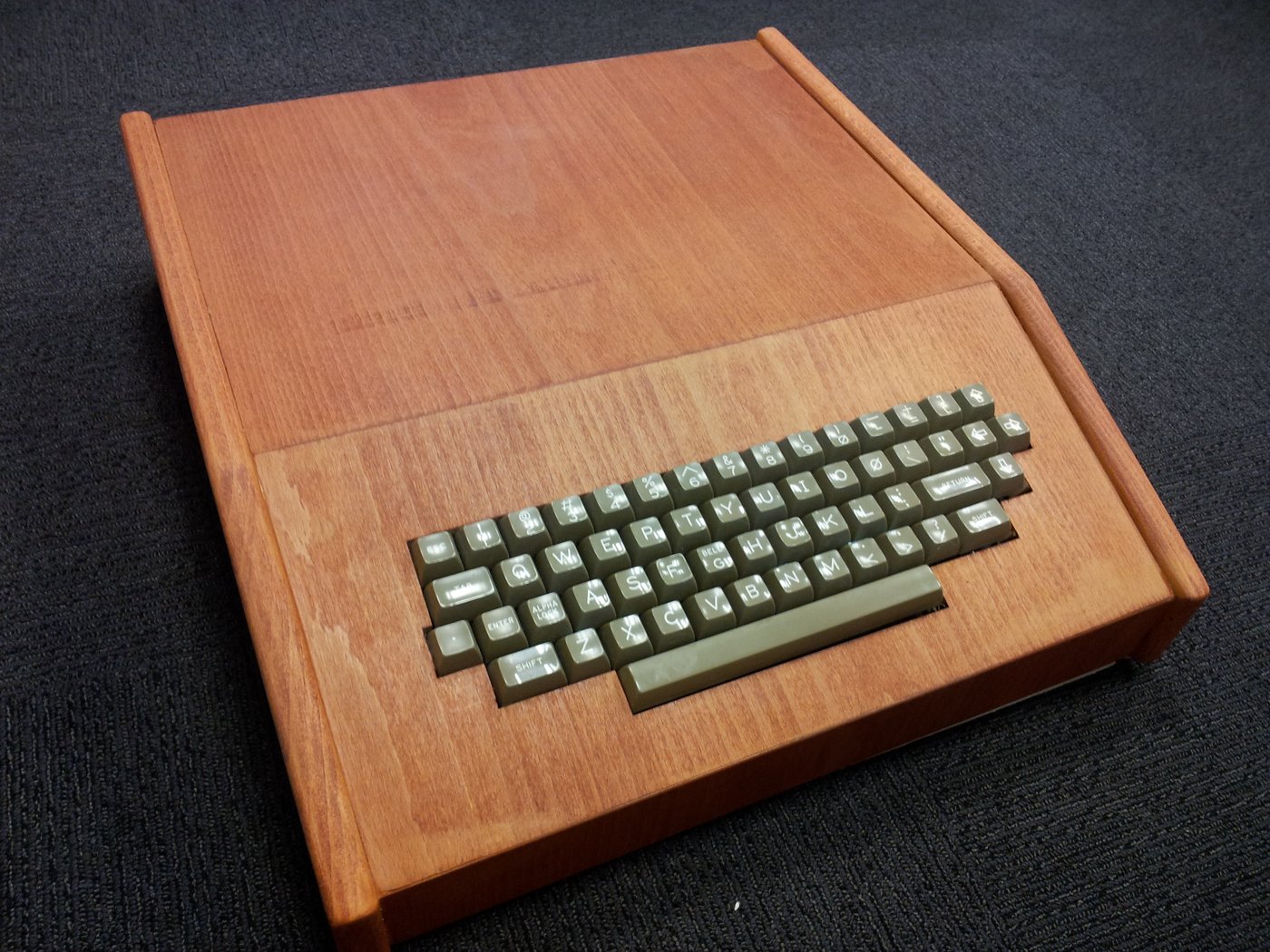
It was Woz’s friend Steve Jobs who looked at the giveaway and saw something else: a business. Where Wozniak wanted the admiration of his peers, Jobs wanted to sell them a finished, ready-to-assemble printed circuit board, and his instinct — that the Homebrew hobbyists were not just a community but a market — is the hinge on which the whole story turns. Apple Computer was, in a real sense, the moment one member of the club decided to stop giving the room schematics and start selling it product. The two impulses that Gates’s Open Letter had set against each other — share it freely versus charge for it — were, in the Apple founding, present in a single partnership.
But Apple was only the most famous graduate. The same meetings were attended by Bob Marsh and Gary Ingram, founders of Processor Technology, whose Sol-20 (designed by Felsenstein) became one of the first computers with a built-in keyboard; by Harry Garland and Roger Melen, the Stanford-trained pair behind Cromemco, makers of the Dazzler color-graphics board and later of serious S-100 business machines; by George Morrow of Morrow Designs; by Adam Osborne, the columnist and publisher who would launch the first successful portable computer; by Paul Terrell, whose Byte Shop chain became one of the earliest computer-store franchises (and Apple’s first customer); and by the people who would build North Star Computers, IMSAI’s successor Fischer-Freitas, and more. The boards being passed around the parking lot in 1975 were, very often, the first prototypes of companies that would be shipping product within eighteen months.
8.6 How a garage seeded an industry
The standard way to measure Homebrew’s importance is to count the companies, and the count is genuinely startling. In What the Dormouse Said, his history of the period, the journalist John Markoff records that at least twenty-three companies — Apple among them — traced their lineage directly to the Homebrew Computer Club. Apple, Cromemco, Processor Technology, North Star, Morrow Designs, the Byte Shop, Osborne — a substantial fraction of the early American personal-computer industry can be drawn on a single family tree rooted in Gordon French’s garage. It is hard to think of another voluntary hobby club, in any field, that spun off an entire industry from a couple of dozen folding chairs.
Why there, and why then? Three things came together. The first was timing: the club formed at the precise moment the Altair made a personal computer real but left it almost unusably crude — no good keyboard, no display, no storage, hardly any software. Every one of those gaps was a product waiting to be built, and Homebrew was a room full of exactly the engineers who could build them, staring at the same Altair on the same table and each seeing a different missing piece. The second was place: the club sat in the middle of the densest concentration of semiconductor and electronics talent on Earth, with Stanford, SLAC, HP, Intel, and a hundred suppliers within easy driving distance, so a hobbyist’s good idea had an unusually short path to becoming a manufacturable board. The third — and this is the part that is easy to romanticise but was genuinely decisive — was the sharing culture itself. Because designs, code, and hard-won debugging knowledge flowed freely through the meetings, every member effectively had the whole club’s R&D at their back. A problem that might have stumped a lone tinkerer for a month got solved in the random-access period in ten minutes. The open ethic was not in spite of the commercial explosion; it was the accelerant of it. The companies grew out of the commons.
There is an irony in that, and it is the irony this volume has been circling. The same free-copying culture that made Homebrew such a spectacular engine of innovation was the very thing Bill Gates condemned in the Open Letter to Hobbyists — and Gates was not simply wrong. As the hobby matured into an industry, the things worth making shifted from hardware you could photocopy a schematic of to software you could photocopy a tape of, and a commons that worked beautifully for circuit diagrams worked far less well for the people trying to make a living writing code. The club that gave the world Apple by sharing everything also, by sharing everything, provoked the document that announced the end of sharing as a default. Both halves are true, and both were present in that garage from the first rainy Wednesday.
The Homebrew Computer Club kept meeting until 1986, but its decisive work was essentially finished by 1977, when the machines its members had founded companies to build — the Apple II above all — went on sale to a public that no longer needed to brew anything at home. The club had made itself obsolete in the best possible way: it had turned the homebrew computer into something you could simply buy. The competitors who fought the S-100 wars of Volume 9, and the full personal-computer revolution of Volume 10, both walk out of this room. An Altair sat on a table in a garage in Menlo Park, thirty people gathered around it in the rain, and Silicon Valley as we know it began to take shape that night.
Sources
- Wikipedia, “Homebrew Computer Club.” Confirms the central facts: the first meeting on March 5, 1975 in Gordon French’s garage in Menlo Park; Fred Moore and Gordon French as conveners; the occasion being the arrival of the first Altair 8800 in the area (a review unit sent to the People’s Computer Company); Lee Felsenstein as moderator; and the roster of member-founded companies — Apple (Jobs/Wozniak), Cromemco (Garland/Melen), Processor Technology (Marsh), Morrow Designs, Byte Shop (Terrell), Osborne Computer, and the IMSAI-successor Fischer-Freitas (Fischer). https://en.wikipedia.org/wiki/Homebrew_Computer_Club
- FoundSF, “Homebrew Computer Club.” Source for the texture of the meetings: Felsenstein assuming the moderator role at the fourth meeting; the two-part “mapping” and “random access” structure and the selectively enforced ninety-second limit; the open show-and-tell sharing culture; the rainy first night with roughly thirty attendees; and an account of Dompier’s music demonstration (“Fool on the Hill” and “Daisy, Daisy”) at an early meeting. https://www.foundsf.org/Homebrew_Computer_Club
- Kevin Driscoll, “Code critique: ‘Altair Music of a Sort’” (CCSWG 2012), reproducing and analysing Steve Dompier’s own account. Source for the Dompier music demo specifics: the accidental discovery via a transistor/weather radio next to the Altair going “zzzzip”; the use of nested timing-loop registers to set pitch and duration; the songs “The Fool on the Hill” and the “Daisy” encore; and the publication history — People’s Computer Company, Vol. 3 No. 5 (May 1975), reprinted in Dr. Dobb’s Journal, Vol. 1 No. 2 (February 1976). https://kevindriscoll.org/projects/ccswg2012/fool_on_a_hill.html
- Computer History Museum, CHM Revolution — “Steve Wozniak: The Homebrew Computer Club and the Apple I” and “The Homebrew Computer Club.” Corroborates Wozniak’s attendance at the first meeting, his crediting Homebrew as the direct inspiration for the Apple I, and the club’s role as “the crucible/melting pot of an industry.” https://www.computerhistory.org/revolution/personal-computers/17/312
- Steve Wozniak, iWoz (2006), as quoted in the Wikipedia “Steve Wozniak” article. Source for Woz’s stated design goal — to show the people at Homebrew “that it was possible to build a very affordable computer … a real computer you could program for the price of the Altair — with just a few chips” — and for his freely giving away the Apple I schematics to fellow members. https://en.wikipedia.org/wiki/Steve_Wozniak
- John Markoff, What the Dormouse Said: How the Sixties Counterculture Shaped the Personal Computer Industry (2005), as cited in the Wikipedia Homebrew article. Source for the figure that at least twenty-three companies, including Apple, traced their lineage directly to the Homebrew Computer Club. https://en.wikipedia.org/wiki/Homebrew_Computer_Club
- Wikipedia, “An Open Letter to Hobbyists.” Background for the cultural collision tied to Volume 7: Bill Gates’s February 1976 letter accusing hobbyists of software theft, written against the backdrop of Altair BASIC paper tapes being freely copied — including at Homebrew meetings — and his complaint that “most of you steal your software.” https://en.wikipedia.org/wiki/Open_Letter_to_Hobbyists
- Paul Freiberger and Michael Swaine, Fire in the Valley: The Making of the Personal Computer, “The Homebrew Computer Club” chapter (O’Reilly edition). The standard narrative history of the club — the garage origin, the show-and-tell ethic, Dompier, Felsenstein’s moderation, and the founders it produced — underpinning the framing of this volume. https://www.oreilly.com/library/view/fire-in-the/9781680500455/f_0032.html
- Figure: “Invitation to First Homebrew Computer Club meeting” by Gotanero, CC BY-SA 3.0, via Wikimedia Commons — the flyer Fred Moore mailed to Steve Dompier on February 17, 1975, announcing the March 5, 1975 first meeting at Gordon French’s home; an authentic founding artifact that also documents the Dompier connection. https://commons.wikimedia.org/wiki/File:Invitation_to_First_Homebrew_Computer_Club_meeting.jpg
- Figure: “Apple 1 replica” by Yarivi, CC BY-SA 3.0, via Wikimedia Commons — a working replica of the Apple I, the machine Wozniak designed to show off at Homebrew. https://commons.wikimedia.org/wiki/File:Apple_1_replica.jpg


Comments (0)