Altair 8800 · Volume 1
Altair 8800 — Volume 1 — The Machine That Started an Industry
An orientation to the 1975 kit that put a real computer on the kitchen table — and to the fourteen-volume journey that ends on a workbench.
1.1 A blue box and a row of switches
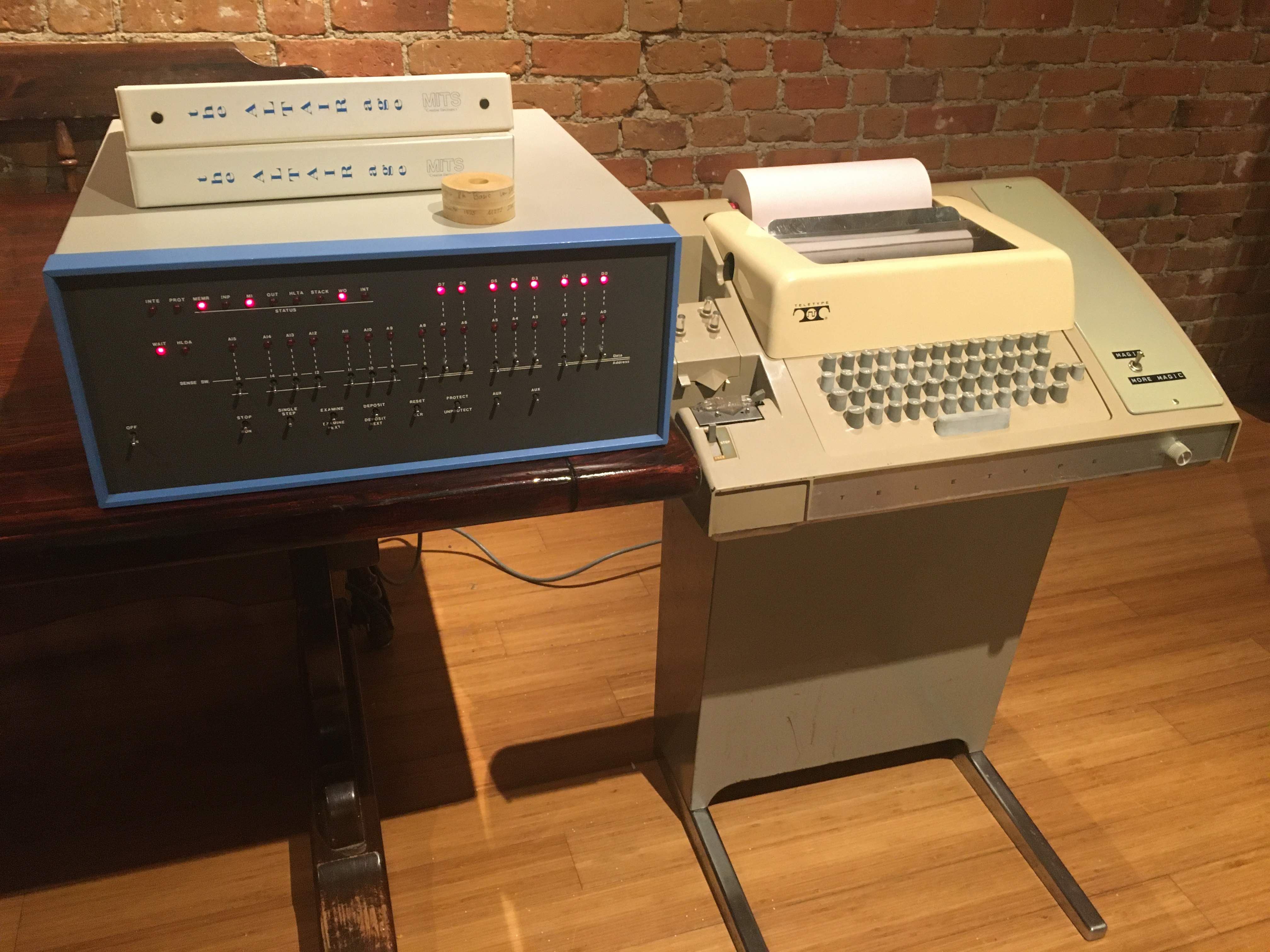
Open the lid on the story of the personal computer and the first thing you find is not a sleek beige machine with a keyboard and a screen. It is a squat blue-grey box about the size of a stereo receiver, fronted by a panel of small toggle switches and two neat rows of red lights, and very little else. No keyboard. No display. No disk. To make it do anything at all you flip the switches in patterns, press another switch to commit each pattern to memory, and read the answer back from the glow of the lamps. To a person raised on glass screens it looks less like a computer than like the front of a piece of laboratory test equipment — which, in spirit, is exactly what its maker built.
This is the Altair 8800, introduced in 1975, and despite its forbidding austerity it is one of the most consequential machines ever sold. It did not have the best hardware of its moment, nor the friendliest design, nor even, at first, enough memory to do anything genuinely useful. What it had was a price, a magazine cover, and timing — and out of those three things grew an entire industry. The Altair is widely and rightly remembered as the spark of the personal-computer revolution: the machine that first let an ordinary person own a real, general-purpose, programmable computer, and around which the companies, clubs, standards, and software of the new microcomputer world rapidly assembled themselves.
This is Volume 1 of a fourteen-volume deep dive into the Altair 8800 — into the machine itself, the moment that launched it, and the world it called into being. It is an orientation volume. It assumes no prior knowledge: not of the Intel 8080 at its heart, not of binary or front-panel toggling, not of the S-100 bus or Altair BASIC. All of that comes later, unhurried, each in its own volume. The job here is only to establish what the Altair is, why it mattered so enormously out of all proportion to its modest specifications, and how the rest of the series is laid out. Think of it as the establishing shot before the story proper begins.
1.2 What the Altair 8800 is
The Altair 8800 is a microcomputer kit, sold by mail order beginning in early 1975 by a small Albuquerque, New Mexico company called MITS — Micro Instrumentation and Telemetry Systems. It was designed by the company’s founder and president, Ed Roberts (Henry Edward Roberts), an engineer who had built MITS up through the early 1970s selling electronics kits, most notably calculators, to the hobbyist market. When the calculator business collapsed under price competition from the big manufacturers, Roberts bet the failing company on a wildly more ambitious product: a computer that an enthusiast could afford and assemble at home.
At the center of the Altair sat the Intel 8080, one of the first commercially significant microprocessors — an entire central processing unit on a single chip, running at two megahertz. That was the crucial enabling part. A microprocessor meant that the “computer” no longer had to be a cabinet full of circuit boards costing thousands of dollars; it could be a single integrated circuit costing a fraction of that, and everything else in the machine could be built cheaply around it. MITS negotiated the 8080 from Intel at a price far below its list cost, and that bargain is much of the reason the finished machine could be sold for what it was.
And the price was the headline. The Altair 8800 shipped as a kit for $397 — a box of parts you soldered and assembled yourself — or fully assembled for around $498. For a few hundred dollars, less than the cost of a good colour television, you could own a computer. What you got for that money was, by any later standard, almost nothing: the bare machine came with just 256 bytes of memory — not kilobytes, bytes — no keyboard, no screen, no storage, and no software. Its entire user interface was the front panel: a bank of toggle switches through which you entered binary instructions and data one bit at a time, and a bank of red LEDs that displayed the machine’s internal state. Internally, the design hung the processor and memory off a passive backplane of connector slots, so that the buyer could later plug in expansion boards — more memory, input and output interfaces — as money and ambition allowed. That row of slots, soon standardized by the industry as the S-100 bus, turned out to matter as much as the computer itself.
In short: a single-chip processor, a quarter-kilobyte of memory, a panel of switches and lights, an empty row of expansion slots, and a mail-order price an ordinary person could justify. That is the whole machine. Its genius was not in any one of those parts but in the fact that they added up, for the first time, to a real computer a private individual could buy and keep.
1.3 The Popular Electronics moment
A cheap computer kit from an unknown New Mexico company might easily have vanished without trace. What lifted the Altair out of obscurity, and into history, was a magazine cover. The January 1975 issue of Popular Electronics — the leading American hobbyist-electronics magazine of the day — carried the Altair 8800 on its front, beneath a banner proclaiming it the “World’s First Minicomputer Kit to Rival Commercial Models.” Inside, a feature article by Ed Roberts and his collaborator walked readers through this astonishing new thing: a genuine computer they could build for under four hundred dollars.
There is a wonderful, telling detail behind that cover. The machine on it was not finished — was barely even named — when the magazine’s editor, Les Solomon, commissioned the article. The actual working prototype was reportedly lost in shipping between Albuquerque and the magazine’s New York offices, so the photograph that detonated an industry shows an empty box, a mock-up dressed up to look like the real thing. The name “Altair,” industry legend holds, came from the magazine side rather than from MITS — a star name suggested, as the story goes, in the editor’s household. The first icon of personal computing, in other words, was a marketing photograph of a hollow shell with a borrowed name. It scarcely mattered, because the demand it unleashed was overwhelmingly real.
MITS was a small, nearly bankrupt company that had run the numbers carefully. Roberts calculated he needed to sell roughly 200 machines over the coming year just to break even; in his most optimistic moments he told his banker he might move 800. Instead, the orders arrived by the thousand. When the January issue reached subscribers, MITS was inundated — flooded with mail and phone calls, hiring extra hands just to answer the telephones and open the envelopes full of cheques. The company took on the order of a thousand orders in February alone and claimed to have shipped some 2,500 machines by the end of May. A struggling calculator firm had, almost overnight, become the center of a new market it could barely keep up with. The deluge of demand that followed that single cover is the reason January 1975 is so often marked as the birth month of the personal computer.
1.4 Why it mattered
It is worth pausing to say plainly why a half-built, hard-to-use box of switches deserves any of this attention, because the specifications alone will never explain it. The Altair mattered not for what it could do — which, out of the box, was very little — but for who could now have it.
Before the Altair, owning a computer was essentially unthinkable for a private person. Computers were institutional property. The great mainframes were roomfuls of equipment costing hundreds of thousands or millions of dollars, tended by professional staff behind glass walls. Even the minicomputer — the revolution chronicled in this site’s companion series on DEC’s PDP-8/I — had only brought the machine down one rung: from the corporate data center to the single laboratory, the department, the classroom. A mini like the PDP-8 cost on the order of ten or twenty thousand dollars; a lab could own one, but a person could not. The minicomputer democratized computing, but it stopped at the institution’s door.
The Altair carried that democratization the rest of the way — from the institution to the individual, from the laboratory bench to the kitchen table. For a few hundred dollars, a hobbyist, a student, an engineer tinkering after work could now own a real stored-program computer outright. And ownership, as the PDP-8 series argues at length, changes everything about one’s relationship to a machine. When you own the computer, it waits for you. You can leave a half-finished program toggled into its switches overnight. You can experiment freely, break things cheaply, and learn by doing rather than by booking time on someone else’s schedule. The Altair put that relationship within reach of a private person for the first time in history.
What makes the story almost paradoxical is how bad the bare machine was at being useful. With 256 bytes of memory and no input but switches and no output but lights, the first Altair could do little more than run tiny hand-entered routines and blink its lamps in response. Its owners spent hours toggling in programs bit by bit, and a single slip meant starting over. And yet that very inadequacy became a kind of engine. Every limitation was an invitation: the machine needed more memory, so people designed memory boards; it needed a way to talk to a Teletype, so people built interface cards; it needed a real programming language, so two young programmers in Boston wrote one. A computer that did everything would have left nothing for a community to do. The Altair, precisely because it arrived as a bare and hungry platform, summoned an entire ecosystem to complete it.
1.5 What it set off
The Altair did not just sell well; it created an industry around itself, and the shape of that industry is the subject of most of the volumes to come. Here it is enough to sketch the preview.
First, the hardware ecosystem. Because the Altair was built around an open backplane of expansion slots, third parties could design boards that plugged straight into it — and they did, in profusion. That connector standard, formalized as the S-100 bus, became the first widely adopted microcomputer expansion standard, and a whole cottage industry of memory boards, interface cards, and peripherals grew up to serve Altair owners and the machines that copied them. For years, “S-100” was nearly synonymous with serious hobby and small-business computing.
Second, software — and the founding of a company that would come to define the era. Two young programmers, Bill Gates and Paul Allen, saw the Popular Electronics cover, recognized what it meant, and wrote a version of the BASIC programming language for the 8080 before they even had an Altair to run it on. Altair BASIC became the machine’s killer application — the thing that turned a panel of blinking lights into something you could actually program in a human-readable language — and the partnership Gates and Allen formed to sell it, first styled Micro-Soft, would become Microsoft.
Third, community. In the San Francisco Bay Area, enthusiasts drawn together by the new machine began meeting as the Homebrew Computer Club, a freewheeling gathering of hobbyists, hackers, and future entrepreneurs — among them the founders of Apple — that became the social cradle of personal computing. Fourth, competition: the Altair’s success and its open bus invited clones and rivals, the most famous being the IMSAI 8080, and the resulting “S-100 wars” pushed the whole field forward. And from all of this — the boards, the BASIC, the clubs, the clones — ran a direct line to the breakout personal computers of 1977 and the mass-market industry that followed. Each of these threads gets a volume of its own; for now, simply hold the shape of it: one bare blue box, and an industry crystallizing around it.
1.6 The fourteen volumes
This series is built to be read in order but to reward dipping. Having set the scene, the volumes that follow widen out into history, then drill down into the machine, then step back out to the world it made — and end, deliberately, on a workbench.
Table 1 — The fourteen volumes
| Vol | Title | Focus |
|---|---|---|
| 1 | The Machine That Started an Industry (this volume) | Orientation — what the Altair 8800 is, why it mattered, and the shape of the whole series. |
| 2 | The Intel 8080 and the Birth of the Microprocessor | The chip at the heart of it all — how the single-chip CPU came to be, and why it made a personal computer possible. |
| 3 | MITS, Ed Roberts & Popular Electronics, January 1975 | The people and the moment — a failing calculator firm, a determined engineer, and the magazine cover that lit the fuse. |
| 4 | Architecture — the 8080, the S-100 Bus, the Front Panel | How the machine is organized: the processor, the open backplane, and the switches-and-lights interface. |
| 5 | The Bare Machine — Toggling in Programs, Reading the Lights | Operating the Altair with nothing attached — entering code bit by bit and reading answers from the lamps. |
| 6 | The S-100 Ecosystem — Boards, Memory, Peripherals | The expansion world — memory boards, interface cards, and the peripherals that made the Altair usable. |
| 7 | Altair BASIC — Gates, Allen, and the Birth of Micro-Soft | The killer app and the company it founded — how a language turned the kit into a real computer. |
| 8 | The Homebrew Computer Club & the Hobbyist Explosion | The community — the clubs, newsletters, and hackers who turned a product into a movement. |
| 9 | Clones & Competitors — IMSAI and the S-100 Wars | The rivals the Altair invited — the IMSAI 8080 and the scramble of companies its open bus created. |
| 10 | The PC Revolution It Sparked | The line from the Altair to 1977 and beyond — how a hobby kit became a mass-market industry. |
| 11 | Using the Machine — Software & Daily Operation | What it was actually like to live with an Altair — the software, the workflow, the daily ritual of operation. |
| 12 | Surviving Machines, Emulators & Museums | Preservation today — the original machines that survive, the emulators, and the museums keeping them running. |
| 13 | The Modern Revival — Altair-Duino and Kindred Replicas | The replica scene — the Altair-Duino and the wider family of front-panel recreations. |
| 14 | ⭐ Building My Altair 8800 Replica | The workbench finale — assembling Jeff’s own Altair-Duino and bringing the blinking lights back to life. |
The final volume is where this whole series is headed. Volume 14 is personal: it documents the building of Jeff’s own Altair-Duino, a faithful modern recreation of the Altair 8800’s front panel — its toggle switches and red lights reproduced just as in 1975 — driven underneath by an Arduino Due microcontroller emulating the original 8080 machine. That replica, sold as a kit and assembled by hand, is the destination. The arc runs from a January 1975 magazine cover in New York to a soldering iron on a desk in 2026, and it is meant to.
1.7 Where we go from here
That is the orientation. The Altair 8800 was, in the end, a deceptively crude object: a single-chip processor, a quarter-kilobyte of memory, a panel of switches and lights, and an empty row of slots, sold by mail for a few hundred dollars by a nearly bankrupt company in the desert. It was hard to use and, on its own, barely useful. But cheap, real, and ownable, arriving at exactly the right moment, is precisely what reshapes the world. The Altair proved that a computer could be a personal possession rather than an institutional one — and in proving it, it called forth the bus, the software, the clubs, the companies, and the whole industry that personal computing became. Volume 2 begins the story properly, with the silicon at its heart: the Intel 8080 and the birth of the microprocessor.
Sources
- Wikipedia, “Altair 8800.” Confirms the 1975 introduction by MITS of Albuquerque; Ed Roberts as designer; the Intel 8080 at 2 MHz; the $397 kit / ~$498 assembled prices; 256 bytes of initial RAM; the January 1975 Popular Electronics cover and its “World’s First Minicomputer Kit to Rival Commercial Models” banner; the empty-box cover photo; the break-even and order figures; and the S-100 bus, Altair BASIC, and IMSAI clone context. https://en.wikipedia.org/wiki/Altair_8800
- National Museum of American History (Smithsonian), “Altair 8800 Microcomputer.” Confirms the kit ($397) and assembled (~$498) pricing and the contents of the kit, the Intel 8080, and the machine’s role as a foundational personal computer. (The $397 kit / $498 assembled figures used throughout this volume are the original Popular Electronics, January 1975 advertised prices; some later secondary sources quote different numbers for other configurations.) https://americanhistory.si.edu/collections/object/nmah_334396
- Computer History Museum, “Altair 8800 on cover of Popular Electronics” and “Cover of January 1975 issue of Popular Electronics.” Confirm the January 1975 cover, the demand it generated, and the Altair’s standing as the spark of the personal-computer era. https://www.computerhistory.org/collections/catalog/102652186 · https://www.computerhistory.org/revolution/personal-computers/17/312/1141
- History-Computer, “MITS Altair 8800 — Complete History.” Background on MITS, Ed Roberts, the calculator-business collapse, the Intel 8080 deal, and the order deluge following the magazine cover. https://history-computer.com/products/altair-8800-complete-history-of-the-mits-altair-8800/
- Adwater & Stir, “Altair History.” Context on MITS and the Altair, and the maker of the Altair-Duino replica that is the subject of Volume 14. https://adwaterandstir.com/altair-history/
- Figure: “Altair 8800 and Model 33 ASR Teletype” by Tim Colegrove, via Wikimedia Commons, licensed CC BY-SA 4.0. https://commons.wikimedia.org/wiki/File:Altair_8800_and_Model_33_ASR_Teletype.jpg

Comments (0)