Altair 8800 · Volume 6
Altair 8800 — Volume 6 — The S-100 Ecosystem: Boards, Memory, Peripherals
How a passive backplane and a published pinout turned one company's accessory list into an entire industry's parts catalogue — and, in the bargain, undercut the company that drew it.
6.1 About This Volume
Volume 4 opened the cabinet and laid the Altair bare as architecture: an 8080 on a card, a front panel wired to the bus, and — the quiet protagonist of this whole volume — a passive backplane, a row of identical hundred-pin sockets carrying nothing but signals and power. Volume 5 then showed what it was like to use the bare machine: sixteen switches, a wall of red lamps, and the patience to toggle a program in one byte at a time. Between them those two volumes describe an Altair that is, functionally, an island. It computes, but it cannot easily talk, remember, or store. It is a processor in a box with almost nothing to do.
This volume is about everything that filled the empty slots. The Altair’s backplane did not care who made the card that plugged into it; the bus signals were the same whether the board came from MITS in Albuquerque or from a two-man startup in a Berkeley garage. That indifference — a passive bus with a published pinout — was the single most consequential design decision in the machine’s life, more consequential, in the end, than the choice of processor. It meant that the moment the Altair shipped, anyone could build a card for it, and within eighteen months dozens of companies were doing exactly that: memory boards, serial and parallel interface boards, video boards, cassette and disk controllers, prototyping cards. The accessory list MITS printed in its catalogue became, very quickly, a parts catalogue for an entire industry — an industry that would soon give the bus a new name, S-100, precisely so it would no longer have to credit MITS every time it described its own products.
So this is the ecosystem volume. We will trace the explosion of third-party S-100 cards; tell the story of MITS’s notorious 4K dynamic-RAM board and how its failures handed a market to better-engineered static-RAM rivals like Processor Technology; cover the storage that finally let a program survive a power-off — paper tape, the cassette interfaces standardised as the Kansas City standard, and at last the floppy disk; and watch the front panel of Volume 5 begin its slow retirement in favour of the terminal and the disk drive. Underneath all of it runs a single irony, the open-bus paradox: MITS published the bus, the ecosystem flourished, and the ecosystem ate MITS. That sets the table for Volume 7, where the most famous S-100-era software of all — Altair BASIC, loaded into one of those third-party memory boards from one of those paper-tape readers — turns the toggling-and-octal machine into one you could converse with.
6.2 A bus that belonged to everyone
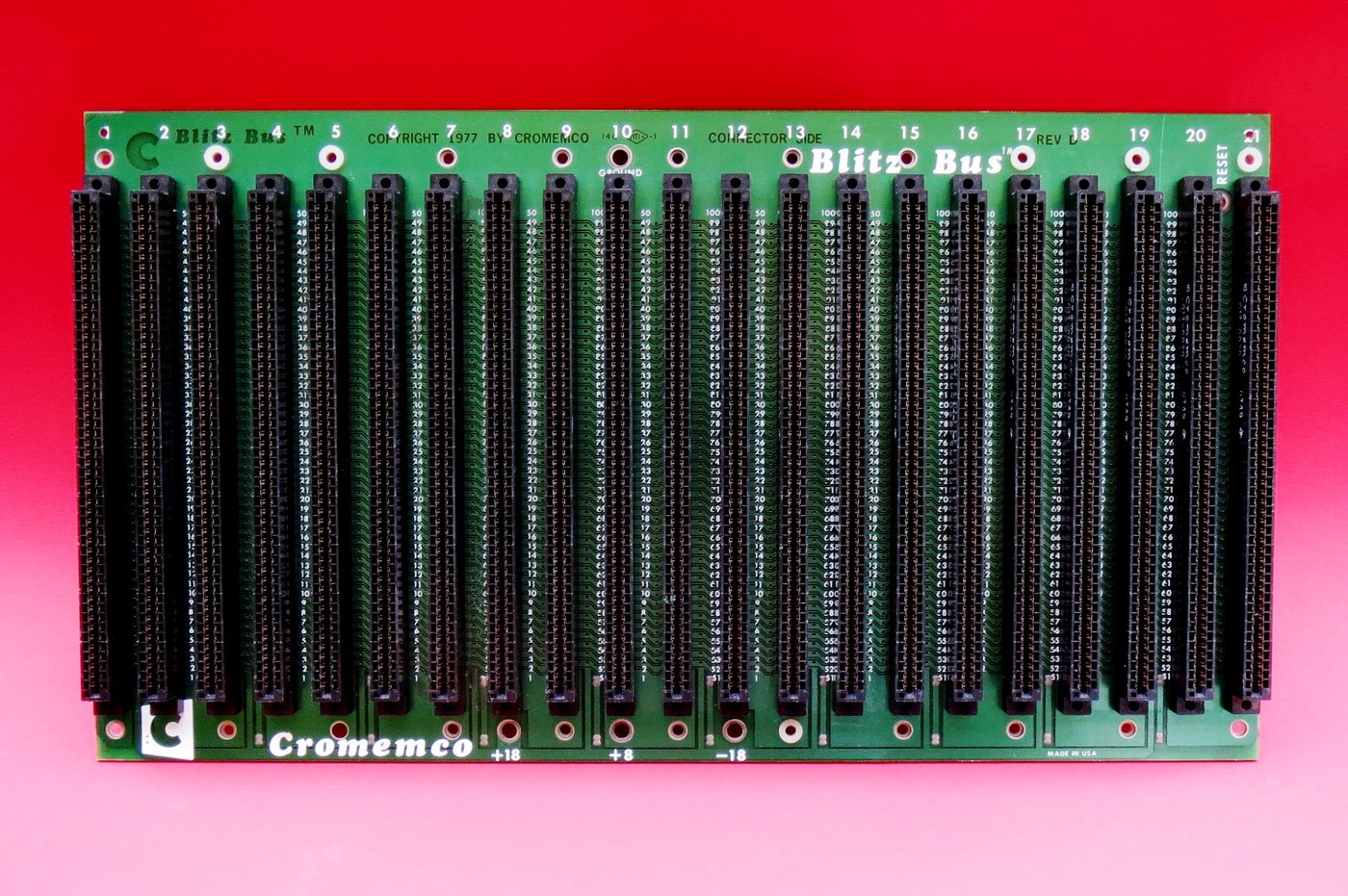
Recall the physical fact at the centre of the Altair, because the entire ecosystem hangs from it. The machine’s backplane is passive: it contains no logic, only the wiring that ties one hundred numbered pins straight across every slot, plus the power rails. Every card in the machine — the CPU itself included — is a peer hanging off that common bus. The story, often repeated and apparently true, is that the hundred-pin connector was not the product of careful engineering at all: an unnamed draftsman at MITS picked a stock edge connector out of a parts catalogue because it was cheap and available, and the signal assignments were handed out across its pins more or less arbitrarily. There were redundant lines, two uncommitted pins, an idiosyncratic split of the power and ground returns — a pinout no committee would have designed. And it became the first industry-standard microcomputer bus anyway, warts and all, because it was there first and it was open.
That openness was not a grand philosophical stance; it was partly just how MITS did business and partly the path of least resistance. To sell expansion memory and interface boards for its own machine, MITS had to tell customers what the bus signals were. Once that information was public — in manuals, in the Computer Notes newsletter, on schematics — there was nothing to stop a third party from building a compatible card, and no patent or proprietary connector standing in the way. Hobbyists who had soldered their own Altairs were exactly the sort of people who could design a memory board; some of them founded companies to sell what they designed. By 1976 the Altair bus had so many independent suppliers that the very name became awkward. Forced to keep calling it “the Altair bus” — advertising their products by naming a competitor — several of those companies wanted a neutral term. The one that stuck was coined in August 1976 by Harry Garland and Roger Melen of Cromemco, who, on a flight to the PC ‘76 show in Atlantic City, found themselves sharing the cabin with Bob Marsh and Lee Felsenstein of Processor Technology and worked out a name: the bus had one hundred pins, so call it Standard-100, or S-100. The term first appeared in print in a Cromemco advertisement in the November 1976 issue of Byte. The renaming is the open-bus story in miniature: the standard had outgrown its originator, and the industry quietly relabelled MITS’s accident as everyone’s property.
6.3 The explosion of third-party cards
What did the slots fill up with? Begin with the obvious need: memory. A stock Altair shipped with 256 bytes of static RAM — a quarter of a kilobyte — in a 64-kilobyte address space (Volume 4). To do anything substantial, above all to run a language interpreter, you needed kilobytes, and that meant buying memory boards. Memory was therefore the first and largest market, and the one where the third parties drew the most blood, for reasons we come to in the next section.
Then input and output, because the bare machine could not talk to anything. Serial interface boards — MITS’s own 88-SIO and the two-port 88-2SIO, and a flood of competitors’ equivalents — gave the Altair an asynchronous serial port into which a Teletype or a video terminal could be plugged. Parallel interface boards (the 88-PIO class) drove devices that wanted byte-wide ports: line printers, paper-tape punches, instruments. An interface board is what physically ended the bare-machine predicament of Volume 5: with an 88-2SIO and a Teletype, the Altair finally had a keyboard, a printer, and a paper-tape reader, and could be loaded with something other than fingertips.
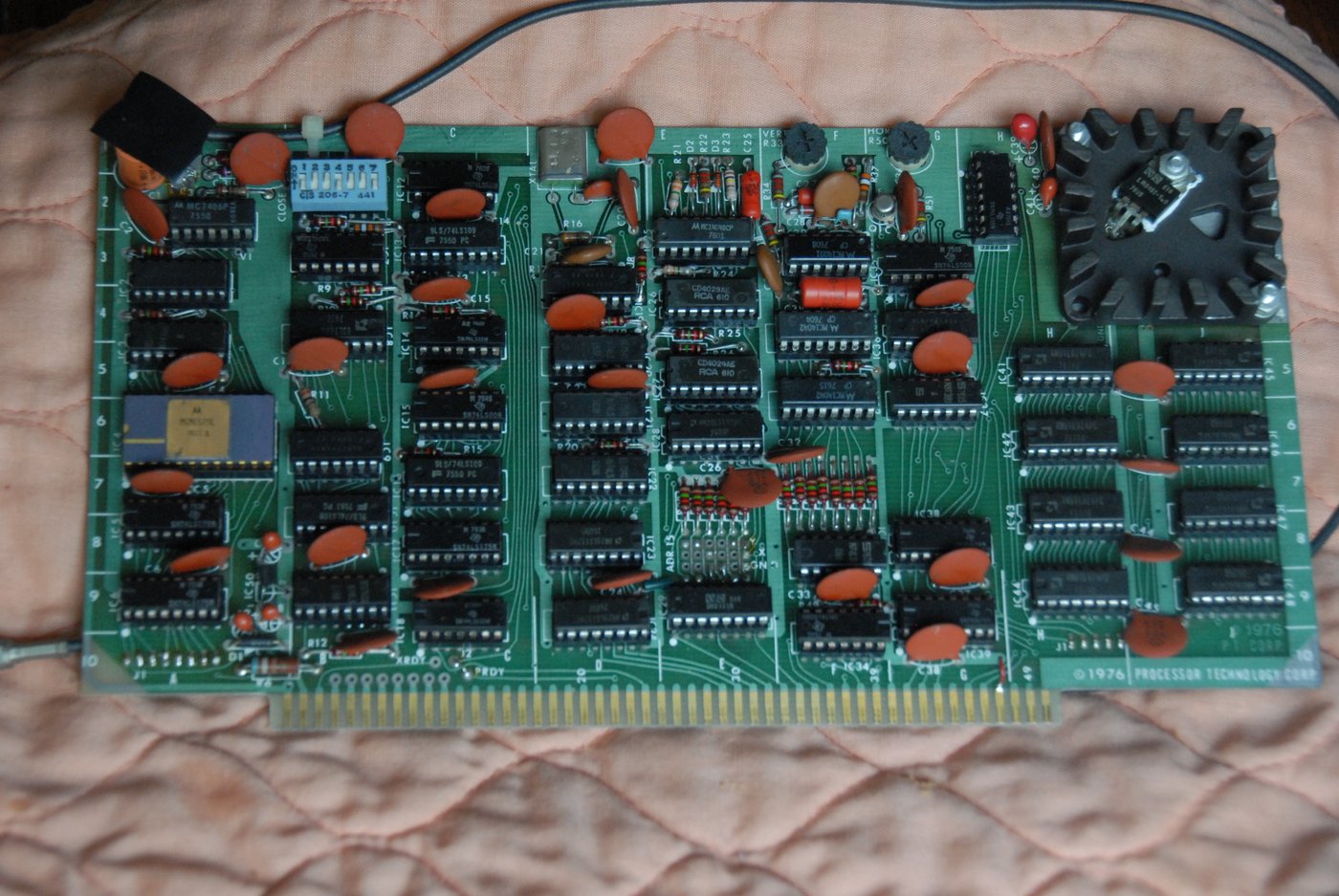
Beyond memory and plain I/O came the more imaginative cards, and here the third parties left MITS behind entirely. Processor Technology’s VDM-1 of 1976 — a video display module on a single S-100 card — generated a 16-line-by-64-character screen of text by writing directly into a small block of on-board memory that the card scanned out to an ordinary monitor or modified television. This was a genuinely new idea for a hobby machine: a memory-mapped CRT controller that made glass-teletype output cheap, with no Teletype required. There were cassette-interface cards, EPROM boards carrying resident monitors and bootstraps, real-time-clock cards, music and speech boards, prototyping boards sold blank so you could wire up whatever the catalogue lacked, and eventually floppy-disk controllers. The defining quality of the ecosystem was that no single company set its boundaries. If a card could be made to live on the bus, someone made it, and the Altair you actually found on a hobbyist’s bench in 1977 was rarely a pure MITS machine — it was a MITS chassis full of other people’s boards.
6.4 Cheap dynamic RAM and the board that taught the market to distrust MITS
No single product did more to shape the ecosystem than a board that did not work very well. To understand why, you need the distinction between the two kinds of memory chip available in 1975.
Static RAM holds each bit in a little flip-flop that keeps its state as long as power is applied; you write it, you read it, and it simply remembers. Dynamic RAM stores each bit as a charge on a tiny capacitor, which is far denser and cheaper per bit — but the charge leaks away in milliseconds, so every cell must be refreshed, read and rewritten, periodically, or the data evaporates. Dynamic RAM is cheaper to buy and harder to use correctly; static RAM costs more and just works. In 1975 that trade-off was the central engineering decision of any memory board.
MITS, chasing the low price that would let it advertise affordable memory, built its 88-S4K, a 4-kilobyte dynamic RAM board — and got the hard part wrong. The board obtained its refresh timing by a technique called cycle stealing: rather than including independent refresh circuitry, it leaned on the 8080’s own bus cycles to sneak in the refresh of the dynamic cells. The fatal flaw is in the word “steal.” Sometimes the 8080 was busy doing something else exactly when the memory needed refreshing — and if the refresh was missed, the capacitors quietly discharged and the data was simply gone. The board could therefore forget what it was told, intermittently and without warning, in a way that depended on what the processor happened to be doing. Compounding the design, the layout was awkward, with needless wiring and a reputation for requiring owners to fiddle with jumpers and patches to coax it into working at all. The result was predictable: lost sales, boards returned to Albuquerque, and a customer base that learned, expensively, that MITS memory could not be trusted.
That lesson was the opening a generation of competitors walked straight through. The cleanest example is Processor Technology, founded in Berkeley by Bob Marsh and Gary Ingram, both regulars at the early Homebrew Computer Club meetings (Volume 8). Their very first product was a memory board, and their entire pitch was the inverse of MITS’s mistake: a reliable, static 4-kilobyte board, the 4KRA, built from low-power 2102 static RAM chips, sold specifically because everyone in the hobby knew the MITS dynamic board was flaky. It did not need refreshing, it did not forget, and it could be dropped into an Altair as a direct, better replacement for the board that had let the owner down. The 4KRA was close to an instant hit and launched Processor Technology into a thriving business — one that would go on to the VDM-1 video board and, with Lee Felsenstein, the self-contained Sol-20 computer named for Popular Electronics editor Les Solomon. MITS, for its part, eventually retreated to a 4K static board of its own, an implicit admission that the cheap-dynamic gamble had failed.
There is a tidy moral in this episode, and it is the open bus’s moral exactly. Because the bus was public, a customer burned by the MITS memory board was not stuck; he could buy a Processor Technology board, or a Solid State Music board, or one of a dozen others, and plug it into the same slot. The openness that let MITS sell its mediocre board also guaranteed that a better board from a competitor would beat it on the same machine. Competition on the merits was built into the architecture. MITS’s reliability stumble did not merely cost MITS some memory sales; it taught the whole hobbyist market that the interesting boards, and increasingly the trustworthy ones, came from the third parties — a habit of mind that would corrode MITS’s position across every product category, not just RAM.
6.5 Making the bytes survive: paper tape and the Kansas City cassette standard
Volume 5 ended on a particular kind of despair: every byte hand-toggled into the Altair evaporated when the power went off, so that next session you toggled it all in again. Storage — any way to keep a program while the machine was cold — was therefore not a luxury but the difference between a toy and a tool. The S-100 ecosystem answered in three waves: paper tape, cassette, and eventually disk.
Paper tape came first because it came attached to the Teletype. The classic Altair terminal was a Teletype ASR-33, an electromechanical printing terminal with a paper-tape reader and punch built in. Once an interface board (the 88-SIO or 88-2SIO) connected the Altair to the Teletype, you could punch a program out to a long ribbon of perforated paper tape and, later, read it back in. This is how Altair BASIC was distributed and loaded (Volume 7): you toggled in a short bootstrap loader by hand — the one unavoidable bit of switch-flipping — and the loader pulled the rest of the program off the paper tape through the serial port. Paper tape was slow, bulky, and tied to an expensive Teletype, but it broke the evaporation problem: a program on tape survived the power-off, and could be copied, mailed, and shared.
The cheaper, more democratic medium was the audio cassette. The idea was irresistible: a five-dollar consumer cassette recorder, the kind already on every hobbyist’s shelf, could store data if you encoded the bits as audio tones. The trouble was that in 1975 every manufacturer encoded those tones differently, so a tape written by one machine’s cassette interface was gibberish to another’s. To fix this, Byte magazine — through publisher Wayne Green — convened a symposium in Kansas City, Missouri, on 7–8 November 1975, gathering manufacturers and hobbyists to agree on a single scheme. The participants settled on an approach based on a design by Don Lancaster, and after the meeting Lee Felsenstein (Processor Technology) and Harold Mauch (Percom) wrote up the formal specification. Byte reported the symposium in its February 1976 issue and ran hardware examples (by Lancaster and Mauch) in March 1976. The result was the Kansas City standard, the first widely adopted way to interchange data on cassette across different machines.
The encoding itself is worth setting down, because its modesty explains so much about the era’s patience. A 0 bit was recorded as four cycles of a 1200 Hz tone; a 1 bit as eight cycles of a 2400 Hz tone — a form of frequency-shift keying in which both symbols occupy the same amount of tape time, which is what lets a drifting consumer cassette motor stay in sync. The data rate that fell out of this was 300 baud: with 11-bit frames, an effective throughput of roughly 27 bytes per second. That is glacial. An eight-kilobyte BASIC took about five minutes to load from cassette, the tape hissing and warbling the whole way while the owner waited and hoped no dropout corrupted a byte. It was reliable enough and cheap enough to matter enormously — a hobbyist could now keep a shoebox of programs on ordinary cassettes — and the slowness was exactly the kind of friction that, like the toggling of Volume 5, created demand for the next improvement. Faster variants soon appeared (the 1200-baud CUTS scheme among them), but the Kansas City standard’s real importance was that it existed at all: a piece of interchange infrastructure, agreed across competing companies, in a market only ten months old.
6.6 The terminal and the disk: retiring the front panel
The two storage technologies above were stopgaps on the road to the thing every serious user actually wanted, which was a fundamentally different way to operate the machine — one that left the front panel behind.
Consider what a terminal changed. With a serial interface board and either a Teletype or, increasingly, a video terminal such as the Lear Siegler ADM-3A — or a VDM-1 video card and a surplus monitor — the Altair acquired a real keyboard and a real screen. Combined with software resident in memory (a monitor program, or the BASIC interpreter), this transformed the experience. You no longer spelled programs into switches and read answers off lamps; you typed commands and read responses as text. The sixteen toggle switches and the rows of LEDs, the entire interface of Volume 5, became vestigial: still present, still useful for the cold-start bootstrap and for low-level debugging, but no longer the way one normally talked to the machine. The front panel did not vanish overnight, and on a bare Altair it remained the irreducible means of getting the first bytes in. But once a terminal and a resident program were in place, the lights-and-switches ritual was demoted from the interface to a fallback — a profound change in what owning an Altair felt like, accomplished entirely with plug-in cards.
The other half of the transformation was the floppy disk, which solved at a stroke the slowness of cassette and the volatility of RAM. MITS announced the Altair Floppy Disk system (88-DCDD) in its Computer Notes in early 1976: a Pertec FD400 8-inch drive in its own cabinet, driven by a pair of S-100 boards (a controller built around its own dedicated logic) that plugged into the Altair chassis. It was expensive and aimed at the serious user, but it offered something cassette never could — fast, random-access, rewritable storage measured in hundreds of kilobytes. Competitors followed and, characteristically, undercut: North Star introduced its MICRO-DISK System (MDS), built around the new 5.25-inch Shugart SA-400 minifloppy drive, far smaller and cheaper than the eight-inch monsters. Disk drives needed an operating system to manage them, and the one that won was CP/M, Gary Kildall’s disk operating system from Digital Research, which became the lingua franca of S-100 machines and the reason software written for one vendor’s S-100 computer would often run on another’s. A terminal for interaction, a floppy for storage, and CP/M to tie them together: by 1977 that combination had turned the toggle-and-tape Altair of 1975 into something recognisable as a small computer in the modern sense — and had, not incidentally, moved the centre of gravity of the whole ecosystem decisively away from the front panel and toward software.
6.7 The open-bus paradox: the ecosystem that ate its originator
Stand back and the shape of the story is clear, and a little tragic for MITS. By publishing the bus and selling into an open market, MITS lit the fuse on an explosion of third-party hardware that made the Altair vastly more capable and more attractive than MITS could ever have made it alone. The VDM-1, the reliable static-RAM boards, the cassette and disk controllers, the terminals, CP/M — almost none of the things that made an Altair genuinely useful in 1977 were MITS products. The open bus was the platform’s greatest strength: it recruited an entire industry to build the Altair’s accessories for free, and it created the network effect — many vendors, many cards, much software — that no closed competitor could match.
And the very same openness was MITS’s undoing. Because the bus was public and the connector unpatented, every dollar of hardware value the ecosystem created was a dollar MITS mostly did not capture. Customers bought MITS chassis and then filled them with other companies’ boards. When MITS stumbled — the dynamic-RAM debacle being the sharpest case — customers simply bought a competitor’s board for the same slot, and learned to look past MITS for the good stuff. The companies the open bus had nurtured, Processor Technology and IMSAI and Cromemco and North Star among them, grew into direct rivals; some, like IMSAI, sold whole plug-compatible S-100 computers that ran the same cards and the same software (Volume 9). The renaming of the bus from “Altair” to “S-100” in 1976 was the symbolic moment the platform stopped belonging to its inventor. By the time the bus was formally enshrined as IEEE-696 — a committee effort whose specification appeared in 1979 and gained final IEEE approval in 1982 — the standard had long since become an industry’s shared property, and MITS, sold to Pertec in 1977 and soon wound down, was no longer even a meaningful part of the story it had begun.
This is the open-bus paradox, and it is the through-line of the Altair’s middle years: the decision that built the ecosystem was the same decision that ensured MITS would not own it. Whether that was a blunder or simply the nature of being first is a fair question — a closed bus might have kept MITS richer for longer while strangling the platform that made the Altair historically immortal. What is not in question is the result. The passive backplane and the published pinout took one small company’s accessory list and turned it into the parts catalogue of the entire microcomputer industry, and into that fertile, crowded, competitive marketplace stepped the piece of software that would matter most of all. The boards were in the slots and the memory was, at last, reliable and large enough; the terminal and the tape were ready to load it. What went into that memory next — Bill Gates and Paul Allen’s Altair BASIC, the program that gave the machine a human language — is the subject of Volume 7.
Sources
- Wikipedia, “S-100 bus.” Confirms the central facts of the open bus: that it originated as the Altair 8800’s bus of January 1975; that the 100-pin connector was selected by an unnamed MITS draftsman from a parts catalogue with signal names assigned arbitrarily; that the name “S-100” (Standard 100) was coined in August 1976 by Harry Garland and Roger Melen of Cromemco — sharing a flight to the PC ‘76 Atlantic City show with Processor Technology’s Bob Marsh and Lee Felsenstein — to avoid having to call it “the Altair bus,” first appearing in print in a Cromemco advertisement in Byte, November 1976; and the IEEE-696 standardisation (1979 specification by Elmquist, Fullmer, Gustavson, and Morrow extending the bus to 16-bit data and 24-bit address, with final IEEE Computer Society approval in 1982 and ANSI approval in 1983). https://en.wikipedia.org/wiki/S-100_bus
- S100 Computers, “MITS 4K Dynamic RAM Board.” The primary source for the dynamic-RAM-board story: the MITS 88-S4K obtained its refresh pulses from the 8080 by “cycle stealing,” with the consequence that when the CPU was busy at the moment a refresh was due the memory “forgets” and data is lost; the awkward board design required owners to experiment with jumpers and patches; and the result was lost sales, returned boards, and an opening for competitors supplying more reliable and cheaper static 4K RAM boards. https://www.s100computers.com/Hardware%20Folder/MITS/4K%20Dynamic%20RAM/4K%20DRAM.htm
- S100 Computers, “Processor Technology History.” Confirms Processor Technology was founded by Bob Marsh and Gary Ingram, both early Homebrew Computer Club attendees in Berkeley; that their first product was a reliable static 4 kB memory board (the 4KRA), built deliberately because they knew MITS’s dynamic board was unreliable, using low-power 2102 static RAMs; that the 4KRA was nearly an instant hit and launched the company; and that Marsh and Felsenstein went on to build the self-contained Sol computer, named after Popular Electronics editor Les Solomon. http://www.s100computers.com/Hardware%20Folder/Processor%20Technology/History/History.htm
- Wikipedia, “Kansas City standard.” Source for the cassette-standard facts: the Byte-sponsored symposium held 7–8 November 1975 in Kansas City, Missouri (organised via publisher Wayne Green); the standard based on Don Lancaster’s design and written up after the meeting by Lee Felsenstein (Processor Technology) and Harold Mauch (Percom); reported in Byte February 1976 with hardware examples in March 1976; the FSK encoding (a “0” as four cycles of 1200 Hz, a “1” as eight cycles of 2400 Hz) yielding 300 baud and roughly 27 bytes per second over 11-bit frames; and the practical slowness — about five minutes to load an 8 KB BASIC — with faster later variants such as CUTS at 1200 baud. https://en.wikipedia.org/wiki/Kansas_City_standard
- Wikipedia, “Altair 8800.” Corroborates the base-machine memory configuration and the role of S-100 expansion; the MITS interface boards (88-SIO / 88-2SIO serial, parallel I/O) that connected a Teletype and broke the bare-machine predicament; the MITS 88-DCDD 8-inch floppy disk system; and the third-party expansion market that grew up around the open bus. https://en.wikipedia.org/wiki/Altair_8800
- Daves Old Computers / “88-dcdd” device notes and retrotechnology Altair pages. Used to confirm the Altair Floppy Disk system details: a Pertec FD400 8-inch drive driven by two S-100 boards forming a dedicated controller, announced in MITS Computer Notes in early 1976; and the North Star MICRO-DISK System (MDS) alternative built around the 5.25-inch Shugart SA-400 minifloppy. http://dunfield.classiccmp.org/altair/index.htm · https://www.emustudio.net/documentation/user/altair8800/88-dcdd
- Retrotechnology, “Origins of S-100 computers” and the “S-100 and IEEE-696 Bus List.” Background on the open-hardware character of the S-100 world — full schematics and third-party card expansion as the norm long before the IBM PC — and on the 1976 collective adoption of the “S-100” name in preference to “Altair bus.” https://retrotechnology.net/herbs_stuff/s_origins.html · https://www.retrotechnology.com/herbs_stuff/s100bus.html
- Figure (S-100 backplane): “Cromemco S-100 Mother Board (1977)” by Cromemco, CC BY-SA 3.0, via Wikimedia Commons — a passive S-100 motherboard of bare hundred-pin connectors and power rails, used to illustrate the open bus in its third-party form. https://commons.wikimedia.org/wiki/File:Cromemco_S-100_Mother_Board_(1977).jpg
- Figure (third-party card): “ProcessorTechnology-VDM-1” by Gah4, CC BY-SA 4.0, via Wikimedia Commons — a Processor Technology VDM-1 video display module, the memory-mapped S-100 video card that gave the Altair a screen and exemplifies the imaginative third-party hardware the open bus invited. https://commons.wikimedia.org/wiki/File:ProcessorTechnology-VDM-1_.jpg
.jpg)

Comments (0)