Altair 8800 · Volume 2
Altair 8800 — Volume 2 — The Intel 8080 and the Birth of the Microprocessor
How a whole computer's brain was squeezed onto a sliver of silicon — and why the chip that resulted made a personal computer thinkable at last.
2.1 About This Volume
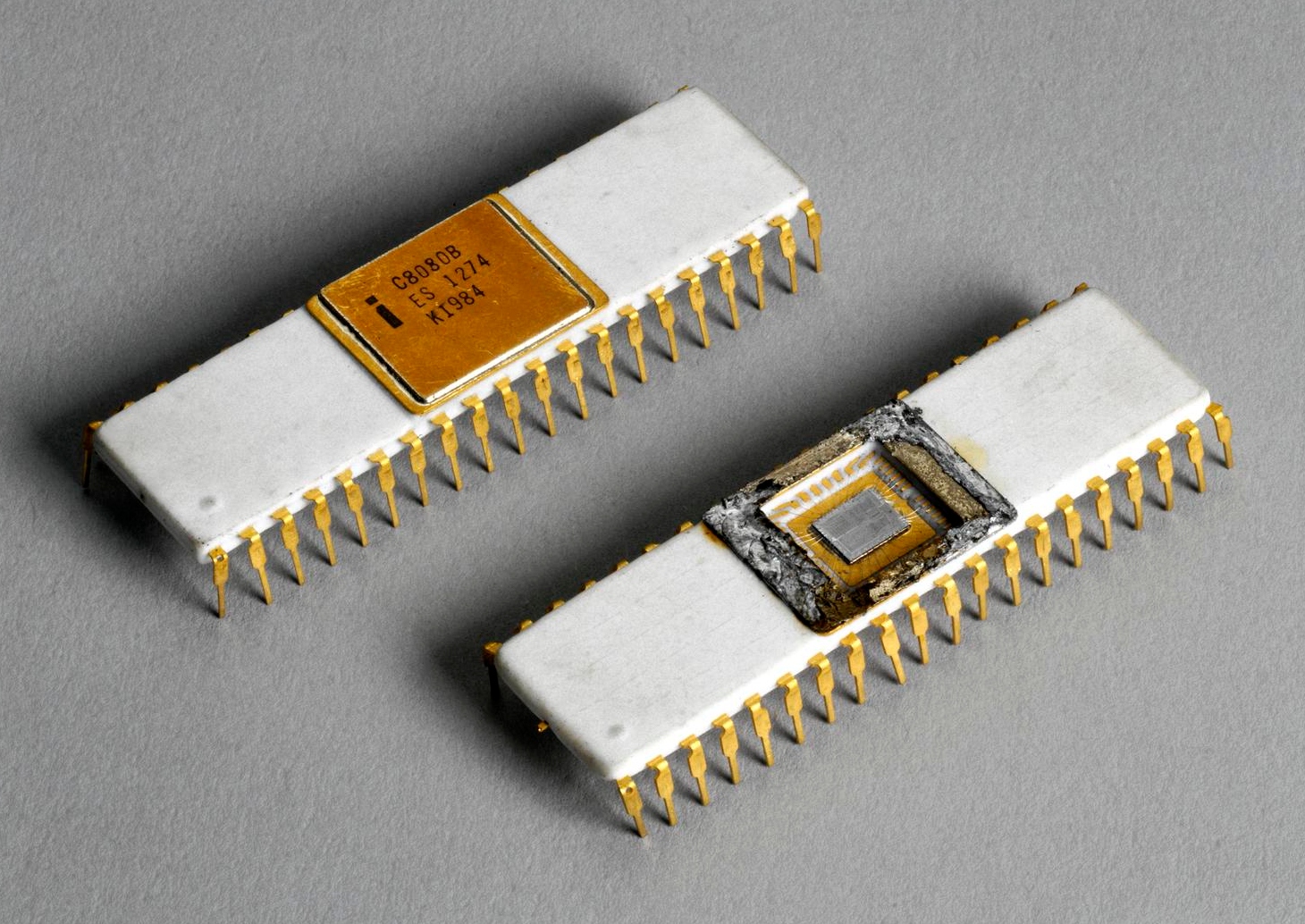
The Altair 8800 of Volume 1 was, in the end, a frame built around a single part. Strip away the blue cabinet, the toggle switches, the red lamps, and the row of expansion slots, and what remains — the thing that made the whole machine a computer rather than a box of blinking lights — is one black plastic rectangle a little under two inches long, with forty metal legs and a number printed on its back: 8080. Everything in the Altair exists to feed that chip, to listen to it, or to give a human some way of talking to it. The processor is the computer; the rest is plumbing.
This volume is about where that chip came from. It is the “what is a microprocessor, and why this one” volume — the silicon prehistory of the Altair. To understand why a struggling calculator company in Albuquerque could suddenly offer a real computer for under four hundred dollars in 1975, you have to understand the four-year sprint that preceded it inside a young semiconductor firm in California: the invention of the microprocessor itself, in 1971, and its rapid evolution across three generations of chip until, in 1974, it arrived at a part powerful enough and cheap enough to anchor a machine an individual could own.
We will move in order. First, the central idea — what it actually means to put a processor on a single chip, and why that was a watershed rather than merely a refinement. Then the three chips that got us there: the 4004 of 1971, the first commercial microprocessor; the 8008 of 1972, the first eight-bit one, capable but hobbled; and the 8080 of 1974, the breakthrough that the Altair was built on. We will be precise about who did what, and about the numbers — transistor counts, clock speeds, addressing limits — because in this story the numbers are the plot. The companion machine in this site’s other launch series, DEC’s PDP-8/I, will serve throughout as a useful foil: a real, successful computer of the late 1960s whose central processor was not a chip at all, but a wardrobe of circuit boards. The distance between those two ways of building a processor is the distance this volume travels.
2.2 What a microprocessor is
A computer’s central processing unit — its CPU — is the part that actually computes: it fetches instructions from memory one after another, decodes what each one means, and carries it out, whether that is adding two numbers, comparing them, moving a value from one place to another, or jumping to a different part of the program. It contains the arithmetic and logic circuitry that does the work, a handful of fast internal storage locations called registers, and the control logic that sequences the whole fetch-decode-execute cycle. Every stored-program computer, from a 1950s mainframe to the device you are reading this on, has a CPU at its heart. What changed in 1971 was not what a CPU does but how much physical hardware it takes to build one.
Consider how a CPU was built before the microprocessor. Take the PDP-8/I, the minicomputer chronicled in this site’s companion series, introduced by Digital Equipment Corporation in 1968. Its processor was not a component you could hold; it was a subsystem. The arithmetic unit, the registers, the instruction decoder, and the control logic were spread across many printed-circuit boards, each carrying dozens of individual integrated circuits — small-scale logic chips with a few gates apiece — wired together across a backplane. The CPU was, in effect, a filing cabinet of electronics. That is why a minicomputer cost on the order of ten or twenty thousand dollars and weighed as much as a piece of furniture: building a processor meant assembling hundreds of separate parts, each of which had to be manufactured, mounted, soldered, interconnected, and tested.
A microprocessor collapses that entire cabinet onto a single integrated circuit — one chip of silicon, a few millimetres on a side, sealed inside a small package with a row of pins along each edge. The arithmetic-logic unit, the registers, the instruction decoder, the control sequencing: all of it is etched into one piece of silicon at once, by the same photolithographic process that prints the rest of the chip. The phrase the era reached for was “computer on a chip,” and while that was not quite literal — the microprocessor is the processor; it still needs separate memory and input/output chips around it to make a working computer — the spirit was exactly right. The single most expensive, most complex, most labour-intensive part of a computer, the part that had always defined its cost and bulk, had been reduced to a mass-produced component you could buy for the price of a nice dinner and drop into a circuit board like any other chip.
Why was this a watershed and not just a smaller version of the same thing? Because integration changes economics, not merely size. A processor built from hundreds of discrete parts costs roughly the same to build for each unit you make; there is no great saving in volume, because every board still has to be stuffed and soldered. A processor etched onto a single chip, by contrast, costs a fortune to design and to tool up for — but once the production line exists, each additional chip costs almost nothing. The cost moves from the per-unit assembly into the one-time design, and the per-unit price falls off a cliff as volume rises. That is precisely the curve that, a few years later, would let an Intel 8080 reach hobbyists at a few dollars apiece in quantity. The microprocessor did not just make processors smaller; it made them cheap, and cheap in a way that compounded with every unit sold.
None of this would have been possible without a specific run of progress in semiconductor manufacturing. Through the 1960s, the number of transistors that could be reliably fabricated on a single chip had been climbing relentlessly — the trend Gordon Moore had already named. The crucial enabling technology for the first microprocessors was MOS (metal-oxide-semiconductor) fabrication, and specifically the silicon-gate refinement of it, developed at Fairchild Semiconductor in the late 1960s. Silicon-gate MOS made transistors smaller, faster, and more reliable than the older metal-gate process, and — vitally — it let designers pack thousands of them onto one die. It is no coincidence that the man who pioneered silicon-gate technology at Fairchild in 1968 turns out to be the same man who, a few years later, would lead the design of the chip that put it to its most famous use. His name was Federico Faggin, and the rest of this volume largely follows him.
2.3 The 4004 (1971): the first microprocessor
The first microprocessor was not conceived as the brain of a computer at all. It was born from a calculator contract.
In 1969 a Japanese firm, Busicom, approached Intel — then a two-year-old company known for memory chips, not logic — to build a custom chip set for a line of printing calculators. Busicom’s own engineers had sketched an elaborate design: roughly a dozen custom chips, each hard-wired for a specific calculator function. At Intel, an engineer named Marcian “Ted” Hoff looked at the proposal and judged it too complex and too inflexible to be practical. He proposed a radically different approach: instead of many single-purpose chips, build one small, general-purpose programmable processor and have it run the calculator’s behaviour as a program stored in memory. Change the program, and the same silicon could be a calculator, or a cash register, or anything else. Hoff, with Stanley Mazor, worked out the architecture of such a processor; Masatoshi Shima, Busicom’s engineer, contributed to the design and the calculator logic it had to implement.
But an architecture on paper is not a chip. Turning that proposed processor into a piece of working silicon — actually laying out thousands of transistors densely enough to fit, and making them function — was a formidable problem that had stalled for months. It was solved when Federico Faggin joined Intel in 1970 and took charge of the chip’s design. Faggin brought the silicon-gate methodology he had pioneered at Fairchild and used it to create the random-logic design techniques that made a processor on a single chip physically realizable. He led the design and the actual silicon implementation; Shima worked alongside him. The result, completed in early 1971 and released commercially on 15 November 1971, was the Intel 4004.
By any modern measure the 4004 was tiny. It was a 4-bit processor — it handled data four bits at a time, enough for one decimal digit, which was all a calculator needed. It contained about 2,300 transistors, fabricated on a 10-micrometre silicon-gate PMOS process, and ran at a clock rate of around 740 kHz, executing on the order of 90,000 instructions per second from a repertoire of 46 instructions. Those figures are almost comically modest beside the cabinet-sized PDP-8 processor it could not remotely have replaced. And yet the significance is hard to overstate: for the first time, the complete central processing unit of a computer — arithmetic, registers, control, the lot — existed on one chip, mass-producible, for a few dollars. The 4004 is rightly remembered as the first commercially available microprocessor, the proof of concept for everything that followed. Its limitation was equally clear: four bits and a calculator’s instruction set are not the foundation of a general-purpose computer. For that, you needed to handle data a full byte at a time.
It is worth getting the credit straight, because popular accounts often flatten it. The 4004 was a team achievement: Hoff conceived the single-processor approach and, with Mazor, the architecture; Shima contributed from the Busicom side; and Faggin led the chip design and the silicon-gate implementation that made it buildable at all. Hoff is frequently called the microprocessor’s inventor for the original idea; Faggin is the one who turned the idea into working silicon and went on to drive the family forward. Both framings point at the same four names, and all four belong in the story.
2.4 The 8008 (1972): eight bits, but awkward
While the 4004 was still being finished, Intel was already at work on a second, parallel microprocessor — and this one came from an entirely different direction. In the late 1960s, a Texas firm called Computer Terminal Corporation (CTC, later Datapoint) was designing a programmable computer terminal, the Datapoint 2200, and wanted its processor logic reduced to a single chip to save space and cost. CTC’s engineers, Victor Poor and Harry Pyle, devised the architecture and instruction set for an 8-bit processor and contracted Intel to fabricate it. Faggin again led the silicon work.
By the time Intel delivered the chip, CTC had moved on and built its terminal from conventional logic instead, leaving Intel holding a finished design it was free to sell. Intel released it in April 1972 as the Intel 8008 — the world’s first 8-bit microprocessor. Handling a full eight-bit byte at a time, with an instruction set descended from a real computer terminal rather than a calculator, the 8008 was a genuine step toward a general-purpose machine. It contained about 3,500 transistors and could address 16 kilobytes of memory.
But the 8008 was, by the standards of what people wanted to build, frustratingly hobbled — and the reasons why are exactly what makes it instructive. It was slow, running at clock rates of only 500 to 800 kHz with instructions that took many cycles each. Its memory reach was small: a 14-bit address gave it just 16 KB of address space. And most awkward of all was its bus. To save pins, Intel packaged the 8008 in a cramped 18-pin housing, which forced a single 8-bit bus to do triple duty — carrying data, address bits, and status information in turn, multiplexed across multiple clock phases. The consequence for anyone trying to build a computer around it was punishing: the processor could not simply be wired to memory. It needed a thicket of perhaps thirty additional support chips to latch addresses, demultiplex the bus, and generate the timing the chip needed to function. The “computer on a chip” turned out to require a small board of other chips just to keep it fed.
The 8008 found real uses; it powered some of the earliest microcomputers, the French Micral N and the American SCELBI among them. But it pointed toward a personal computer without being able to be the basis of a good one. It was too slow to run anything ambitious, too cramped in memory to hold a useful program and its data, and too awkward to interface for a hobbyist to build around cheaply. The lesson Intel’s engineers drew was precise: the architecture was sound, but it needed to be faster, to address far more memory, and — above all — to present a clean, conventional bus that an ordinary engineer could connect to memory and peripherals without a forest of glue logic. That list of fixes is, almost exactly, the specification of the chip that came next.
2.5 The 8080 (1974): the breakthrough
The Intel 8080, introduced in April 1974, was the chip that got it right — and it is no accident that the same hands shaped it. The 8080 was designed by a team led by Federico Faggin, with the detailed design carried out by Masatoshi Shima working under him; Stanley Mazor also contributed, and the three are the names on the 8080’s patent. Faggin had pushed for the project as the logical next step beyond the 8008, and the 8080 reads as a deliberate, point-by-point answer to everything the 8008 had gotten wrong.
The numbers tell the story. The 8080 was fabricated in the newer, faster NMOS process (with a roughly 6-micrometre feature size) rather than the slower PMOS of its predecessors, and it packed roughly 6,000 transistors onto the die — about seventy per cent more than the 8008. It ran at 2 MHz, several times the 8008’s clock, and with a more efficient design it executed common instructions far more quickly, reaching several hundred thousand instructions per second. Crucially, Intel gave it a proper 40-pin DIP package — more than twice the pins of the 8008’s cramped 18 — and used that pin budget to provide a clean, non-multiplexed bus: a separate 16-bit address bus and 8-bit data bus, with distinct control signals. That single architectural change is enormous in practice. It meant a designer could connect the 8080 to memory and input/output devices in a straightforward, conventional way, with only a few support chips rather than thirty. The processor had finally become something an ordinary engineer — or an ambitious hobbyist — could build a computer around without heroics.
The 16-bit address bus did something else just as important: it let the 8080 directly address 65,536 bytes — 64 KB — of memory, four times the 8008’s reach. Sixty-four kilobytes does not sound like much today, but in 1974 it was enough to hold a real operating environment: a meaningful program and its data, a BASIC interpreter, the beginnings of a usable computer rather than a toy. The instruction set was richer too, expanded to about 78 instructions, including direct register-to-register moves, 16-bit operations, and proper subroutine support. The 8080 carried seven 8-bit working registers — the accumulator A plus six general-purpose registers, B, C, D, E, H, and L, which could also be paired up to hold 16-bit values — together with a 16-bit stack pointer and program counter. That stack pointer, pointing into main memory, gave the 8080 a flexible hardware stack for nested subroutine calls and interrupts: the kind of facility that makes structured, reusable software practical.
Put those gains together and you can see precisely why the 8080 could anchor a personal computer where the 8008 could not. It was several times faster, so it could actually run an interpreted language or a real application at a tolerable pace. It could address 64 KB rather than 16, so there was room for that software to live and work. It presented a clean bus, so a small company could design a machine around it — and, critically, design it as an open backplane into which other boards could be plugged, the architecture that would become the Altair’s S-100 bus. And its instruction set and hardware stack were rich enough to support genuine programs. The 8008 had been a proof that an 8-bit processor could exist on a chip; the 8080 was the first one capable enough to build a useful general-purpose computer around. Every limitation that had made the 8008 a dead end for personal computing, the 8080 specifically removed.
2.6 From chip to computer: the price unlock
Capability was half the breakthrough. The other half was price — and here the 8080’s story bends directly into the Altair’s.
When Intel introduced the 8080 in April 1974, it set the single-unit list price at about $360. That figure is worth pausing on. A few hundred dollars for the central processing unit of a computer would have seemed miraculous only a few years earlier, when a processor was a cabinet of boards costing many thousands. But $360 was the retail, buy-one price; like all chips, the 8080 grew dramatically cheaper in volume, and within a few years quantity prices would fall to a handful of dollars apiece. The combination — a processor genuinely capable of running a useful computer, sold at a price that was already a few hundred dollars and falling fast — is what made a sub-$400 computer kit something a person could seriously contemplate. For the first time, the most important and historically most expensive part of a computer cost less than a colour television.
This is exactly the opening that Ed Roberts and MITS drove through. As Volume 1 recounted, Roberts was running a nearly bankrupt calculator company and needed a product that could be sold cheaply enough to reach hobbyists yet was a real computer. The 8080 made the arithmetic work. By committing to buy in quantity, MITS reportedly secured 8080s from Intel at a deep discount — on the order of $75 per chip rather than the $360 list — and that OEM bargain is much of the reason the finished Altair 8800 could be advertised as a kit for $397. The processor that would have been unthinkable to own a decade earlier had become a line item cheap enough to bury inside a hobbyist kit and still come in under four hundred dollars.
And that, in a sentence, sets up the whole machine to come. The Altair 8800 is, at its core, an Intel 8080 given the things a bare processor needs to become a usable computer: a front panel of switches and lamps so a human can load and read it, an open backplane bus so memory and peripheral boards can be added, and a power supply to run it all. The chip supplied the intelligence; MITS supplied the frame. Volume 3 turns to the people and the moment — Roberts, MITS, and the January 1975 Popular Electronics cover — and Volume 4 opens the cabinet to study how the 8080, the S-100 bus, and the front panel fit together. But the reason any of it was possible traces straight back to the 40-pin chip in this volume.
The 8080 itself did not stop there, and a quick note on its descendants helps place it in history. Intel followed it in 1976 with the 8085, a refined, single-power-supply version of the same architecture. More consequentially, Federico Faggin left Intel in 1974 — the very year the 8080 shipped — to co-found his own company, Zilog, soon joined by his 8080 collaborator Masatoshi Shima. There the team designed the Zilog Z80 (1976), an enhanced, 8080-compatible processor that ran existing 8080 software unmodified while adding many new instructions; it became one of the most popular microprocessors of the era, powering countless later machines. The 8080’s architectural line, in other words, ran on for years through both its maker and the breakaway company its own designer founded. But for the story of the Altair, the 8080 is the destination: the chip that, in 1974, was finally fast enough, roomy enough, clean enough, and cheap enough to make a computer a person could own.
Sources
- Wikipedia, “Intel 4004.” Confirms the 15 November 1971 commercial release; ~2,300 transistors; 4-bit architecture; ~740 kHz clock; 10-µm silicon-gate PMOS process; the Busicom calculator origin; and the roles of Ted Hoff and Stanley Mazor (architecture), Masatoshi Shima (Busicom), and Federico Faggin (chip design / silicon-gate implementation). https://en.wikipedia.org/wiki/Intel_4004
- Computer History Museum, “1971: Microprocessor Integrates CPU Function onto a Single Chip” (The Silicon Engine). Confirms the 4004 as the first commercial single-chip microprocessor and the development team and Busicom context. https://www.computerhistory.org/siliconengine/microprocessor-integrates-cpu-function-onto-a-single-chip/
- IEEE Spectrum, “Chip Hall of Fame: Intel 4004 Microprocessor.” Background on the 4004’s design, the Busicom project, and Faggin’s silicon-gate contribution. https://spectrum.ieee.org/chip-hall-of-fame-intel-4004-microprocessor
- Wikipedia, “Intel 8008.” Confirms the April 1972 release as the first 8-bit microprocessor; ~3,500 transistors; 500–800 kHz clock; 14-bit address / 16 KB; the Computer Terminal Corporation (Datapoint) origin with Victor Poor and Harry Pyle; the 18-pin multiplexed-bus limitation and the ~30 support chips required; and the relationship to the 8080. https://en.wikipedia.org/wiki/Intel_8008
- Wikipedia, “Intel 8080.” Confirms the April 1974 introduction; NMOS process; “4,500 or 6,000” transistors; 40-pin DIP; 2 MHz clock; 16-bit address bus and 64 KB addressing; seven 8-bit registers (A, B, C, D, E, H, L) plus a 16-bit stack pointer; the expanded instruction set; the designers Faggin, Shima, and Mazor (named on the 8080 patent); and the lineage to the 8008, 8085, and Z80. https://en.wikipedia.org/wiki/Intel_8080
- WikiChip, “Intel 8080 (MCS-80).” Corroborates the 8080’s specifications, bus structure, and instruction set (~78 instructions). https://en.wikichip.org/wiki/intel/mcs-80/8080
- Intel timeline / newsroom, “Launching a Classic: The 8080” and “50 Years Ago: Celebrating the Influential Intel 8080.” Confirm the April 1974 launch and the ~$360 introductory list price. https://timeline.intel.com/1974/launching-a-classic:-the-8080 · https://newsroom.intel.com/client-computing/50-years-ago-the-influential-intel-8080
- TechSpot, “History of the Microprocessor and the Personal Computer, Part 2.” Confirms the $360 list price and that MITS obtained 8080s for the Altair at roughly $75 each in volume. https://www.techspot.com/article/884-history-of-the-personal-computer-part-2/
- Wikipedia, “Zilog Z80” and “Zilog.” Confirm that Federico Faggin (with Ralph Ungermann, later joined by Masatoshi Shima) founded Zilog in 1974 after leaving Intel, and that the Z80 (1976) was an 8080-compatible superset. https://en.wikipedia.org/wiki/Zilog_Z80
- Figure: “Intel 8080 open-closed” by The Science Museum UK, via Wikimedia Commons, licensed CC BY 4.0. https://commons.wikimedia.org/wiki/File:Intel_8080_open-closed.jpg

Comments (0)